

Tilicho Lake Trek
The Tilicho Lake Trek is a 12-day journey to one of the highest lakes on earth, set at 4,919 m in a bare glacial cirque
Porter
$308 $280/porter
No payment required yet
Trip Overview
The Tilicho Lake Trek is a 12-day journey to one of the highest lakes on earth, set at 4,919 m in a bare glacial cirque beneath Tilicho Peak on the northern side of the Annapurna massif. The route follows the upper Marsyangdi from Chame through Manang, then branches west along an exposed traverse to Tilicho Base Camp before the long climb to the lake itself.
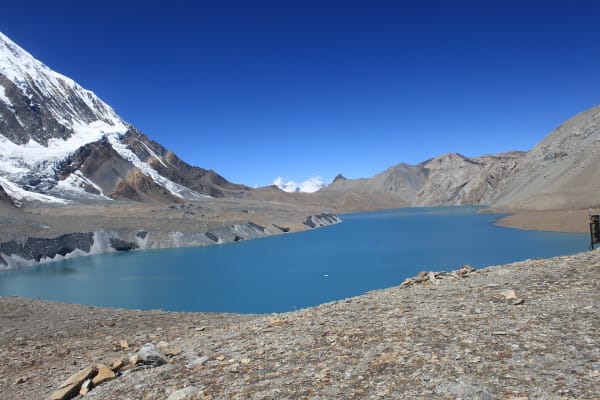
The water is an extraordinary deep turquoise, ringed by snow and rock walls, and the silence at the lake is one of the more memorable things about trekking in Nepal. With an acclimatization day in Manang (3,540 m), a comfortable ascent profile, and no pass to cross, this itinerary offers a serious high-altitude objective with a manageable level of commitment — you return down the same valley rather than continuing over Thorong La.
Trip Highlights
Tilicho Lake (4,919 m): Stand beside one of the highest lakes in the world, in a silent glacial basin below Tilicho Peak.
Acclimatization Day in Manang: Rest and explore the circuit's largest village, with monasteries, viewpoints, and altitude briefings.
The Chame to Manang Trail: Walk from pine forest into dry Tibetan-influenced high country beneath Annapurna II, III, and IV.
No High Pass Required: Return down the Marsyangdi rather than crossing Thorong La, keeping the trek far less committing.
A Gradual, Well-Judged Ascent: Step up through Shree Kharka and Tilicho Base Camp with a profile designed for safe adaptation.
Itinerary
A 12-day trek to Tilicho Lake (4,919 m) via Chame and Manang, with an acclimatization day, a gradual ascent through Shree Kharka, and no pass to cross.
1Day 1Arrival in Kathmandu (1,400 m)
Arrival in Kathmandu (1,400 m)
You arrive at Tribhuvan International Airport in Kathmandu (1,400 m), where our representative meets you and drives you to your hotel in Thamel.
Your guide runs the pre-trek briefing. The Tilicho Lake trek goes up the Manang valley and into the Khangsar Khola side valley to reach Tilicho Lake at 4,919 m — one of the highest lakes of its size anywhere on earth — and returns the same way, with no pass to cross.
That makes it less committing than the full Annapurna Circuit, but it is not an easy trek: it involves two nights above 4,000 m, a long exposed climb to the lake, and a notorious landslide traverse on the approach to base camp. Your guide checks your kit — warm layers, gloves and a good sleeping bag all matter at Tilicho Base Camp. Overnight in Kathmandu.
2Day 2Drive from Kathmandu (1,400 m) to Besisahar (830 m)
Drive from Kathmandu (1,400 m) to Besisahar (830 m)
A half-day drive west and then north. We leave Kathmandu after breakfast on the Prithvi Highway, following the Trishuli River through its gorge — terraced hillsides, roadside bazaars and rafting groups on the green water below.
At Dumre the road turns north and follows the Marsyangdi valley up toward the mountains. The scenery becomes more enclosed as the valley narrows, with the river running fast below and the first big ridgelines appearing ahead.
Besisahar (830 m) is the traditional starting point of the Annapurna Circuit and the end of the sealed road. It is a small, busy bazaar town full of trekkers, jeep drivers and porters organising loads for the valley above.
The drive takes six to seven hours. Arriving in the afternoon leaves time to walk around the town and get an early night before tomorrow's rough transfer. Overnight in Besisahar.
3Day 3Drive from Besisahar (830 m) to Chame (2,670 m)
Drive from Besisahar (830 m) to Chame (2,670 m)
A rough but spectacular jeep day up the Marsyangdi valley. The road beyond Besisahar is a single lane cut into the gorge wall, with the river far below, waterfalls crossing the track and steep drops on the outside edge.
The route climbs through Bhulbhule, Jagat and Dharapani (1,860 m), where the Manaslu Circuit trail comes in from the east over the Larkya La. It then continues up through Danakyu and Timang, where on a clear day there is a superb head-on view of Manaslu (8,163 m) behind you.
The vegetation changes steadily as you climb: subtropical scrub and banana at the bottom, then pine and blue fir, with the air cooling noticeably and the settlements taking on a Tibetan character — flat-roofed stone houses, mani walls and prayer flags.
Chame (2,670 m) is the district headquarters of Manang, with shops, a bank and small hot springs by the river. The journey takes six to seven hours. Overnight in Chame.
4Day 4Trek from Chame (2,670 m) to Manang (3,540 m)
Trek from Chame (2,670 m) to Manang (3,540 m)
The first walking day, and a substantial one — nearly 900 m of gain, covering ground the classic circuit spreads over two days.
The trail leaves Chame through pine forest into a narrow section of valley, passing beneath the Paungda Danda: an immense curved slab of rock sweeping over 1,500 m up from the riverbed in one unbroken sheet, and among the largest rock faces in the Himalaya.
Beyond it the valley opens out and the landscape changes character completely as you cross into the rain shadow — drier, browner, distinctly Tibetan. The trail passes through Pisang and continues up the widening valley with Annapurna II (7,937 m), Annapurna IV and Gangapurna ranged across the southern skyline.
Manang (3,540 m) is the largest village on the route — a compact Tibetan-style settlement of flat-roofed stone houses with bakeries, gear shops and even a cinema hall. Overnight in Manang.
5Day 5Explore and Acclimatization in Manang (3,540 m)
Explore and Acclimatization in Manang (3,540 m)
An acclimatisation day, and a necessary one after yesterday's height gain. The principle is climb high, sleep low — so this is a rest day that still involves going uphill.
The gentler option walks up to the Gangapurna Lake and the viewpoint above it, gaining around 300 m, with a close view of the Gangapurna Glacier calving into milky meltwater. The steeper alternative climbs to Praken Gompa, a small monastery clinging to the cliff above the village at about 3,950 m, where the resident lama gives blessings to trekkers heading higher.
Manang itself repays a wander: narrow lanes between flat-roofed houses, firewood stacked on every roof, and yaks in the streets. The Himalayan Rescue Association gives a free talk on altitude sickness here at 3 pm each afternoon, and on a trek that will reach 4,919 m it is well worth an hour. Overnight in Manang.
6Day 6Trek from Manang (3,540 m) to Shree Kharka (3,800 m)
Trek from Manang (3,540 m) to Shree Kharka (3,800 m)
A short, gentle day of around 260 m of gain — moving up slowly is the whole strategy from here on.
The trail heads west out of Manang and up the Khangsar Khola valley, leaving the main circuit route almost immediately. Within an hour the traffic thins to almost nothing: this is a side valley, and the great majority of circuit trekkers never come this way.
The path climbs gradually to Khangsar (3,734 m), the last village on this side of the valley — a small Tibetan-influenced settlement of stone houses among barley terraces, with an old ruined gompa on the slope above. Beyond it the country becomes genuinely high and arid, with no trees, sparse scrub and enormous scree slopes on both sides.
Shree Kharka (3,800 m) is a small cluster of lodges on an open shelf with wide views back down the valley toward the Annapurnas. Overnight in Shree Kharka.
7Day 7Trek from Shree Kharka (3,800 m) to Tilicho Base Camp (4,150 m)
Trek from Shree Kharka (3,800 m) to Tilicho Base Camp (4,150 m)
A short day by distance, and the one this route is known for — not for the 350 m of height gained but for the ground it crosses.
The trail contours west from Shree Kharka into an increasingly barren, high-altitude landscape of rock and scree. After an hour or so it reaches the landslide traverse: a long path cut across steep, unstable slopes with a considerable drop below.
It is not technical and involves no climbing, but it demands concentration and steady footing, and rockfall is a genuine consideration. Your guide will assess conditions, take the group across in small parties, and generally aim to do it early in the day while the slope is still frozen and settled.
Tilicho Base Camp (4,150 m) is a handful of lodges in a bare amphitheatre of rock with no vegetation whatsoever. It is cold, basic and often windy, and sleep at this height is frequently broken. Eat well, drink constantly and turn in early — tomorrow starts before dawn. Overnight at base camp.
8Day 8Hike from Tilicho Base Camp (4,150 m) to Tilicho Lake (4,919 m) and Back to Tilicho Base Camp (4,150 m)
Hike from Tilicho Base Camp (4,150 m) to Tilicho Lake (4,919 m) and Back to Tilicho Base Camp (4,150 m)
The day the whole trek is built around. We set out around 4:00 am, because the wind at the lake strengthens sharply through the morning and the long exposed climb is far better done in the cold and dark than in a gale.
The trail zigzags up an endless series of switchbacks on open scree — nearly 800 m of ascent with no shelter, no water and no let-up. It is the hardest sustained climb of the trip and takes three to four hours. Sunrise partway up lights Tilicho Peak (7,134 m) and the Grand Barrier ridge above you.
Tilicho Lake (4,919 m) sits in a stark, treeless basin beneath the peak — frozen for much of the year, and an extraordinary opaque turquoise when it is not. There is no vegetation, no birdsong and almost no sound at all; the silence at the lake is what most trekkers remember longest.
We descend the same switchbacks to Tilicho Base Camp (4,150 m), arriving in the early afternoon. Overnight at base camp.
9Day 9Trek from Tilicho Base Camp (4,150 m) to Manang (3,540 m)
Trek from Tilicho Base Camp (4,150 m) to Manang (3,540 m)
A long descending day back down the Khangsar Khola valley, giving up around 600 m and returning to comfort.
The first task is the landslide traverse again, taken early and carefully while the slope is still settled from the cold night. Crossing in this direction puts the exposure on your other side, which feels different but is no more difficult.
Beyond it the trail descends to Shree Kharka (3,800 m), where we normally stop, and continues down through Khangsar (3,734 m) and its barley terraces. The valley widens and takes on colour as you lose height, and after two nights above 4,000 m the thicker air makes an immediate difference to how you feel.
Manang (3,540 m) is reached in the afternoon. After the bare rock and cold of Tilicho Base Camp, its bakeries, hot showers and lively lodges are a genuine pleasure. Overnight in Manang.
10Day 10Drive from Manang (3,540 m) to Besisahar (830 m)
Drive from Manang (3,540 m) to Besisahar (830 m)
A long day on rough road, retracing the Marsyangdi valley by jeep. The road now reaches Manang, which is what makes an out-and-back itinerary of this length possible.
The track descends past Humde, Pisang and Chame (2,670 m), then continues down through Danakyu, Dharapani and Jagat. It is slow, bumpy and frequently spectacular — a single lane cut into the gorge wall, waterfalls crossing the road, and the river running fast below.
Watching the landscape change in reverse is the pleasure of the day: from the dry, brown, Tibetan-feeling upper valley down through pine and blue fir into the humid subtropical green of the lower Marsyangdi, with banana trees and rice terraces near the bottom.
Besisahar (830 m) is where the sealed road begins again. The journey takes seven to eight hours. Overnight in a lodge.
11Day 11Drive from Besisahar (830 m) to Kathmandu (1,400 m)
Drive from Besisahar (830 m) to Kathmandu (1,400 m)
A comfortable final day on the road, entirely on sealed surface. The drive to Kathmandu (1,400 m) takes six to seven hours with a lunch stop.
The road follows the Marsyangdi down to Dumre and then joins the Prithvi Highway heading east, tracing the Trishuli River through its long gorge. It is the same country you drove up ten days ago, and it looks entirely different on the way back — greener, lower and much warmer than anywhere you have been since.
The last section climbs out of the river valley and over the rim into the Kathmandu Valley, arriving in the capital in the late afternoon.
You transfer to your hotel with the evening free. After a week and a half in teahouses, two of those nights at 4,150 m, a hot shower and a proper meal go a long way. Thamel is a few minutes' walk for anything you need. Overnight in Kathmandu.
12Day 12Departure from Kathmandu (1,400 m)
Departure from Kathmandu (1,400 m)
Your final day in Nepal. If your flight leaves later in the day there is time for one more part of the Kathmandu Valley — Boudhanath Stupa, Pashupatinath Temple and Swayambhunath are all a short drive from Thamel and each worth an hour.
Our representative will collect you from your hotel and transfer you to Tribhuvan International Airport around three hours before your scheduled departure.
The Tilicho Lake trek reaches one of the highest large lakes on earth without crossing a single pass, through a side valley that most Annapurna Circuit trekkers never see. If you would like to link it into a longer route next time, the full Annapurna Circuit continues from Tilicho over Thorong La (5,416 m) and down into Mustang. Safe travels.
Inclusions & Exclusions
Ground and jeep transport as per the itinerary, Kathmandu accommodation, teahouse lodging, all trekking meals, conservation area permits, a licensed guide, trekking map, first aid, and government taxes are included, while international flights, visa, insurance, personal gear, porter service, city meals, personal expenses, and tips are excluded.
What's Included
Airport pickup and drop-off services in Kathmandu.
Ground transportation from Kathmandu to Besisahar and shared jeep from Besisahar to Chame as per the itinerary.
Jeep transportation from Manang to Besisahar and ground transportation from Besisahar to Kathmandu.
Accommodation in Kathmandu with breakfast.
Accommodation in local teahouses during the trek.
Annapurna Conservation Area Permit (ACAP) and required trekking permits.
Professional English-speaking licensed trekking guide.
Three meals a day (breakfast, lunch, and dinner) during the trek.
Group trekking map for route guidance.
First aid kit carried by the guide.
All government taxes, permit fees, and service charges.
What's Excluded
International flight tickets to and from Nepal.
Nepal entry visa fees.
Travel insurance, including emergency helicopter evacuation coverage.
Personal trekking equipment and clothing.
Porter services (available at an additional cost).
Lunch and dinner in Kathmandu.
Snacks, bottled water, hot showers, Wi-Fi, charging fees, and alcoholic or soft drinks.
Personal expenses such as laundry, phone calls, and souvenirs.
Tips for guides, drivers, and support staff.
Any additional accommodation, transportation, or expenses caused by unforeseen circumstances beyond the itinerary.
Route Map
Explore the terrain map showing the trek route.
Loading map...
Altitude Profile
Pricing
Transparent per-person pricing based on group size, covering the services listed in the itinerary with no hidden charges.
Add-ons
Customize your trek with optional services such as porter support and other personalized arrangements at an additional cost.
Best Time to Trek
March to May and September to November are the seasons to aim for. Autumn brings the most settled weather for the exposed traverse to Tilicho Base Camp and the clearest conditions in the lake basin. Spring is warmer with more snow around the lake, which is scenically dramatic, though the approach can be icy in March and early April.
Winter frequently blocks the base camp trail with snow and the lodge often closes, so December to February carries a genuine risk of not reaching the lake. The monsoon leaves the Manang valley drier than most of Nepal thanks to the rain shadow, but the drive to Chame is landslide-prone and the lake basin is usually filled with cloud.
For a month-by-month look at weather and trail conditions, see our guide to the best time to trek in Nepal.
Altitude & Acclimatization
This itinerary gives a more generous acclimatization profile than the shorter version, with two nights of road approach through Besisahar and Chame, a full rest day at Manang (3,540 m), and then measured steps up to Shree Kharka at 3,800 m and Tilicho Base Camp at 4,200 m before the lake at 4,919 m.
The lake day is a classic climb-high, sleep-low exercise, gaining over 700 m before returning to base camp for the night, which is why serious altitude illness is uncommon on this route despite the elevation. Your guide checks the group each evening for headache, poor sleep, appetite loss, and shortness of breath at rest, and will add a night at Manang if anyone is struggling. Drink three to four litres of water a day, walk at a conversational pace, and skip alcohol from Manang upward.
Prevention, symptoms and treatment are covered in depth in our guide to altitude sickness in Nepal.
Travel Insurance
Travel insurance covering trekking to at least 5,500 m is mandatory, giving a safe margin over the Tilicho Lake high point of 4,919 m. Standard policies commonly cap at 3,000 m or 4,000 m, which would leave you without cover from Manang onward, so read the altitude clause carefully rather than assuming your existing policy applies.
Confirm the policy includes emergency helicopter evacuation and repatriation, medical treatment, and trip cancellation. The traverse to Tilicho Base Camp has no vehicle access and evacuation means a helicopter, which operators dispatch only against a guarantee of payment. Please send us your policy number and the insurer's 24-hour emergency line before you leave Kathmandu.
Our guide to travel insurance for trekking in Nepal explains the altitude limits, evacuation terms and common exclusions to check before you buy.
Packing List
The lake day is cold and exposed, and the base camp nights are the coldest of the trek. Bring waterproof trekking boots, three or four base layers, a fleece, an insulated down jacket, a windproof and waterproof shell jacket and trousers, trekking trousers, a warm hat, sun hat, liner and insulated gloves, and several pairs of wool socks. A sleeping bag rated to -15°C is right for Tilicho Base Camp.
Also pack a 30-40 litre daypack, trekking poles (genuinely important on the loose scree traverse), a headlamp with spare batteries for the pre-dawn lake start, high-SPF sunscreen and lip balm, category 3 or 4 sunglasses for the glare off snow and water, an insulated bottle plus purification tablets or a filter, a personal first aid kit, quick-dry towel, toiletries, and a power bank. Keep the porter-carried duffel under 15 kg.
For the complete kit list, organised by the altitude you will reach, see our Nepal trekking packing list.
Accommodation, Food & Drinking Water
You stay in a tourist-standard hotel in Kathmandu and in teahouses throughout the trek. Besisahar, Chame, and Manang have comfortable lodges with hot showers, warm dining rooms, and in Manang bakeries and coffee shops. Shree Kharka and Tilicho Base Camp are much simpler — small twin rooms or dormitories, shared toilets, and heating only where everyone eats. Base camp has limited beds and fills fast in peak season, so we arrive early.
Three meals a day are included on the trek. Breakfast is porridge, eggs, Tibetan bread, or pancakes; lunch and dinner come from the lodge menu with dal bhat and free refills the best value alongside noodles, fried rice, momos, soups, and pasta. Manang has the widest choice anywhere on the route. Refill your bottle at lodges or the safe drinking water stations and treat it with tablets, a filter, or a UV pen; carry at least two litres on the lake day, since there is no water source on the climb.
What the lodges are really like, from rooms and meals to showers and charging, is covered in our guide to teahouse trekking in Nepal.
Frequently Asked Questions
Find quick answers to common questions about the Tilicho Lake Trek.
1Can I leave extra luggage in Kathmandu?
Yes. Your Kathmandu hotel stores anything you do not need on the trail free of charge until you return, so you can travel with trekking kit only.
2How many hours do we walk each day?
Five to seven hours on most days. The Tilicho Lake day is the longest at eight to nine hours from a pre-dawn start, gaining over 700 m to the lake and returning to base camp the same day.
3Which permits are required and do you arrange them?
The Annapurna Conservation Area Permit and trekking registration are included in your package and arranged by our team from passport copies and passport-sized photographs supplied before departure.
4Is the traverse to Tilicho Base Camp dangerous?
It crosses steep, loose scree with some exposure and occasional rockfall. Groups cross in the morning when conditions are most stable. It is not technical and needs no equipment, but trekking poles help and your guide will hold the group if conditions are poor.
5Can I continue over Thorong La instead of returning?
Yes, and many trekkers do — from Tilicho Base Camp the trail rejoins the main circuit at Yak Kharka for the crossing to Muktinath. That is a different itinerary with additional days and permits, so tell us before booking if you would prefer it.
6Can I still see the lake if it is frozen?
Yes, and many people prefer it. Tilicho freezes from roughly December to April, and the combination of ice, snow, and the surrounding cirque is spectacular, although the approach is harder and can be blocked entirely in deep winter.
7Is mobile network and Wi-Fi available?
Coverage is good in Besisahar, Chame, and Manang and fades above Shree Kharka, with no signal at base camp or the lake. Manang lodges sell Wi-Fi at slow speeds. Expect to be offline for the last few days.
8Can I charge devices and are ATMs available?
Lodges offer charging for a fee that increases with altitude, and Tilicho Base Camp is solar-only and limited. Chame and Manang have ATMs but they are unreliable, so carry enough Nepalese rupees from Kathmandu to cover the whole trek.
9How cold does it get at night?
Tilicho Base Camp typically drops to between -5°C and -15°C in the main seasons, colder with wind, and the pre-dawn start for the lake is the coldest part of the trek. A -15°C sleeping bag plus a liner is the right specification.
10How large are the groups and who leads the trek?
Groups are capped at twelve trekkers and led by a licensed English-speaking guide experienced on the Tilicho traverse. We add an assistant guide for larger groups so the party can split by walking pace on the lake day.
Gallery
Explore authentic moments, landscapes, and mountain views from the Tilicho Lake Trek.
Trekking Guides & Articles
Tilicho Lake Trek: The Highest Large Lake in the World — Tilicho Lake sits at 4,919 m in a bowl of bare rock behind the Annapurna massif — turquoise, enormous, and reached across one of the most exposed trail sections in Nepal.
Tilicho Peak Expedition: The Complete Guide — A 7,134 m royalty peak above one of the highest large lakes in the world, climbed rarely enough that a season may pass with no ascent.
Nar Phu Valley Trek: Two Medieval Villages Behind the Annapurnas — A restricted valley north of Manang holding two of the most isolated Tibetan-Buddhist villages in Nepal, reached through a slot canyon and left over the 5,320 m Kang La.
Annapurna Circuit Trek: The Complete Guide — One of the great walks of the world: a circuit from subtropical valleys over the 5,416 m Thorong La into Tibetan-Buddhist high desert.
Altitude Sickness in Nepal: Prevention, Symptoms, and Treatment — Altitude sickness is the single most common reason a Nepal trek ends early — and it is almost entirely preventable with the right ascent profile.
Has the Road Ruined the Annapurna Circuit? An Honest Answer — Roads now reach Manang and Muktinath, and the old Annapurna Circuit is not what it was.
Fix Departure
This trek runs every week on the selected day. Choose custom dates for one-off departures.
Showing fixed departures in Oct 2026
Guest Reviews
We will be back
“From our first enquiry to the drive home, Tilicho Lake Trek was brilliantly organised. The arrangements were seamless: permits sorted, transport on time, rooms ready when we arrived. The best money I ...
Weronika James
Get in Touch
Tell us the dates you have in mind and roughly what you want out of the trek — one of our guides will reply, usually within 24 hours.
Email Us
info@greencompasstreks.com
Call Us
+977 9864379436
Office
Lakeside, Pokhara, Nepal
Office Hours
Sunday – Friday, 9:00 AM – 9:00 PM
Similar Treks
You might also like these treks



Porter
$308 $280/porter
No payment required yet