

Annapurna Base Camp Trek from Pokhara
The 5-day Annapurna Base Camp Trek is a compact and rewarding Himalayan adventure through lush forests, traditional moun
Porter
$193 $175/porter
No payment required yet
Trip Overview
The 5-day Annapurna Base Camp Trek is a compact and rewarding Himalayan adventure through lush forests, traditional mountain villages, and spectacular alpine landscapes. Starting from Pokhara, the trail passes through Jhinu Danda, Sinuwa, Deurali, and the Annapurna Sanctuary before reaching Annapurna Base Camp at 4,130 m. Along the way, trekkers experience changing landscapes, from green forests and terraced hillsides to rugged high-altitude terrain surrounded by towering Himalayan peaks.
After enjoying the breathtaking scenery at Annapurna Base Camp, the trek descends through Bamboo and returns to Jhinu Danda, followed by a scenic drive back to Pokhara. The trek offers an excellent combination of natural beauty, mountain culture, and Himalayan adventure within a short timeframe, making it ideal for travelers with limited time who want to experience the iconic Annapurna region.
Trip Higlights
Short and Scenic Himalayan Adventure: Complete the iconic Annapurna Base Camp experience in just 5 days, ideal for travelers with limited time.
Enter the Annapurna Sanctuary: Walk into a dramatic natural amphitheater surrounded by towering Himalayan peaks and rugged mountain landscapes.
Experience Changing Altitudes: Travel from the lower hills to 4,130 m, experiencing significant changes in vegetation, climate, and scenery.
Sunrise at Annapurna Base Camp: Wake up surrounded by spectacular Himalayan peaks and witness the first light illuminating the Annapurna range.
Return Through the Modi Khola Valley: Descend through peaceful forests and mountain settlements before reaching Jhinu Danda and driving back to Pokhara.
Itinerary
A scenic 5-day Annapurna Base Camp Trek through lush forests, mountain villages, and spectacular Himalayan landscapes, reaching Annapurna Base Camp at 4,130 m before returning to Pokhara.
1Day 1Drive from Pokhara (822 m) to Jhinu Danda (1,780 m) and Trek to Lower Sinuwa (2,340 m)
Drive from Pokhara (822 m) to Jhinu Danda (1,780 m) and Trek to Lower Sinuwa (2,340 m)
This short version of the trek skips Kathmandu entirely and starts where the mountains do. We leave Pokhara (822 m) after an early breakfast, driving north-west past Hemja and Nayapul before the road turns up the Modi Khola valley and roughens into rutted track. The jeep ride to Jhinu Danda (1,780 m) takes about three hours and climbs almost a kilometre.
From Jhinu the walking starts straight away. The trail drops to a suspension bridge over the Modi Khola, then climbs a long flight of stone steps to Chhomrong (2,170 m) — a Gurung village strung down a hillside, and the last real settlement before the Sanctuary. Stone-paved lanes, slate roofs and a clear view straight up the valley to Annapurna South make it a good place for a slow lunch.
Beyond Chhomrong the trail descends to the Chhomrong Khola and climbs again through bamboo and rhododendron to Lower Sinuwa (2,340 m), where you spend the first night. Overnight in a teahouse.
2Day 2Trek from Lower Sinuwa (2,340 m) to Deurali (3,230 m)
Trek from Lower Sinuwa (2,340 m) to Deurali (3,230 m)
With only five days to reach base camp and return, today covers ground. From Sinuwa the trail contours through dense forest and drops slightly into Bamboo (2,310 m), a damp hollow of lodges where the canopy closes over the path entirely.
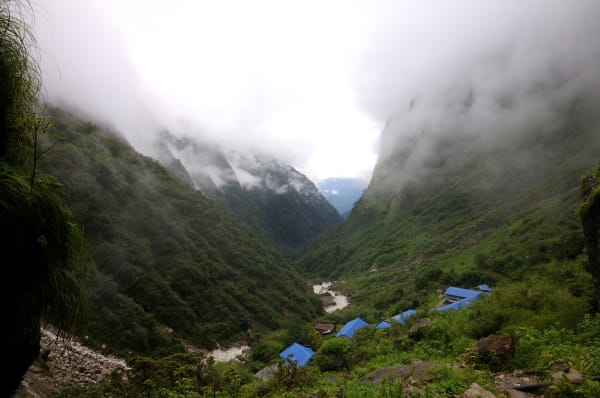
From there it is uphill for the rest of the day. The route follows the west bank of the Modi Khola through Dovan (2,600 m) and past the small shrine at Himalaya, where the gorge narrows and waterfalls pour across the trail. The forest is oak, moss and rhododendron, usually wet, and the stone underfoot can be slick — take it steadily. Langur monkeys are common in this stretch.
The final climb breaks out above the treeline into bare rock and reaches Deurali (3,230 m). You have gained close to 900 m today and are now high enough to notice it: sleep will be lighter, appetite smaller. Drink more water than feels necessary and turn in early. Overnight at Deurali.
3Day 3Trek from Deurali (3,230 m) to Annapurna Base Camp (4,130 m)
Trek from Deurali (3,230 m) to Annapurna Base Camp (4,130 m)
Today you walk into the Annapurna Sanctuary. The trail leaves Deurali and climbs through the top of the gorge, crossing open slopes that hold avalanche risk in spring — your guide checks conditions before committing and may take the alternate high route.
The valley then opens dramatically at Machhapuchhre Base Camp (3,700 m), a handful of lodges on grass beneath the ice flutings of Machhapuchhre. Stop for tea. The remaining 430 m to base camp is gradual, across glacial moraine and alpine meadow, and taking it slowly is the best altitude strategy you have.
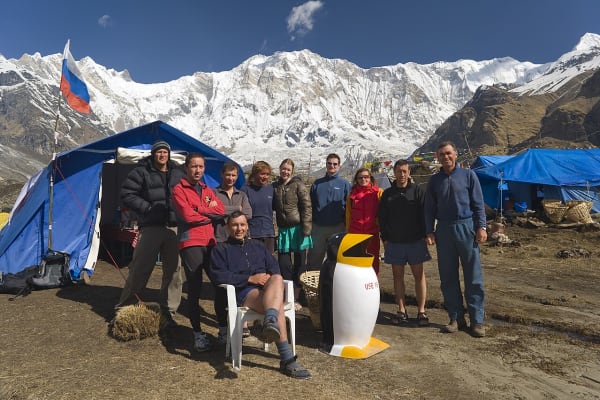
Annapurna Base Camp (4,130 m) sits inside a complete ring of mountains: Annapurna I (8,091 m), Annapurna South, Hiunchuli, Gangapurna, Tent Peak and the fishtail itself. There is no view out — only up. Sunset lights the rim in sequence, and after dark the sky is thick with stars and the glacier below groans and cracks. Overnight at base camp.
4Day 4Trek from Annapurna Base Camp (4,130 m) to Bamboo (2,310 m)
Trek from Annapurna Base Camp (4,130 m) to Bamboo (2,310 m)
Be outside before sunrise. Annapurna I catches the first light while the Sanctuary floor is still in shadow, and over the following twenty minutes the glow works around the entire amphitheatre. It is the coldest and best moment of the trek.
After breakfast we start down. The route retraces yesterday's ground past Machhapuchhre Base Camp and into the gorge, then follows the Modi Khola down through Deurali and Himalaya. Altitude falls away quickly and breathing becomes noticeably easier within a couple of hours.
Continuing through Dovan, the landscape shifts back from rock to forest and the air turns warm and humid again. The day ends at Bamboo (2,310 m) after more than 1,800 m of descent. Long downhill sections on uneven stone steps are hard on the knees, so use poles and take the steeper flights slowly. Overnight at Bamboo.
5Day 5Trek from Bamboo (2,310 m) to Jhinu Danda (1,780 m) and Drive to Pokhara (822 m)
Trek from Bamboo (2,310 m) to Jhinu Danda (1,780 m) and Drive to Pokhara (822 m)
The final morning follows the Modi Khola down through Upper and Lower Sinuwa, drops to the Chhomrong Khola, and climbs the stone staircase one last time to Chhomrong (2,170 m). From there the trail descends steadily through terraced farmland to Jhinu Danda (1,780 m).
A twenty-minute path leads down from the village to the Jhinu hot springs, where three stone pools of naturally heated water sit on the bank of the Modi Khola. After four days of stone steps this is the ideal end to the walking, and there is usually time for a proper soak before the jeep leaves.
The drive back down the valley returns you to Pokhara (822 m) in the late afternoon. Standing by Phewa Lake that evening, you can pick out the peaks you were standing beneath two mornings ago. Overnight in Pokhara.
Inclusions & Exclusions
Everything you need for a comfortable 5-day Annapurna Base Camp Trek is included, while personal expenses, international travel, insurance, and optional services are excluded.
What's Included
Private transportation from Pokhara to Jhinu Danda and back to Pokhara as per the itinerary.
Accommodation in local teahouses during the trek.
All required Annapurna Conservation Area permits and trekking permits.
Professional English-speaking licensed trekking guide.
Three meals a day (breakfast, lunch, and dinner) during the trek.
Group trekking map for route guidance.
First aid kit carried by the guide.
All government taxes, permit fees, and service charges.
What's Excluded
Travel insurance, including emergency helicopter evacuation coverage.
Personal trekking equipment and clothing.
Porter services (available at an additional cost).
Accommodation and meals in Kathmandu or Pokhara unless mentioned in the itinerary.
Snacks, bottled water, hot showers, Wi-Fi, charging fees, and alcoholic or soft drinks.
Personal expenses such as laundry, phone calls, and souvenirs.
Tips for guides, drivers, and support staff.
Any additional accommodation, transportation, or expenses caused by unforeseen circumstances beyond the itinerary.
Route Map
The route map shows the complete 5-day Annapurna Base Camp Trek, from Pokhara through Jhinu Danda and Annapurna Base Camp, before descending back to Pokhar
Loading map...
Altitude Profile
Pricing
Our Annapurna Base Camp Trek pricing covers essential trekking services, permits, accommodation, meals, transportation, and guide services, with flexible options available to suit your needs.
Add-ons
Enhance your trek with optional services and extra comfort based on your preferences.
Trekking Permits
The Annapurna Base Camp Trek requires the necessary permits to enter and trek through the Annapurna Conservation Area. The main permit is the Annapurna Conservation Area Permit (ACAP), which helps regulate trekking activities and supports conservation efforts in the region.
Our team arranges the required permits before the trek, so you can focus on enjoying the journey without worrying about the paperwork. Trekkers should carry their passport and permit documents throughout the trek, as they may be checked at designated checkpoints.
Our guide to Annapurna region permits explains the ACAP permit and the checkpoints where it is inspected.
Travel Insurance
Travel insurance is strongly recommended for the Annapurna Base Camp Trek, as the route reaches an altitude of 4,130 m and involves several days of mountain trekking. Your insurance should specifically cover trekking at the maximum altitude of the itinerary.
Make sure your policy includes emergency medical treatment and helicopter evacuation, if required. Insurance also provides protection against unexpected situations such as trip cancellation, lost baggage, illness, or accidents during your journey.
Our guide to travel insurance for trekking in Nepal explains the altitude limits, evacuation terms and common exclusions to check before you buy.
Altitude & Acclimatization
The trek gradually climbs from the lower hills to Annapurna Base Camp at 4,130 m, making altitude awareness an important part of the journey. Trek at a comfortable pace, stay well hydrated, eat regularly, and allow your body time to adjust as you gain elevation.
Symptoms such as headache, dizziness, nausea, unusual tiredness, or shortness of breath should not be ignored. If symptoms become serious or worsen, inform your guide immediately and descend to a lower altitude when necessary.
Prevention, symptoms and treatment are covered in depth in our guide to altitude sickness in Nepal.
Best Time to Trek
The best seasons for the Annapurna Base Camp Trek are spring (March–May) and autumn (September–November). These months generally offer stable weather, clear mountain views, comfortable trekking conditions, and colorful landscapes.
Winter (December–February) can bring cold temperatures and snow at higher elevations, while the monsoon season (June–August) brings rain, cloudy skies, and potentially muddy or slippery trails. Trekking is still possible outside the peak seasons, but conditions can be more challenging.
For a month-by-month look at weather and trail conditions, see our guide to the best time to trek in Nepal.
Trekking Gear & Packing
Proper equipment helps make the Annapurna Base Camp Trek safer and more comfortable. Essential items include sturdy trekking shoes, warm layers, a waterproof jacket, trekking trousers, gloves, a warm hat, sunglasses, sunscreen, a water bottle, and a good-quality sleeping bag.
Because temperatures can change significantly between lower villages and Annapurna Base Camp, packing layers is especially useful. Keep your backpack light and carry only the equipment you genuinely need for the trek.
For the complete kit list, organised by the altitude you will reach, see our Nepal trekking packing list.
Frequently Asked Questions
Find answers to common questions about the Annapurna Base Camp Trek, including difficulty, accommodation, permits, preparation, and trekking conditions.
1How difficult is the Annapurna Base Camp Trek?
The trek is considered moderate to challenging, with several hours of walking each day, steep sections, and a maximum altitude of 4,130 m.
2How many hours do we trek each day?
Most trekking days involve approximately 5–7 hours of walking, depending on the route, trail conditions, and walking pace.
3Is the Annapurna Base Camp Trek suitable for beginners?
Yes, reasonably fit beginners can complete the trek with proper preparation, a steady pace, and guidance from an experienced trekking team.
4How far in advance should I book the trek?
It is recommended to book a few weeks in advance, especially during the busy spring and autumn seasons, to secure transportation, accommodation, permits, and guide arrangements.
5What type of accommodation is available during the trek?
Accommodation is provided in local mountain teahouses, offering basic rooms and shared facilities along the trekking route.
6Can I charge my phone and other electronic devices during the trek?
Charging facilities are available at many teahouses, usually for an additional fee. Carrying a power bank is recommended for convenience.
7Is Wi-Fi available during the Annapurna Base Camp Trek?
Wi-Fi may be available at some teahouses, but the connection can be slow or unreliable, particularly at higher elevations.
8Is drinking water available along the trekking route?
Yes, drinking water can be purchased or refilled at villages and teahouses along the route. Trekkers should use water purification tablets, a filter, or another suitable purification method.
9Can I customize the Annapurna Base Camp Trek itinerary?
Yes, the itinerary can often be adjusted according to your available time, fitness level, preferred walking hours, and transportation requirements.
10What happens if the weather affects the trekking route?
If weather or trail conditions make a section unsafe, the trekking team may adjust the itinerary or arrange an alternative plan based on the situation and local conditions.
Gallery
Explore the Annapurna Base Camp Trek through authentic trekking trails, mountain landscapes, local villages, and memorable moments from the journey to 4,130 m.
Trekking Guides & Articles
Annapurna Base Camp Trek: The Complete Guide — A walk from rice terraces into a glacial amphitheatre ringed by 7,000 and 8,000 m peaks, in nine days from Kathmandu or five from Pokhara.
Annapurna Base Camp Trek Itinerary: Day by Day — The full Annapurna Base Camp itinerary day by day, with altitudes, walking hours and what each stage is actually like.
Everest Base Camp vs Annapurna Base Camp: Which Trek to Choose — Nepal's two most popular treks, compared honestly on altitude, difficulty, scenery, cost, access, season and crowds.
Mardi Himal vs Poon Hill vs Annapurna Base Camp: Which to Choose — The three treks most visitors to Pokhara choose between, compared on days, altitude, difficulty, crowds, cost and what you actually see.
Annapurna Treks During Dashain: ABC, Poon Hill and Mardi Himal — The Annapurna foothills are where a trekker meets Dashain head-on: Gurung villages with swings at every corner, lodge owners handing out tika.
Short Treks from Pokhara: Himalayan Walks in 3 to 10 Days — Pokhara is the best trekking base in Nepal: the Annapurna trailheads are under two hours away, and there is no mountain flight to catch.
Fix Departure
This trek runs every week on the selected day(s). Choose custom dates for one-off departures.
Showing fixed departures in Oct 2026
Guest Reviews
We loved every moment
“We did Annapurna Base Camp Trek from Pokhara as our first ever trek and came home already planning the next one. The trails were beautiful and not crowded at all when we went. I would absolutely book ...
Hunter Russell
Get in Touch
Tell us the dates you have in mind and roughly what you want out of the trek — one of our guides will reply, usually within 24 hours.
Email Us
info@greencompasstreks.com
Call Us
+977 9864379436
Office
Lakeside, Pokhara, Nepal
Office Hours
Sunday – Friday, 9:00 AM – 9:00 PM
Similar Treks
You might also like these treks


Porter
$193 $175/porter
No payment required yet