

Poonhill Trek from Pokhara
The Poon Hill Trek from Pokhara is the shortest genuine Himalayan trek in Nepal — three days from Pokhara and back, with
Porter
$116 $105/porter
No payment required yet
Trip Overview
The Poon Hill Trek from Pokhara is the shortest genuine Himalayan trek in Nepal — three days from Pokhara and back, with one of the world's great mountain sunrises in the middle. A morning drive to Ulleri (2,050 m) skips the steepest staircase section, leaving a pleasant forest walk up to the ridge village of Ghorepani (2,885 m).
Before dawn on the second morning you climb to Poon Hill (3,210 m) for sunrise across a 180-degree horizon of Dhaulagiri, Annapurna South, Annapurna I, Nilgiri, Hiunchuli, and Machhapuchhre. The trail then crosses to Tadapani and descends through Ghandruk, a beautifully preserved Gurung village, before the drive back to Pokhara. For travellers with only a long weekend, nothing else in Nepal comes close for value.
Trip Highlights
Three Days from Pokhara: A complete Himalayan trek and a world-class sunrise inside a long weekend.
Sunrise from Poon Hill (3,210 m): Watch first light cross Dhaulagiri, Annapurna South, Annapurna I, and Machhapuchhre from a single viewpoint.
Start at Ulleri: Drive past the steepest staircase section and begin the walk on the pleasant forest trail above.
Rhododendron Forest to Ghorepani: Walk through some of the densest rhododendron forest in Nepal, spectacular in spring.
Finish in Ghandruk: Descend through a classic Gurung village of stone streets and slate roofs with Annapurna South overhead.
Itinerary
A 3-day Pokhara-to-Pokhara trek from Ulleri to Ghorepani, with the Poon Hill sunrise at 3,210 m and a descent through Tadapani to Ghandruk.
1Day 1Drive from Pokhara (822 m) to Ulleri (2,050 m) and Trek to Ghorepani (2,860 m)
Drive from Pokhara (822 m) to Ulleri (2,050 m) and Trek to Ghorepani (2,860 m)
This three-day version cuts out the Kathmandu travel entirely and starts from the lakeside. We leave Pokhara (822 m) early by jeep, driving west through Nayapul and Birethanti before turning up the Bhurungdi Khola valley on rough mountain road.
The track climbs hard, switchbacking past Tikhedhunga to Ulleri (2,050 m). This is worth appreciating: it saves you the notorious Ulleri staircase, roughly 3,000 stone steps that trekkers on the classic route grind up on foot, and it means the short itinerary loses very little.
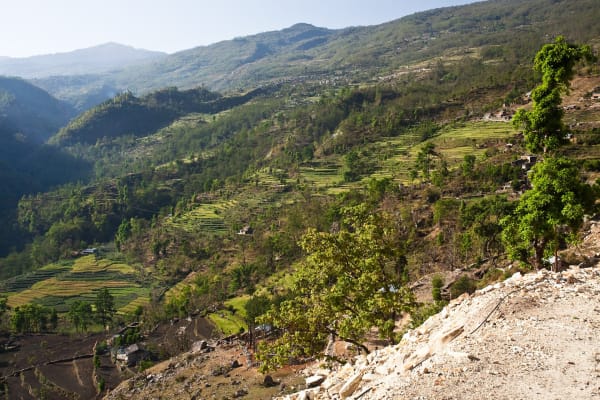
From Ulleri the walking starts, climbing steadily through Banthanti and Nangethanti into superb old rhododendron forest — in spring the whole hillside flowers red and pink. Ghorepani (2,860 m) sits in a saddle at the head of the valley, a cluster of blue-roofed lodges with Dhaulagiri to the west. Overnight in Ghorepani.
2Day 2Morning Hike to Poon Hill (3,210 m) and Trek to Tadapani (2,630 m)
Morning Hike to Poon Hill (3,210 m) and Trek to Tadapani (2,630 m)
A 4:30 am start for the head-torch climb to Poon Hill (3,210 m), about 45 minutes of stone steps above the village. It is the most popular sunrise viewpoint in Nepal and you will share it with a crowd, which is part of the atmosphere.
The panorama justifies it completely. From the platform at the top you look across a 180-degree wall of Himalaya containing two eight-thousanders — Dhaulagiri (8,167 m) to the west and Annapurna I (8,091 m) to the east — with Nilgiri, Tukuche, Annapurna South, Hiunchuli and Machhapuchhre in between, each catching the light in turn.
We return to Ghorepani for breakfast, then follow the ridge trail east, climbing to Deurali around 3,000 m before contouring and descending through ancient moss-hung rhododendron forest to Tadapani (2,630 m). The view of Annapurna South and Machhapuchhre from the lodges here is head-on and excellent. Overnight in Tadapani.
3Day 3Trek from Tadapani (2,630 m) to Ghandruk (1,940 m) and Drive to Pokhara (822 m)
Trek from Tadapani (2,630 m) to Ghandruk (1,940 m) and Drive to Pokhara (822 m)
Worth being awake at first light: Machhapuchhre turns gold directly in front of the lodges, and after yesterday's crowded summit you will likely have this one to yourself.
After breakfast the trail descends steeply through thick forest, losing around 700 m on stone steps and tree roots. This stretch is prime habitat for the Himalayan monal, Nepal's national bird — startlingly iridescent when it breaks from cover — and the forest is full of birdsong in the early morning.
The path emerges into terraced farmland and reaches Ghandruk (1,940 m), the most attractive Gurung village in the Annapurna region: stone-paved lanes, slate roofs stacked up the hillside, and a small museum of traditional Gurung life. It is worth an hour before leaving. A jeep then takes us back down the valley to Pokhara (822 m), arriving in the late afternoon — three days after setting out, having stood beneath two eight-thousanders in between. Overnight in Pokhara.
Inclusions & Exclusions
Private transport to Ulleri and back from Ghandruk, teahouse lodging, all trekking meals, conservation area permits, a licensed guide, trekking map, first aid, and government taxes are included, while international flights, visa, insurance, personal gear, porter service, city accommodation and meals, personal expenses, and tips are excluded.
What's Included
Private transportation from Pokhara to Ulleri and from Ghandruk back to Pokhara as per the itinerary.
Accommodation in local teahouses during the trek.
Annapurna Conservation Area Permit (ACAP) and required trekking permits.
Professional English-speaking licensed trekking guide.
Three meals a day (breakfast, lunch, and dinner) during the trek.
Group trekking map for route guidance.
First aid kit carried by the guide.
All government taxes, permit fees, and service charges.
What's Excluded
Travel insurance, including emergency helicopter evacuation coverage.
Personal trekking equipment and clothing.
Porter services (available at an additional cost).
Accommodation and meals in Kathmandu or Pokhara unless mentioned in the itinerary.
Snacks, bottled water, hot showers, Wi-Fi, charging fees, and alcoholic or soft drinks.
Personal expenses such as laundry, phone calls, and souvenirs.
Tips for guides, drivers, and support staff.
Any additional accommodation, transportation, or expenses caused by unforeseen circumstances beyond the itinerary.
Route Map
Explore the terrain map showing the trek route.
Loading map...
Altitude Profile
Pricing
Transparent per-person pricing based on group size, covering the services listed in the itinerary with no hidden charges.
Add-ons
Customize your trek with optional services such as porter support and other personalized arrangements at an additional cost.
Best Time to Trek
March to May and October to November are the strongest seasons. Spring is exceptional on this route because the forest between Ulleri and Ghorepani is dense rhododendron, in full flower through late March and April. Autumn gives the clearest air of the year and the highest chance of a cloudless Poon Hill sunrise.
Since the trek stays below 3,210 m it also works well from December to February, when views are outstandingly clear, the viewpoint is far quieter, and only the mornings are genuinely cold. Avoid the monsoon between June and August, when cloud obscures the range, the forest is full of leeches, and the stone steps become slippery.
For a month-by-month look at weather and trail conditions, see our guide to the best time to trek in Nepal.
Trek Difficulty & Fitness
This is an easy to moderate trek and probably the most accessible multi-day route in Nepal. Three walking days, a maximum sleeping altitude of 2,885 m, and frequent lodges make it well suited to first-time trekkers, active families, and older travellers in reasonable health. Driving to Ulleri removes the notorious 3,300-step climb from Birethanti, which is the section most people find hardest.
What remains is still stone-step walking, particularly on the descent from Tadapani to Ghandruk. A few weeks of regular walking with some hill work is enough preparation, and trekking poles noticeably reduce the strain on knees during the descents.
To build that fitness step by step, follow our 12-week training plan for a Nepal trek.
Travel Insurance
Travel insurance is required for this trek and your policy should cover trekking to at least 4,000 m, which brackets the Poon Hill viewpoint at 3,210 m with room to spare. Most standard travel policies cover this range, but check the altitude clause specifically rather than assuming, as some cap at 2,500 m.
Make sure emergency helicopter evacuation and medical treatment are included. Altitude illness is uncommon at these elevations, but slips on wet stone steps causing ankle and knee injuries are the usual reason trekkers need help, and there is no road access above Ulleri. Send us your policy number and the insurer's emergency contact before you set off.
Our guide to travel insurance for trekking in Nepal explains the altitude limits, evacuation terms and common exclusions to check before you buy.
Packing List
You need surprisingly little for this trek. Bring comfortable waterproof trekking boots, two base layers, a fleece, a light down jacket for the cold Poon Hill morning, a waterproof shell, trekking trousers, a warm hat, sun hat, gloves, and wool socks. A sleeping bag rated to -5°C is plenty for Ghorepani, and lodges also supply blankets.
Also pack a 25-litre daypack, trekking poles for the descent to Ghandruk, a headlamp with spare batteries for the pre-dawn climb, high-SPF sunscreen and lip balm, sunglasses, a reusable bottle with purification tablets or a filter, a small first aid kit with blister care, insect repellent, a quick-dry towel, toiletries, and a power bank. Almost everyone manages this trek without a porter.
For the complete kit list, organised by the altitude you will reach, see our Nepal trekking packing list.
Accommodation, Food & Drinking Water
Both nights are spent in teahouses, at Ghorepani and Tadapani. Lodges on this route are among the most comfortable anywhere in Nepal's trekking regions — twin rooms with real beds, many with attached bathrooms, hot showers, and heated dining rooms. Ghorepani has a dozen or more lodges and gets genuinely busy in October, so we book ahead and arrive in good time.
Three meals a day are included on the trek. The menus are wide by trekking standards, with dal bhat and free refills, noodles, fried rice, momos, soups, pasta, pizza, and a good breakfast range of porridge, eggs, Tibetan bread, and pancakes. Kitchens here are experienced with international diets, so let us know about vegetarian, vegan, or allergy requirements in advance. Refill your bottle at the lodges and treat it with tablets, a filter, or a UV pen instead of buying plastic bottles, which the conservation area discourages.
What the lodges are really like, from rooms and meals to showers and charging, is covered in our guide to teahouse trekking in Nepal.
Frequently Asked Questions
Find quick answers to common questions about the Poonhill Trek from Pokhara.
1How many hours do we walk each day?
Four to six hours a day. The Ulleri to Ghorepani walk takes around four hours, day two combines a two-hour pre-dawn Poon Hill round trip with a five-hour walk to Tadapani, and the last day to Ghandruk is about five hours before the drive back.
2Which permits are required and do you arrange them?
The Annapurna Conservation Area Permit and trekking registration are included in your package and arranged by our team from passport copies and passport-sized photographs supplied before departure.
3Is three days really enough for a Himalayan trek?
For this route, yes. Driving to Ulleri removes a full day of climbing, so the three days are spent on the best sections of the trail. You get the sunrise, the forest, and two Gurung villages without any of the filler.
4How crowded is Poon Hill at sunrise?
In October and November it can be several hundred people on the viewpoint. It remains worth doing, and setting off a little before the main wave gets you a better position. Winter and the shoulder months are much quieter.
5Is this trek suitable for children or older travellers?
Yes. It is one of the best options in Nepal for active children from around eight and for older travellers in good health, thanks to the low altitude, short days, and comfortable lodges. The stone steps are the main consideration.
6How long are the drives at each end?
Pokhara to Ulleri takes roughly two and a half to three hours on a mix of sealed and rough road, and the return from Ghandruk to Pokhara is around two to three hours. Both are scenic and straightforward.
7Is mobile network and Wi-Fi available?
Yes, and better than on most treks. Ncell and NTC both work at Ulleri, Ghorepani, Tadapani, and Ghandruk, and lodges sell Wi-Fi access. Speeds are fine for messaging and sending photos.
8Can I charge my devices on the trail?
Yes, at every lodge, from micro-hydro or mains power, usually for a small fee or free if you are eating there. Electricity on this route is the most reliable of any trek in the region.
9Where can I withdraw cash?
Pokhara has plenty of ATMs and there are none on the trail. Carry Nepalese rupees from Pokhara for snacks, drinks, hot showers, Wi-Fi, and tips.
10Can I leave extra luggage in Pokhara?
Yes. Your Pokhara hotel stores anything you do not need on the trail free of charge until you return, which on a three-day trek means you need carry very little.
Gallery
Explore authentic moments, landscapes, and mountain views from the Poonhill Trek from Pokhara.
Trekking Guides & Articles
Meditation for Trek Anxiety: Altitude, Flights and Exposure — Fear of altitude, the Lukla flight, suspension bridges, being far from help — trek anxiety is common and manageable.
Mardi Himal vs Poon Hill vs Annapurna Base Camp: Which to Choose — The three treks most visitors to Pokhara choose between, compared on days, altitude, difficulty, crowds, cost and what you actually see.
Annapurna Treks During Dashain: ABC, Poon Hill and Mardi Himal — The Annapurna foothills are where a trekker meets Dashain head-on: Gurung villages with swings at every corner, lodge owners handing out tika.
Short Treks from Pokhara: Himalayan Walks in 3 to 10 Days — Pokhara is the best trekking base in Nepal: the Annapurna trailheads are under two hours away, and there is no mountain flight to catch.
Trekking in Nepal with Asthma, Diabetes or High Blood Pressure — A long-term condition rarely rules out a Nepal trek, but it changes the planning.
Poon Hill Trek: Nepal's Best Short Sunrise Trek — Three to seven days, a maximum of 2,885 m, and a dawn panorama over Dhaulagiri, Annapurna South and Machhapuchhre.
Fix Departure
This trek runs every week on the selected day. Choose custom dates for one-off departures.
Showing fixed departures in Oct 2026
Guest Reviews
Perfect short adventure
“We did Poonhill Trek from Pokhara as our first ever trek and came home already planning the next one. The trails were beautiful and not crowded at all when we went. Five stars, no hesitation.”
Tomasz Adams
Get in Touch
Tell us the dates you have in mind and roughly what you want out of the trek — one of our guides will reply, usually within 24 hours.
Email Us
info@greencompasstreks.com
Call Us
+977 9864379436
Office
Lakeside, Pokhara, Nepal
Office Hours
Sunday – Friday, 9:00 AM – 9:00 PM
Similar Treks
You might also like these treks



Porter
$116 $105/porter
No payment required yet