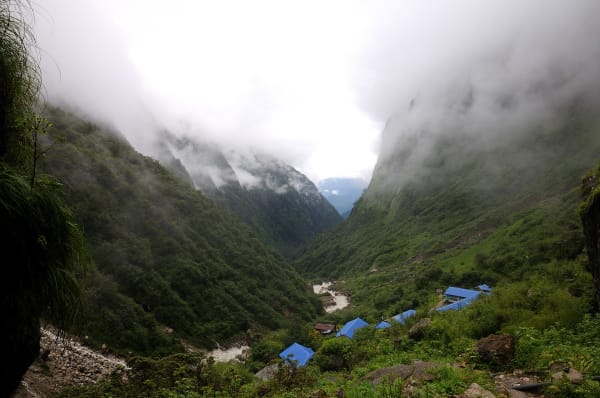
Nepal's teahouse network is the reason you can walk for two weeks in the Himalaya with a 7 kg daypack. On the main trails, a family-run lodge appears every one to three hours: a dining room with a stove, a kitchen, and a row of simple twin bedrooms. You arrive, you order dinner, you sleep, you go on.
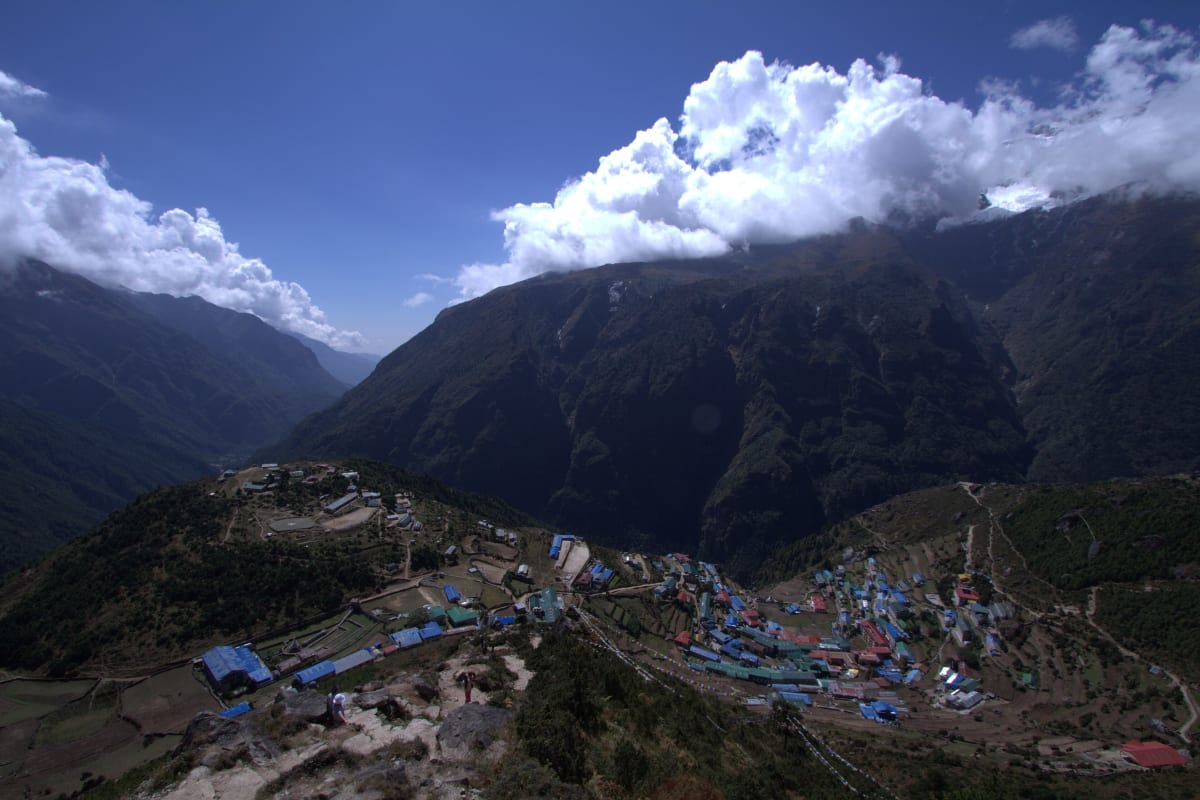
The word teahouse covers a lot of ground, though. At Namche Bazaar you can get an espresso and a hot shower in a lodge with double glazing. At Gorak Shep, six hours higher, you get a plywood room at -15 °C and a toilet down an outside stair. Knowing where on that spectrum your route sits is most of what you need.
What You Get for Your Night
| Altitude band | Rooms | Bathroom | Heating | Food |
|---|---|---|---|---|
| Below 2,500 m | Twin beds, thick blankets, sometimes an attached bathroom and a window seat | Often attached, flush toilet, hot shower | Rarely needed | Wide menu, fresh vegetables, meat available |
| 2,500 – 3,500 m | Twin beds with foam mattress, blankets, shared corridor | Usually shared, flush or squat, gas or solar shower | Stove in the dining room after dark | Full menu, bakeries in bigger villages |
| 3,500 – 4,500 m | Plywood partitions, thin mattress, single blanket | Shared, often outside the main building | Dining room stove burning yak dung or kerosene | Shorter menu, everything carried up, no fresh meat |
| Above 4,500 m | Basic twin room, very cold, sometimes dormitory in peak season | Shared, usually outside, often no running water at night | Dining room only, lit in the evening | Limited menu, dal bhat, soup, noodles, eggs |
Two practical consequences. First, the dining room is the only warm space in the building above 3,500 m, which is why evenings on a trek are sociable whether you planned it or not. Second, your sleeping bag does the real work at night — lodge blankets are not enough above 4,000 m.
Food and How Ordering Works
Menus are remarkably consistent across the country: dal bhat, fried rice, noodle dishes, momos, soups, pasta, potatoes, porridge, eggs, Tibetan bread, and pancakes. Prices rise with altitude because everything above the last road is carried in on a porter's back or a mule's flank.
On our trips, three meals a day are included during the trek, so ordering is simple: your guide collects choices for the group and the kitchen cooks in one go. Two pieces of advice worth taking:
- Order dal bhat when you are hungry. It is the dish the kitchen makes for itself, it comes with free refills, and it is the best value on any menu in Nepal.
- Order the same dish as the group when you can. A single kitchen cooking eight different dishes on one stove takes a long time, and you are all cold.
- Be cautious with meat above about 3,500 m. It has been carried uphill unrefrigerated for days. Lodges in Sagarmatha National Park often do not serve it at all, which is a good sign rather than a limitation.
Our trail food guide goes into what to order where in more detail, including what to eat when altitude has taken your appetite.
Showers, Toilets, Charging, and Wi-Fi
All four are available on the main trails, all four cost money above the road head, and all four get worse with altitude.
- Hot showers — gas or solar heated, typically NPR 300–700. Above 4,500 m, washing is usually a bowl of hot water, and most trekkers skip it entirely.
- Toilets — a mix of western and squat. Bring your own paper and hand sanitiser; few lodges supply either.
- Charging — from solar or micro-hydro, NPR 200–500 per device, slower and dearer as you go up. Bring a power bank and sleep with it in your bag, because cold flattens batteries overnight.
- Wi-Fi — widely sold on the Everest and Annapurna trails, intermittent elsewhere. A local SIM with data is usually better value than buying lodge access every night.
Heating deserves its own note: lodge stoves are lit in the evening, not all day, and the fuel is often dried yak dung. Dress for the dining room as you would for outside and you will be comfortable.
Booking, Busy Seasons, and Single Rooms
In October and April the popular lodges fill. On a guided trip this is handled for you: our guides call ahead each morning, and we hold rooms at the pinch points — Gorak Shep, Annapurna Base Camp, High Camp on Mardi Himal, Dharmasala before Larke La — where there are only a handful of beds in total.
Two honest caveats about peak season. Single rooms cannot be guaranteed above about 4,000 m; in a full lodge the room you get is the room available. And in the very busiest weeks, lodges at the highest stops may put extra beds in the dining room. Starting the day early is the single most effective response to both.
Off the main circuits, the picture changes. On the Mundum trail, in Upper Dolpo, or on the Kanchenjunga Circuit, lodges are sparse or basic homestays, and some nights are camping with a support crew. That is part of what makes those routes feel remote.
Lodge Etiquette
- Eat where you sleep. Lodges make their margin on food, not the room, which is why rooms are so cheap.
- Take your boots off at the door.
- Ask before photographing the family, the kitchen, or a shrine inside the lodge.
- Walk clockwise around a chorten or mani wall, and do not move prayer stones.
- Keep the dining room stove clear — it is for the room, not for drying one person's socks.
- Pay your extras the night before you leave rather than at 6 a.m.
- Carry your rubbish out, batteries and wrappers included. There is no collection above the road head.
Finally, the lodge owners are the reason this whole system works. Many of the families on the Annapurna and Everest trails have been feeding trekkers for three generations, and they are the best source of information on conditions higher up that exists — better than any forecast. Ask them.