

Annapurna Base Camp with Mardi Himal Trek from Pokhara
The Annapurna Base Camp with Mardi Himal Trek from Pokhara links two of Nepal's most rewarding trails into a single 10-d
Porter
$385 $350/porter
No payment required yet
Trip Overview
The Annapurna Base Camp with Mardi Himal Trek from Pokhara links two of Nepal's most rewarding trails into a single 10-day circuit that begins and ends in Pokhara, with no Kathmandu days to pay for. The route opens on the Mardi Himal ridge, climbing from Kande through Pitam Deurali, Forest Camp, and High Camp to Mardi Himal Base Camp (4,500 m), where Machhapuchhre rises so close it fills the sky.
From Badal Danda the trail drops to the hot springs at Jhinu Danda and joins the classic Annapurna Sanctuary route, climbing through Sinuwa and Deurali to Annapurna Base Camp (4,130 m), ringed by Annapurna I, Annapurna South, Hiunchuli, and Machhapuchhre. Two contrasting base camps, a high ridge walk, deep sanctuary gorges, and rhododendron forest make this the most complete way to see the Annapurna region for travellers already based in Pokhara.
Trip Highlights
Two Base Camps in One Trek: Reach both Mardi Himal Base Camp (4,500 m) and Annapurna Base Camp (4,130 m) on a single continuous route.
The Mardi Himal Ridge Walk: Follow the exposed ridge above the treeline from Forest Camp to High Camp with Machhapuchhre directly ahead.
The Annapurna Sanctuary: Enter the glacial amphitheatre encircled by Annapurna I, Annapurna South, Hiunchuli, and Fishtail.
Hot Springs at Jhinu Danda: Soak in the natural riverside hot springs on the Modi Khola between the two halves of the trek.
Start and Finish in Pokhara: Skip the Kathmandu transfer days entirely and spend your time walking rather than travelling.
Itinerary
A 10-day Pokhara-to-Pokhara circuit taking in Mardi Himal Base Camp (4,500 m) and Annapurna Base Camp (4,130 m) with the Jhinu Danda hot springs in between.
1Day 1Drive from Pokhara (822 m) to Kande (1,770 m) and Trek to Pitam Deurali (2,100 m)
Drive from Pokhara (822 m) to Kande (1,770 m) and Trek to Pitam Deurali (2,100 m)
A short drive of about an hour from Pokhara on the Baglung Highway brings you to Kande (1,770 m), the roadhead where the Mardi Himal trail begins.
The walking starts immediately with a steep stone staircase climbing out of the road. It is a sharp introduction, but it is short. Above the initial climb the gradient eases and the trail enters oak and rhododendron forest, passing through Australian Camp and Pothana — small clusters of lodges on the ridge with open views south over the Pokhara valley and north to Machhapuchhre when the cloud lifts.
From Pothana the path contours along the ridgeline through thickening forest to Pitam Deurali (2,100 m), where the Mardi Himal trail branches away from the main Ghorepani route. This junction is the moment the trek gets quiet: almost all the traffic continues west, and you turn north onto the ridge. Roughly 4–5 hours of walking. Overnight at Pitam Deurali.
2Day 2Trek from Pitam Deurali (2,100 m) to Forest Camp (2,600 m)
Trek from Pitam Deurali (2,100 m) to Forest Camp (2,600 m)
A gentle day of around 500 m of climbing, spent almost entirely under tree cover on the Mardi ridge.
The trail runs north along the crest through dense, moss-hung forest of oak, maple and rhododendron. In spring the rhododendrons flower red and pink through this whole section; in autumn the light comes through the canopy in shafts. The path is narrow, soft with leaf litter, and rolls up and down rather than climbing steadily. Langur monkeys and Himalayan birdlife are common, and the forest is quiet enough that you often hear them before you see them.
There are no villages on this stretch — the ridge is too steep and too high for farming — so the day is pure woodland walking. Views are limited by the trees, which is exactly why the openness of the days ahead feels so dramatic.
Forest Camp (2,600 m), also called Kokar, is a small line of lodges in a clearing. Around 5 hours of walking. Overnight at Forest Camp.
3Day 3Trek from Forest Camp (2,600 m) to High Camp (3,580 m)
Trek from Forest Camp (2,600 m) to High Camp (3,580 m)
The biggest climbing day of the Mardi section, gaining nearly 1,000 m and breaking out above the treeline.
The morning continues through forest, climbing more steeply now, to Low Camp (2,970 m). From here the character of the trek changes completely. The tall trees give way to stunted rhododendron and juniper scrub, and Machhapuchhre (6,993 m) — the Fishtail — appears directly ahead, so close and so steep that it seems to lean over the ridge.
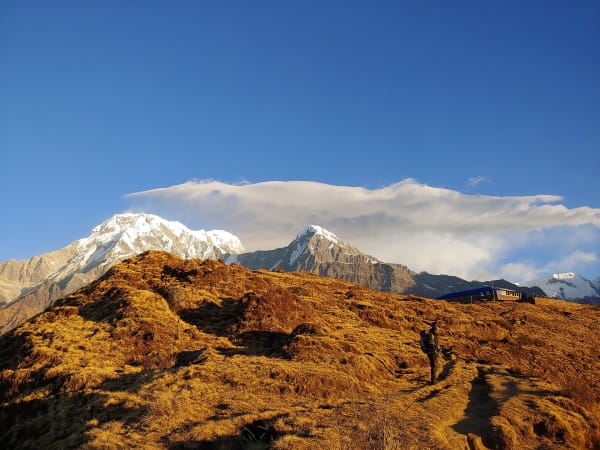
Above Low Camp the trail follows the narrow crest with the ground dropping away sharply on both sides, through Badal Danda (3,210 m) and onto open alpine grass. Annapurna South and Hiunchuli come into view to the west. The last section to High Camp is exposed and can be windy.
High Camp (3,580 m) sits on the ridge with an uninterrupted mountain panorama. Take it slowly today — this is a real altitude gain. Around 5–6 hours. Overnight at High Camp.
4Day 4Early Morning Hike from High Camp (3,580 m) to Mardi Himal Base Camp (4,500 m) and Trek Back to Badal Danda (3,210 m)
Early Morning Hike from High Camp (3,580 m) to Mardi Himal Base Camp (4,500 m) and Trek Back to Badal Danda (3,210 m)
The highlight of the Mardi Himal section, and a long day: a pre-dawn climb to 4,500 m followed by a substantial descent.
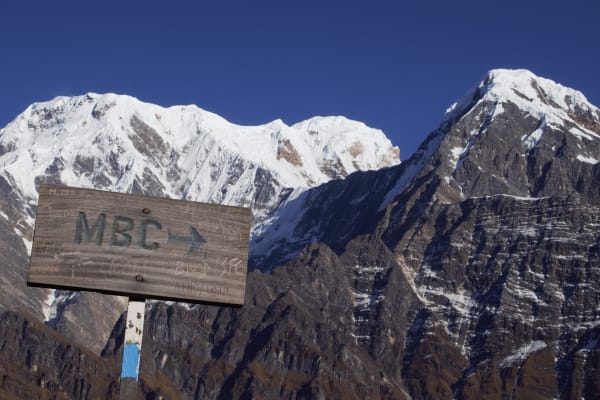
You leave High Camp in the dark, head-torches on, to be high on the ridge for sunrise. The trail climbs a narrowing spine of grass and rock — steep in places, with drops on either side — passing the Lower Viewpoint (4,100 m) and continuing to Mardi Himal Base Camp (4,500 m). As the sun comes up, the light hits Machhapuchhre first and then works west along the range.
From the base camp the view is extraordinary: Machhapuchhre rising almost vertically in front of you, with Annapurna I (8,091 m), Annapurna South, Hiunchuli and Mardi Himal (5,587 m) around the horizon. You are standing on a grass ridge with glaciers on three sides.
After time at the top you retrace the ridge to High Camp for breakfast, then descend to Badal Danda (3,210 m). Roughly 7–8 hours in total. Overnight at Badal Danda.
5Day 5Trek from Badal Danda (3,210 m) to Jhinu Danda (1,780 m)
Trek from Badal Danda (3,210 m) to Jhinu Danda (1,780 m)
A long descending day that drops around 1,400 m and moves you off the Mardi ridge and into the Modi Khola valley for the Annapurna Base Camp half of the trip.
The morning retraces the ridge down through Low Camp and back into the forest, losing height quickly on trails that can be slippery after rain. Below the forest the route turns west, leaving the Mardi ridge to join the main sanctuary trail, and the landscape shifts from alpine to subtropical — bamboo, ferns and terraced farmland, with the air noticeably warmer and heavier.
The final descent to Jhinu Danda (1,780 m) is on stone steps through the village terraces above the Modi Khola.
Jhinu is best known for the natural hot springs a steep twenty-minute walk below the lodges, on the riverbank. After four days on the ridge and a heavy descent, they are worth the extra effort. Around 6–7 hours of walking. Overnight at Jhinu Danda.
6Day 6Trek from Jhinu Danda (1,780 m) to Lower Sinuwa (2,340 m)
Trek from Jhinu Danda (1,780 m) to Lower Sinuwa (2,340 m)
The first day of the Annapurna Base Camp section, turning north up the Modi Khola into the corridor that leads to the sanctuary.
From Jhinu the trail crosses the Modi Khola on a long suspension bridge and climbs to New Bridge, then follows the river upstream through farmland and scattered houses. The valley here is deep, green and steep-sided, with waterfalls coming off the walls on both sides.
At Chhomrong (2,170 m) the route reaches the last large permanent village on the trail — a Gurung settlement built in tiers on the hillside, with Annapurna South and Hiunchuli filling the view north. Chhomrong is the gateway to the sanctuary and the last place with real shops.
From Chhomrong a long stone staircase drops to the Chhomrong Khola and climbs the far side to Lower Sinuwa (2,340 m) — a knee-testing sequence that most trekkers remember. Around 5–6 hours. Overnight at Lower Sinuwa.
7Day 7Trek from Lower Sinuwa (2,340 m) to Deurali (3,230 m)
Trek from Lower Sinuwa (2,340 m) to Deurali (3,230 m)
A steady climbing day up the narrowing throat of the sanctuary, gaining nearly 900 m.
The trail climbs through Upper Sinuwa and enters the bamboo and rhododendron forest that gives the next lodges their names — Bamboo (2,310 m) and Dovan (2,600 m). This is damp, dense, shaded walking beside the roar of the Modi Khola, with the valley walls closing in until only a strip of sky is visible overhead.
Above Dovan the forest thins. The route passes the shrine at Himalaya (2,920 m) and then the Hinku Cave, a large rock overhang once used as shelter, before the vegetation gives out almost entirely and the terrain becomes rock, scree and avalanche debris.
Deurali (3,230 m) sits in this steep, narrow, dramatic section of gorge. Altitude begins to matter from here, so drink well and keep the pace easy. Around 5–6 hours. Overnight at Deurali.
8Day 8Trek from Deurali (3,230 m) to Annapurna Base Camp (4,130 m)
Trek from Deurali (3,230 m) to Annapurna Base Camp (4,130 m)
The day the valley opens and you walk into the Annapurna Sanctuary itself.
The trail climbs from Deurali over moraine and old avalanche runout, following the Modi Khola to its source. After around three hours the gorge suddenly widens at Machhapuchhre Base Camp (3,700 m), and for the first time the mountains stand clear all around rather than overhead. Machhapuchhre is directly above; it has never been officially climbed and remains closed as a sacred peak.
The final two hours to Annapurna Base Camp (4,130 m) cross open alpine meadow, climbing gently. Take it slowly — this is the highest point of the trek and the air is thin.
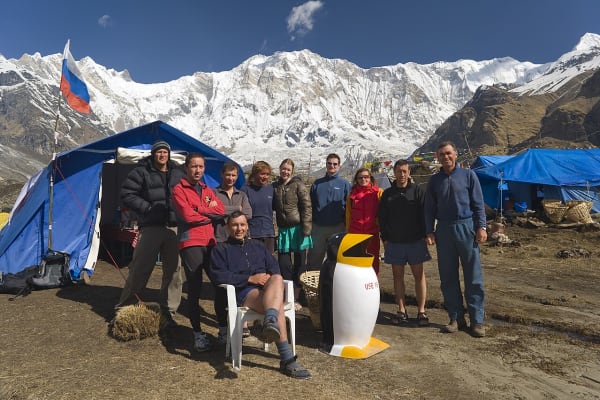
The sanctuary is a near-complete ring of mountains: Annapurna I (8,091 m), Annapurna South, Hiunchuli, Gangapurna, Tharpu Chuli and Machhapuchhre enclosing a glacial basin. Sunset and sunrise here are the reason people come. Around 5–6 hours. Overnight at Annapurna Base Camp.
9Day 9Trek from Annapurna Base Camp (4,130 m) to Bamboo (2,310 m)
Trek from Annapurna Base Camp (4,130 m) to Bamboo (2,310 m)
An early start for sunrise, then a long descent of more than 1,800 m back down the sanctuary corridor.
Most trekkers are outside before dawn. The first light strikes Annapurna I and moves around the ring of peaks one by one, and on a clear cold morning the whole basin turns gold. It is worth the cold hands.
After breakfast you retrace yesterday's route down through Machhapuchhre Base Camp and Deurali, then into the gorge and back below the treeline. Descending is fast but hard on the knees, and the trail is rocky and uneven in places — poles help considerably.
Below Deurali the vegetation returns quickly: first scrub, then rhododendron, then the thick bamboo forest around Dovan. The air warms and thickens with every hour, which after two nights at altitude feels remarkably good.
Bamboo (2,310 m) is a small cluster of lodges in the forest beside the river. Around 6–7 hours. Overnight at Bamboo.
10Day 10Trek from Bamboo (2,310 m) to Jhinu Danda (1,780 m) and Drive to Pokhara (822 m)
Trek from Bamboo (2,310 m) to Jhinu Danda (1,780 m) and Drive to Pokhara (822 m)
The last walking day, followed by the drive back to Pokhara and the end of the trek.
From Bamboo the trail descends through forest to Sinuwa, then drops the long staircase to the Chhomrong Khola and climbs the punishing set of steps back up to Chhomrong (2,170 m) — the same stairs as on the way in, in the harder direction. From Chhomrong the route descends steadily through terraced farmland to Jhinu Danda (1,780 m).
If the schedule allows, there is a last chance for the riverside hot springs before the drive.
From Jhinu the path continues down to the roadhead, where a jeep meets you for the drive back to Pokhara (822 m) — a few hours on rough road through the foothills before it joins tarmac near the valley.
You arrive in Pokhara in the afternoon or early evening, back at lake level after ten days that took in both the Mardi ridge and the sanctuary. Overnight in Pokhara.
Inclusions & Exclusions
Private transport to and from the trailheads, teahouse lodging, all trekking meals, conservation area permits, a licensed guide, trekking map, first aid, and government taxes are included, while international flights, visa, insurance, personal gear, porter service, city accommodation and meals, personal expenses, and tips are excluded.
What's Included
Private transportation from Pokhara to Kande and from Jhinu Danda back to Pokhara as per the itinerary.
Accommodation in local teahouses during the trek.
Annapurna Conservation Area Permit (ACAP) and required trekking permits.
Professional English-speaking licensed trekking guide.
Three meals a day (breakfast, lunch, and dinner) during the trek.
Group trekking map for route guidance.
First aid kit carried by the guide.
All government taxes, permit fees, and service charges.
What's Excluded
Travel insurance, including emergency helicopter evacuation coverage.
Personal trekking equipment and clothing.
Porter services (available at an additional cost).
Accommodation and meals in Kathmandu or Pokhara unless mentioned in the itinerary.
Snacks, bottled water, hot showers, Wi-Fi, charging fees, and alcoholic or soft drinks.
Personal expenses such as laundry, phone calls, and souvenirs.
Tips for guides, drivers, and support staff.
Any additional accommodation, transportation, or expenses caused by unforeseen circumstances beyond the itinerary.
Route Map
Explore the terrain map showing the trek route.
Loading map...
Altitude Profile
Pricing
Transparent per-person pricing based on group size, covering the services listed in the itinerary with no hidden charges.
Add-ons
Customize your trek with optional services such as porter support and other personalized arrangements at an additional cost.
Best Time to Trek
March to May and October to November are the strongest seasons for this combined route. Spring brings rhododendron forest in full bloom on the Mardi Himal ridge, which is one of the finest displays anywhere in Nepal, along with warm days and long daylight. Autumn delivers the clearest air of the year and the most dependable mountain views from both base camps.
December to February is still walkable and beautifully quiet, but snow can close the ridge above Forest Camp and the approach to Annapurna Base Camp, and some High Camp lodges shut. The monsoon from June to August brings persistent cloud, leeches in the forest sections, and a genuine avalanche risk in the sanctuary gorge, so we do not recommend it for this itinerary.
For a month-by-month look at weather and trail conditions, see our guide to the best time to trek in Nepal.
Trek Difficulty & Fitness
This is a moderate to challenging trek. Ten consecutive walking days with no rest day, two separate ascents above 4,000 m, and a large amount of cumulative up and down make it harder than either trail on its own. The steepest sections are the climb from Forest Camp to High Camp, the pre-dawn push to Mardi Himal Base Camp, and the long stone staircases between Chhomrong and Sinuwa.
You should be able to walk five to seven hours a day on consecutive days and manage sustained ascents and descents on uneven stone steps. Six to eight weeks of preparation — regular hill walking with a loaded daypack, plus running, cycling, or stair work — makes a real difference, particularly to your knees on the long descents. Trekking poles are strongly recommended.
To build that fitness step by step, follow our 12-week training plan for a Nepal trek.
Travel Insurance
Travel insurance is required for this trek and your policy must cover trekking to at least 5,000 m to comfortably bracket the Mardi Himal Base Camp high point of 4,500 m. Many standard policies stop at 3,000 m, which would leave you without cover for the most rewarding parts of both trails, so check the altitude clause specifically before buying.
Confirm that the policy includes emergency helicopter evacuation and medical treatment. Above Chhomrong and on the Mardi ridge there is no vehicle access, and evacuation from the sanctuary or High Camp means a helicopter, which operators only dispatch against a guarantee of payment. Send us your policy number and the insurer's 24-hour emergency contact before you start walking.
Our guide to travel insurance for trekking in Nepal explains the altitude limits, evacuation terms and common exclusions to check before you buy.
Packing List
The trek passes from subtropical forest at 1,700 m to snow at 4,500 m, so layering matters. Bring waterproof trekking boots that are already broken in, three base layers, a fleece, an insulated down jacket, a waterproof shell jacket and trousers, trekking trousers, a warm hat, sun hat, gloves, and wool socks. A sleeping bag rated to -10°C covers High Camp and Deurali.
Also pack a 30-40 litre daypack, trekking poles, a headlamp with spare batteries for the pre-dawn base camp starts, high-SPF sunscreen and lip balm, sunglasses, a reusable bottle with purification tablets or a filter, a personal first aid kit with blister care, a quick-dry towel, toiletries, a power bank, and a light rain cover for your pack. Keep the porter-carried duffel under 15 kg.
For the complete kit list, organised by the altitude you will reach, see our Nepal trekking packing list.
Accommodation, Food & Drinking Water
You stay in teahouses for every night of the trek. Lodges at Pitam Deurali, Jhinu Danda, Sinuwa, and Bamboo are comfortable, with twin rooms, blankets, and busy dining rooms. High Camp on the Mardi ridge and Deurali and Annapurna Base Camp in the sanctuary are simpler and considerably colder, with basic twin rooms, shared toilets, and heating only in the dining room. Rooms at Annapurna Base Camp fill quickly in peak season, which is why we start early on that day.
Three meals a day are included on the trek. Breakfast is porridge, eggs, Tibetan bread, or pancakes; lunch and dinner come from the lodge menu, with dal bhat and its free refills the best value alongside noodles, fried rice, momos, soups, pasta, and potato dishes. Prices rise with altitude because everything above Chhomrong is carried up on foot. Refill your bottle at lodges and treat it with tablets, a filter, or a UV pen rather than buying plastic bottles, which are discouraged throughout the conservation area.
What the lodges are really like, from rooms and meals to showers and charging, is covered in our guide to teahouse trekking in Nepal.
Frequently Asked Questions
Find quick answers to common questions about the Annapurna Base Camp with Mardi Himal Trek from Pokhara.
1How many hours do we walk each day?
Most days involve five to seven hours of walking. The push from High Camp to Mardi Himal Base Camp and back down to Badal Danda is the longest at around eight to nine hours, and the Deurali to Annapurna Base Camp day is a steady four to five hours with significant altitude gain.
2Which permits are required and do you arrange them?
You need the Annapurna Conservation Area Permit and the required trekking registration. Both are included in your package and arranged by our team — we only need passport copies and passport-sized photographs before departure.
3Is there a risk of avalanche in the Annapurna Sanctuary?
The gorge between Deurali and Machhapuchhre Base Camp is an avalanche-prone corridor after heavy snowfall, mainly in late winter and early spring. Our guides check conditions daily with lodges higher up and will hold the group or reroute if the section is unsafe.
4How cold does it get at night?
At High Camp and Annapurna Base Camp, night-time temperatures typically fall to between -5°C and -15°C in the main seasons. Lower lodges at Jhinu Danda and Bamboo stay well above freezing. A sleeping bag rated to -10°C plus a liner is the right choice for this route.
5Is mobile network and Wi-Fi available?
Ncell and NTC coverage reaches most villages on both trails, though it drops out on the upper Mardi ridge and in the deepest part of the sanctuary gorge. Many lodges sell Wi-Fi access. Speeds are slow and the service is intermittent at higher elevations.
6Can I charge my devices on the trail?
Yes. Most lodges offer charging from solar or micro-hydro power for a small fee that increases with altitude. Cold drains batteries fast at High Camp and Annapurna Base Camp, so bring a power bank and keep it in your sleeping bag overnight.
7Where can I withdraw cash?
Pokhara has plenty of ATMs, but there are none on either trail. Carry enough Nepalese rupees from Pokhara for the whole trek to cover snacks, drinks, charging, Wi-Fi, hot showers, the Jhinu hot springs entry, and tips.
8Can the two halves be shortened if I run out of time?
Yes. The trek can be cut at Jhinu Danda, where a road connects to Pokhara, so either half can be dropped without abandoning the trip. Tell your guide as early as possible so lodges and transport can be rearranged.
9How large are the groups and who leads the trek?
Groups are capped at twelve trekkers and led by a licensed English-speaking guide from the Annapurna region. On larger groups we add an assistant guide so the party can split by walking pace without anyone walking alone.
10Can I leave extra luggage in Pokhara?
Yes. Your Pokhara hotel will store anything you do not need on the trail free of charge until you return, so you can take only trekking kit into the mountains and leave city clothes and valuables behind.
Gallery
Explore authentic moments, landscapes, and mountain views from the Annapurna Base Camp with Mardi Himal Trek from Pokhara.
Trekking Guides & Articles
Post-Trek Recovery: What Your Body Needs in the First Two Weeks — You come down from a trek lighter, short of sleep, a little dehydrated and with an immune system that has taken a knock.
Mardi Himal Trek: The Complete Guide to Nepal's Best Short Ridge Walk — A high ridge directly under Machhapuchhre, opened to trekkers only in 2012 and still quieter than anything else in Annapurna.
Short Treks from Pokhara: Himalayan Walks in 3 to 10 Days — Pokhara is the best trekking base in Nepal: the Annapurna trailheads are under two hours away, and there is no mountain flight to catch.
Fix Departure
This trek runs every week on the selected day. Choose custom dates for one-off departures.
Showing fixed departures in Oct 2026
Guest Reviews
Incredible trek, incredible team
“We picked Annapurna Base Camp with Mardi Himal Trek from Pokhara after a lot of research and it did not disappoint. Our guide was fantastic — knowledgeable about the mountains, the culture and exactly...
Larissa Ward
Get in Touch
Tell us the dates you have in mind and roughly what you want out of the trek — one of our guides will reply, usually within 24 hours.
Email Us
info@greencompasstreks.com
Call Us
+977 9864379436
Office
Lakeside, Pokhara, Nepal
Office Hours
Sunday – Friday, 9:00 AM – 9:00 PM
Similar Treks
You might also like these treks

Porter
$385 $350/porter
No payment required yet