Nepal is trekkable in every month of the year — but not every trail is. The country runs from 60 m in the Terai to 8,848 m at the summit of Everest, and it has both a monsoon belt and a desert-dry rain shadow behind the main Himalayan chain. Pick the right region for the month and you can walk in clear weather in February or July. Pick the wrong one and you will spend a fortnight in cloud.
The short answer most people are looking for: October and November give the clearest mountain views of the year, and March to early May gives warmer days, flowering forest, and slightly hazier skies. Those are the two main seasons. What follows is the longer answer, month by month, with the routes that suit each one.

Nepal's Four Trekking Seasons at a Glance
Nepal's year divides into four distinct periods, and each one changes the trail experience more than the distance or the difficulty of the route does.
| Season | Months | Conditions | Best suited to |
|---|---|---|---|
| Autumn | Late September – November | Clearest skies, stable weather, moderate temperatures, busiest trails | Everything — this is peak season for every region |
| Winter | December – February | Cold nights, short days, very clear air, quiet trails, snow on high passes | Lower and mid-altitude treks, ridge viewpoints |
| Spring | March – mid May | Warm days, rhododendron in bloom, increasing afternoon haze, busy | All main regions, and the climbing season for high peaks |
| Monsoon | Mid June – mid September | Heavy rain, cloud, leeches, landslide risk, flight delays | Rain-shadow regions only: Upper Mustang, Dolpo, upper Manang |
If your dates are fixed and fall outside autumn and spring, you do not need to cancel the trip — you need to change the region. That is the single most useful thing to understand about trekking in Nepal.
Month-by-Month Breakdown
| Month | What it is like | Where we would send you |
|---|---|---|
| January | The coldest month. Brilliantly clear mornings, nights down to -15 °C above 4,000 m, some high lodges closed | Poon Hill, Mardi Himal, Pikey Peak, Chitwan, Kathmandu Valley |
| February | Still cold but lengthening days, excellent visibility, trails very quiet | Mardi Himal, Langtang Valley, Everest View treks, Pikey Peak |
| March | Warming fast, rhododendron opening from 2,000 m upward, strong season begins | Annapurna Base Camp, Everest Base Camp, Langtang, Mardi Himal |
| April | The best month of spring. Full bloom, warm walking, peak climbing season | Everest Base Camp, Annapurna Circuit, Island Peak, Mera Peak |
| May | Hot at low altitude, afternoon cloud builds, pre-monsoon haze by late month | High-altitude routes, Upper Mustang, expedition summits |
| June | Monsoon arrives mid-month. Humid, wet, leeches in forest | Upper Mustang, Upper Dolpo, Rara Lake |
| July | Wettest month. Flight delays routine, landslides on hill roads | Upper Mustang, Dolpo, Nar Phu, upper Manang |
| August | Still wet, but monsoon flowers spectacular in the rain shadow | Upper Mustang (Tiji is earlier), Dolpo, Gosaikunda at Janai Purnima |
| September | Rain eases from mid-month; the first clear windows arrive late | Everest and Annapurna from about 25 September, Manaslu |
| October | The most reliable month of the year. Clear, stable, busy | Everything — Everest Base Camp, Annapurna Circuit, Manaslu, Kanchenjunga |
| November | Clearest air of all, cooling steadily, still busy early in the month | Everest Base Camp, Annapurna Base Camp, Langtang, Three Passes |
| December | Cold, very clear, quiet, high passes may close after snowfall | Poon Hill, Mardi Himal, Everest View, Pikey Peak, Chitwan |
Autumn: The Most Reliable Season
From the last week of September until the end of November, the monsoon has washed the dust out of the air and the winter systems have not yet arrived. Mornings are usually cloudless, afternoons stay clear well into the evening, and the settled weather means flights to Lukla and Jomsom run close to schedule. For high passes — Thorong La, Larke La, Cho La, Renjo La — this is the most dependable window of the year.
The trade-off is company. October is the busiest month on Nepal's trails, and on the classic routes you will share lodges and viewpoints. Two things help: start the day early, and choose a route one step off the main circuit. Instead of Poon Hill in mid-October, consider Khopra Danda or Mohare Danda, which look at the same mountains from emptier ridges.
Autumn is also festival season. Dashain and Tihar fall in this window, which means villages are at their liveliest and Kathmandu at its quietest — worth planning around either way.
Spring: Flowers, Warmth, and the Climbing Season
March to mid-May is the other main season, and on some trails it is the better one. The rhododendron forest between roughly 2,000 m and 3,500 m flowers from late March into April, and on the approach to Annapurna Base Camp and along the Mardi Himal ridge the display is genuinely one of the sights of Nepal rather than a pleasant extra.
Temperatures are kinder than autumn at altitude, which matters if you sleep badly in the cold, and the longer daylight gives more margin on big days. Spring is also the climbing season: almost every expedition on Everest, Lhotse, Annapurna, and Makalu runs in April and May, when the jet stream lifts off the summits.
The cost is clarity. From mid-April onward, haze and afternoon cloud build over the foothills, so distant panoramas are softer than in November. If your single priority is a sharp, cloudless horizon, go in autumn; if it is warmth, colour, and a living forest, go in spring.

Winter: Cold Nights, Perfect Air, Empty Trails
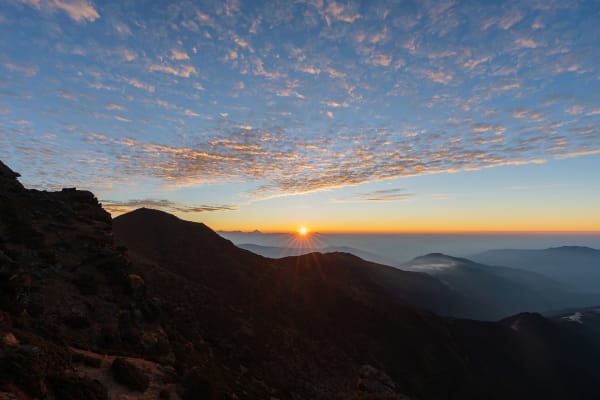
Winter is the most underrated season in Nepal. December and January deliver the most transparent air of the year, the trails are quiet enough that you will have viewpoints to yourself, and lodge prices are soft. The limits are real but manageable: nights fall well below freezing above 3,500 m, daylight is short, and heavy snowfall can close high passes for days at a time.
The answer is to stay below about 4,000 m and walk ridges rather than cross passes. Poon Hill, Mardi Himal, Pikey Peak, and the lower Langtang valley all work well in winter with a warm sleeping bag. What we would not book in January is Thorong La on the Annapurna Circuit or the Everest Three Passes route, where a single storm can leave a group stuck on the wrong side.
Monsoon: Go North of the Himalaya
From mid-June to mid-September, most of Nepal is wet. Trails are slippery, forest sections have leeches, mountain views come in brief gaps, road landslides are common, and domestic flights are unreliable. For the classic teahouse routes it is the one period we genuinely advise against.
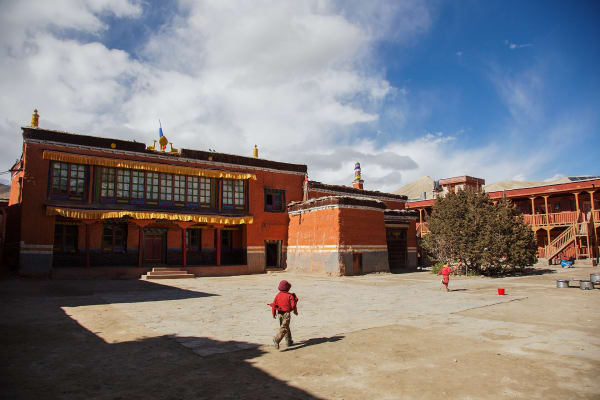
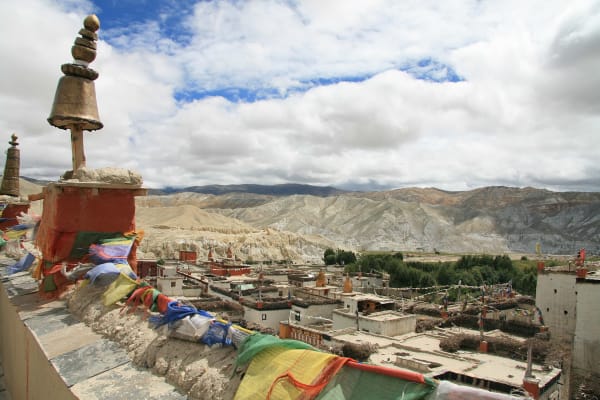
But the main Himalayan chain blocks the monsoon. Behind it, Upper Mustang, Upper Dolpo, Nar Phu, and upper Manang stay dry and walkable through the summer. These are high desert landscapes — ochre cliffs, walled Tibetan-Buddhist villages, barley fields in flood — and July is one of the most beautiful times to be there. Monsoon is also when the high meadows of Rara Lake are green and in flower.
One caution: reaching these regions usually means a flight to Jomsom or Juphal, and those flights are weather-dependent even in the rain shadow. Build one or two spare days into any monsoon itinerary.
How to Choose Your Month
Work backwards from what matters most to you:
- Sharpest mountain views: late October and November.
- Warmth and flowers: late March and April.
- Solitude: December, February, and the first half of September.
- A high pass crossing: October, November, April, or early May.
- Summit a trekking peak: April–May or October–November.
- Travelling in July or August: Upper Mustang, Dolpo, or Nar Phu — nothing south of the divide.
- Lowest prices and quietest lodges: winter, outside the Christmas and New Year fortnight.
Whatever month you land on, altitude matters more than the calendar for how cold you will be at night. Our packing list breaks the layers down by elevation band rather than by season, which is the more useful way to think about it.