

Everest Three Pass Trek
The Everest Three Pass Trek is the most complete circuit of the Khumbu and the benchmark high-altitude trek in Nepal. Ra
Porter
$578 $525/porter
No payment required yet
Trip Overview
The Everest Three Pass Trek is the most complete circuit of the Khumbu and the benchmark high-altitude trek in Nepal. Rather than walking to Everest Base Camp and back along the same trail, this 17-day route links the region's three great crossings — Kongma La (5,535 m), Cho La (5,420 m), and Renjo La (5,360 m) — into a single loop that takes in Everest Base Camp, Kala Patthar, the turquoise Gokyo Lakes, and the vast Ngozumpa Glacier along the way.
Each pass delivers a different perspective on the same giants. Kongma La opens the circuit with a wild, boulder-strewn crossing above Chhukung; Cho La involves a short glacier walk between Dzongla and Gokyo; and Renjo La offers what many trekkers rate as the finest single view in Nepal, with Everest framed perfectly above the Gokyo valley. This is a demanding itinerary with several days spent above 5,000 m, and it rewards trekkers who already have hill fitness and want the Khumbu at its wildest.
Trip Highlights
Cross Three Himalayan Passes Above 5,300 m: Link Kongma La (5,535 m), Cho La (5,420 m), and Renjo La (5,360 m) into one complete circuit of the Khumbu.
Everest Base Camp and Kala Patthar: Reach the base of the world's highest mountain and climb Kala Patthar (5,545 m) for the classic Everest sunrise.
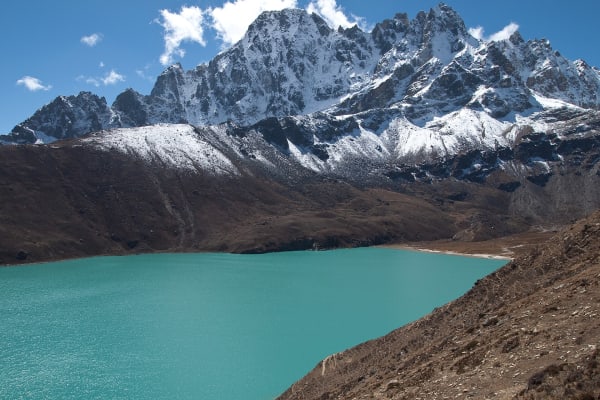
The Turquoise Gokyo Lakes: Spend two nights beside Nepal's highest freshwater lake system, backed by Cho Oyu and the immense Ngozumpa Glacier.
The Renjo La Panorama: Take in what many trekkers consider the finest viewpoint in the country, with Everest rising directly above Gokyo village.
Walk the Ngozumpa Glacier: Cross the longest glacier in the Himalaya on the traverse between Dzongla and the Gokyo valley.
Itinerary
A 17-day Khumbu circuit crossing Kongma La, Cho La, and Renjo La, taking in Everest Base Camp, Kala Patthar, and the Gokyo Lakes with three acclimatization days.
1Day 1Arrival in Kathmandu (1,400 m)
Arrival in Kathmandu (1,400 m)
You arrive at Tribhuvan International Airport in Kathmandu (1,400 m) and are met by our representative for the transfer to your hotel in Thamel.
Your guide runs the pre-trek briefing, and for this itinerary it matters more than most. The Everest Three Passes trek is the most demanding teahouse route in the Khumbu: it crosses Kongma La (5,535 m), Cho La (5,420 m) and Renjo La (5,360 m), takes in Everest Base Camp, Kala Patthar and the Gokyo lakes, and spends the better part of two weeks above 4,000 m.
The passes involve glacier moraine, boulder fields and, depending on season, snow and ice — crampons are sometimes needed on Cho La. Your guide checks kit thoroughly: a four-season sleeping bag, a serious down jacket, insulated gloves and stiff boots are all required. Previous high-altitude experience is strongly recommended. Overnight in Kathmandu.
2Day 2Fly from Kathmandu (1,400 m) to Lukla (2,860 m) and Trek to Phakding (2,651 m)
Fly from Kathmandu (1,400 m) to Lukla (2,860 m) and Trek to Phakding (2,651 m)
A pre-dawn transfer for the mountain flight, from Kathmandu itself or from Ramechhap after an early road transfer, depending on the season. The 30-minute flight runs along the flank of the Himalaya with an unbroken line of peaks out of the left-hand windows.
The landing at Lukla (2,860 m) is justly famous — a 527 m runway on a 12% uphill gradient with a mountainside at one end and a drop at the other.
After tea while the porters sort loads, the walking begins, and helpfully it goes downhill. The trail follows the Dudh Koshi through Chheplung and Ghat, past mani walls carved in Tibetan script, spinning prayer wheels and suspension bridges hung with faded flags. Phakding (2,651 m) is reached in the early afternoon, 200 m lower than Lukla — exactly the right way to begin a trek that will spend two weeks up high. Overnight in a teahouse.
3Day 3Trek from Phakding (2,651 m) to Namche Bazaar (3,440 m)
Trek from Phakding (2,651 m) to Namche Bazaar (3,440 m)
The first hard day. The trail follows the Dudh Koshi upstream through pine forest, crossing the river repeatedly on high suspension bridges. At Monjo you register at the entrance to Sagarmatha National Park, the UNESCO World Heritage site that covers the whole Everest region.
Past Jorsalle the valley narrows and the route crosses the Hillary Bridge, strung high above the confluence of the Dudh Koshi and Bhote Koshi. From the far side comes the climb everyone remembers — roughly 600 m of switchbacks through forest, steep and sustained, and the point at which most people first feel the altitude.
Around halfway up, a clearing gives the first distant view of Mount Everest (8,849 m) behind the Nuptse ridge. Namche Bazaar (3,440 m) fills a natural horseshoe amphitheatre and is the commercial heart of Sherpa country. Overnight in Namche.
4Day 4Acclimatization Day in Namche Bazaar (3,440 m)
Acclimatization Day in Namche Bazaar (3,440 m)
The first acclimatisation day, and the pattern for the whole trek: climb high, sleep low.
The morning excursion climbs to the Everest View Hotel (3,880 m), whose terrace looks straight out at Everest, Lhotse, Thamserku and the extraordinary spire of Ama Dablam (6,812 m). From there we walk on to the Sherpa villages of Khumjung and Khunde beneath the sacred peak of Khumbila — Khumjung's monastery is said to hold a yeti scalp, and its school was founded by Sir Edmund Hillary in 1961.
Back in Namche for the afternoon, the Sherpa Culture Museum and the national park visitor centre are both worth an hour. This is also the last place with reliable gear shops, so it is the moment to buy or hire anything the passes will need. Overnight in Namche Bazaar.
5Day 5Trek from Namche Bazaar (3,440 m) to Tengboche (3,956 m)
Trek from Namche Bazaar (3,440 m) to Tengboche (3,956 m)
One of the most scenic days on the whole route. The trail leaves Namche and contours high along the valley wall with an almost continuous view of Everest, Lhotse, Nuptse and Ama Dablam ahead.
At Kyangjuma the path drops steeply to the Dudh Koshi at Phunki Thanga (3,250 m), where water-driven prayer wheels turn in the river. Then comes the climb: around 700 m of steady ascent through rhododendron and birch to the ridge at Tengboche. It is a long pull, and it comes in the afternoon.
Tengboche (3,956 m) is the spiritual centre of the Khumbu. Its monastery, rebuilt after a fire in 1989, sits on a saddle with Ama Dablam framed behind it, and visitors are welcome at the late-afternoon prayer ceremony — monks, horns and chanting, with the mountain going pink outside. Overnight in Tengboche.
6Day 6Trek from Tengboche (3,956 m) to Dingboche (4,380 m)
Trek from Tengboche (3,956 m) to Dingboche (4,380 m)
Step outside at dawn for sunrise on Ama Dablam from the monastery lawn — from this angle it is arguably the most beautiful mountain in Nepal.
The trail descends through rhododendron forest to Deboche, crosses the Imja Khola on a bridge slung high above a gorge, and climbs to Pangboche (3,930 m), the oldest Sherpa settlement in the valley, whose monastery is worth the short detour. Above Pangboche the vegetation gives out almost entirely and the landscape turns high alpine — dwarf juniper, scrub and rock.
The route continues up the Imja valley through Shomare and climbs to Dingboche (4,380 m), a summer settlement of stone-walled potato and barley fields at the junction of the Imja and Khumbu valleys. Above 4,000 m the air is noticeably thin and the nights are properly cold. Overnight in Dingboche.
7Day 7Acclimatization Day in Dingboche (4,380 m)
Acclimatization Day in Dingboche (4,380 m)
The second acclimatisation day, and the one that sets up the first pass. With Kongma La at 5,535 m only two days away, this rest day is doing serious work.
The standard walk climbs the ridge of Nangkartshang Peak above the village, gaining 400 to 600 m over two or three hours. It is steep, and it will feel harder than the numbers suggest, but the reward from the top is a genuinely enormous panorama: Makalu (8,485 m) to the east, along with Lhotse, Island Peak, Ama Dablam from a new angle and the ice wall of Cho Polu.
We descend to Dingboche for a long lunch and an easy afternoon. Your guide will check how everyone is coping before committing to the Kongma La crossing — it is the highest of the three passes and the least forgiving. Overnight in Dingboche.
8Day 8Trek from Dingboche (4,380 m) to Lobuche (4,938 m) via Kongma La Pass (5,535 m)
Trek from Dingboche (4,380 m) to Lobuche (4,938 m) via Kongma La Pass (5,535 m)
The first and highest pass, and one of the hardest days on any teahouse trek in Nepal. We start before dawn.
The trail climbs steeply out of Dingboche onto a broad shoulder and then works up a long valley of boulder fields and small frozen tarns toward the pass. It is a sustained ascent of over 1,150 m with no shelter and no water, on rough ground where route-finding matters — your guide leads throughout.
Kongma La (5,535 m) is a narrow notch strung with prayer flags, with Makalu visible far to the east and the Khumbu Glacier below to the west. The descent is the crux: a steep, loose drop to the edge of the Khumbu Glacier, followed by a genuinely awkward traverse across the glacier's rubble-covered surface, which is slow going and demands concentration.
The far side climbs onto the moraine and reaches Lobuche (4,938 m) after eight to ten hours. Overnight in Lobuche.
9Day 9Trek from Lobuche (4,938 m) to Gorakshep (5,160 m) and Hike to Kala Patthar (5,545 m)
Trek from Lobuche (4,938 m) to Gorakshep (5,160 m) and Hike to Kala Patthar (5,545 m)
A demanding day at serious altitude, and a shorter one than yesterday, which is just as well.
The morning follows the Khumbu Glacier's lateral moraine — uneven, rocky and slow, with several short climbs — for two to three hours to Gorakshep (5,160 m), the last settlement on the route and the highest place you will sleep.
After lunch and a rest we climb Kala Patthar (5,545 m), the brown hill above Gorakshep. It is a steep 400 m ascent on loose rock and at this altitude it is genuinely hard — three breaths per step near the top is normal.
It is worth every one of them. Kala Patthar gives the finest view of Mount Everest (8,849 m) anywhere in Nepal: from base camp the summit hides behind the west shoulder, but from here the whole south-west face stands clear, with Nuptse, Changtse, Pumori and the Khumbu Icefall below. We descend to Gorakshep. Overnight there.
10Day 10Morning Hike from Gorakshep (5,160 m) to Everest Base Camp (5,364 m) and Trek to Dzongla (4,830 m)
Morning Hike from Gorakshep (5,160 m) to Everest Base Camp (5,364 m) and Trek to Dzongla (4,830 m)
A long day with two distinct halves. After an early breakfast we set out across the Khumbu Glacier to Everest Base Camp (5,364 m), two to three hours over rock, rubble and ice that undulates far more than the map suggests.
Base camp is a sprawl of moraine at the foot of the Khumbu Icefall — a frozen cataract of house-sized séracs tumbling out of the Western Cwm, and the most dangerous section of the standard route up Everest. In spring the site is a small city of tents; outside the season it is bare rock, prayer flags and enormous silence.
We return to Gorakshep for lunch, then descend past Lobuche and turn west off the main trail toward Dzongla (4,830 m), a tiny settlement of two or three lodges on a shelf beneath Cholatse. Leaving the base camp crowds behind here is a distinct change of mood. Overnight in Dzongla.
11Day 11Trek from Dzongla (4,830 m) to Gokyo (4,800 m) via Cho La Pass (5,420 m)
Trek from Dzongla (4,830 m) to Gokyo (4,800 m) via Cho La Pass (5,420 m)
The second pass, and the most technical day of the trek. We start before dawn, because the crossing is long and the weather deteriorates through the afternoon.
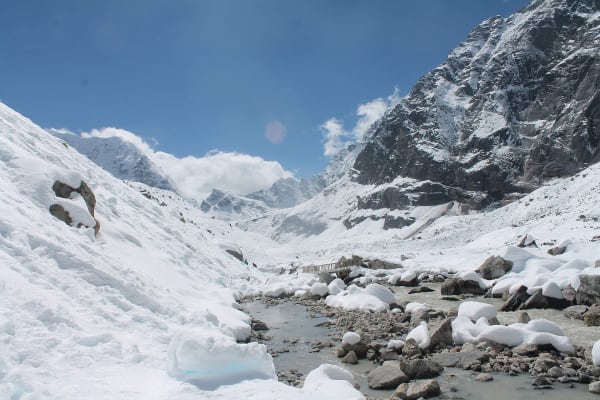
The trail climbs steadily from Dzongla over boulder fields toward the pass. The final approach to Cho La (5,420 m) involves a steep scramble up loose rock and then a crossing of a small glacier — crevassed in places, and often icy enough to need crampons or microspikes, which your guide will advise on before you leave Kathmandu.
The pass itself is a narrow saddle hung with prayer flags, with a superb view of Ama Dablam, Cholatse and Baruntse. The descent is steep and loose at first, then eases across moraine to Thangnak, where we usually stop for tea.
The last stretch crosses the rubble of the Ngozumpa Glacier, the longest in Nepal, and reaches Gokyo (4,800 m) beside its third lake. Eight to ten hours in total. Overnight in Gokyo.
12Day 12Acclimatization Day in Gokyo (4,800 m)
Acclimatization Day in Gokyo (4,800 m)
A well-earned day at Gokyo after two passes, and one that still involves climbing — but at your own pace.
The main option is Gokyo Ri (5,357 m), a steep 550 m ascent above the village taking two to three hours. The summit panorama is arguably the finest in Nepal: four eight-thousanders in one view — Everest, Lhotse, Makalu and Cho Oyu — with the Ngozumpa Glacier and the chain of turquoise lakes laid out below.
The alternative, and for many people the better one, is the walk north along the shore to the fourth (Thonak Tsho) and fifth (Ngozumpa Tsho) lakes — an easy couple of hours each way, far quieter, with a direct view of Cho Oyu's north face from the ridge above the fifth lake.
Either way you sleep at Gokyo. Overnight in the village.
13Day 13Trek from Gokyo Valley (4,800 m) to Marlung (4,210 m) via Renjo La Pass (5,360 m)
Trek from Gokyo Valley (4,800 m) to Marlung (4,210 m) via Renjo La Pass (5,360 m)
The third and final pass, and the one most trekkers remember best. Another pre-dawn start.
The trail climbs west from Gokyo along the northern shore of Dudh Pokhari and then up a long series of stone staircases and switchbacks — steep but straightforward, with no glacier crossing. The lakes shrink below you as you climb.
The view from Renjo La (5,360 m) is the classic image of the Khumbu: Everest, Lhotse, Makalu and Cho Oyu ranged across the eastern horizon, with Gokyo village and the turquoise third lake directly below and the grey sweep of the Ngozumpa Glacier beside them. Many people rate this above both Kala Patthar and Gokyo Ri.
The descent west is long — steep stone steps at first, then open valley — passing Lumde and following the Bhote Koshi down to Marlung (4,210 m). You are now in a valley almost nobody walks. Overnight in Marlung.
14Day 14Trek from Marlung (4,210 m) to Namche Bazaar (3,440 m)
Trek from Marlung (4,210 m) to Namche Bazaar (3,440 m)
A long descending day down the Bhote Koshi valley, and a quiet one — this side of the Khumbu sees a fraction of the traffic of the main trail.
The path follows the river south through Taranga to Thame (3,820 m), an old Sherpa village that was the childhood home of Tenzing Norgay and of several generations of Everest summiteers since. Its monastery, set on the hillside above, is one of the oldest in the Khumbu and worth the short climb.
Below Thame the trail descends through juniper and then rhododendron, and the return of trees after a week above the treeline is genuinely welcome. The valley narrows and joins the main Dudh Koshi route just above Namche.
Namche Bazaar (3,440 m) feels like a metropolis after Marlung — hot showers, bakeries, and a beer if you want one. Overnight in Namche.
15Day 15Trek from Namche Bazaar (3,440 m) to Lukla (2,860 m)
Trek from Namche Bazaar (3,440 m) to Lukla (2,860 m)
The final walking day. From Namche the trail drops steeply down the switchbacks you climbed two weeks ago, losing 600 m to the Hillary Bridge. Descending is faster but harder on the knees, and poles earn their keep.
From the bridge the route follows the Dudh Koshi through Jorsalle and Monjo, where you check out of Sagarmatha National Park, and continues through Phakding. The valley is green and warm again, thick with pine and rhododendron, and busier with villages, mani walls and prayer wheels than the high country has been for a fortnight.
A final undulating section — with one climb near the end that always feels unfair — brings you into Lukla (2,860 m). Tonight is the celebration dinner with your guide and porters, and after three passes above 5,300 m it is a properly earned one. Overnight in Lukla.
16Day 16Fly from Lukla (2,860 m) to Kathmandu (1,400 m)
Fly from Lukla (2,860 m) to Kathmandu (1,400 m)
An early flight out, because Lukla's weather window is a morning one and the airstrip routinely closes by midday. The take-off — accelerating downhill toward the edge of the shelf — is as memorable as the landing was.
The 30-minute flight returns you to Kathmandu (1,400 m), or to Ramechhap with a road transfer, depending on the season. On a clear morning the Himalaya line the northern horizon the whole way.
Lukla flights depend entirely on weather and delays of a day or more are common, which is why we always recommend a buffer day before an international connection. Once in Kathmandu you transfer to your hotel with the afternoon free — after two weeks and three 5,000 m passes, a hot shower and a proper meal are memorable in their own right. Overnight in Kathmandu.
17Day 17Final Departure from Kathmandu (1,400 m) to Tribhuvan International Airport
Final Departure from Kathmandu (1,400 m) to Tribhuvan International Airport
Your final day in Nepal. If your flight is later there is time for one more part of the Kathmandu Valley — Boudhanath Stupa is a fitting close after two weeks in Sherpa country, being the centre of the city's Tibetan Buddhist community, with Pashupatinath and Swayambhunath nearby.
Our representative collects you from your hotel and transfers you to Tribhuvan International Airport around three hours before departure.
The Everest Three Passes trek is the complete Khumbu: Kongma La, Cho La and Renjo La, plus Everest Base Camp, Kala Patthar at 5,545 m, the Gokyo lakes and Gokyo Ri, and the quiet Bhote Koshi valley on the way out. Very few trekking routes anywhere pack in this much. If you want a comparable challenge elsewhere in Nepal, the Kanchenjunga Circuit and Makalu Base Camp are the obvious candidates. Safe travels.
Inclusions & Exclusions
Lukla flights, Kathmandu accommodation, teahouse lodging, all trekking meals, national park and municipality permits, a licensed guide, and government taxes are included, while international flights, visa, insurance, personal gear, porter service, city meals, personal expenses, and tips are excluded.
What's Included
Airport pickup and drop-off services in Kathmandu.
Domestic flights from Kathmandu to Lukla and Lukla to Kathmandu, including airport transfers.
Accommodation in Kathmandu with breakfast.
Accommodation in local teahouses during the trek.
Sagarmatha National Park Entry Permit and Khumbu Pasang Lhamu Rural Municipality Entry Permit.
Professional English-speaking licensed trekking guide.
Three meals a day (breakfast, lunch, and dinner) during the trek.
Group trekking map for route guidance.
First aid kit carried by the guide.
All government taxes, permit fees, and service charges.
What's Excluded
International flight tickets to and from Nepal.
Nepal entry visa fees.
Travel insurance, including emergency helicopter evacuation coverage.
Personal trekking equipment and clothing.
Porter services (available at an additional cost).
Lunch and dinner in Kathmandu.
Snacks, bottled water, hot showers, Wi-Fi, charging fees, and alcoholic or soft drinks.
Personal expenses such as laundry, phone calls, and souvenirs.
Tips for guides, drivers, and support staff.
Any additional accommodation, transportation, or expenses caused by Lukla flight delays, pass closures, bad weather, or other unforeseen circumstances beyond the itinerary.
Route Map
Explore the terrain map showing the trek route.
Loading map...
Altitude Profile
Pricing
Transparent per-person pricing based on group size, covering the services listed in the itinerary with no hidden charges.
Add-ons
Customize your trek with optional services such as porter support and other personalized arrangements at an additional cost.
Best Time to Trek
Spring (late March to May) and autumn (late September to mid-November) are the only two seasons we recommend for the Three Passes. Autumn gives the most reliable pass conditions — settled weather, firm snow, and exceptional visibility. Spring is warmer with longer daylight, which matters on the long pass days, and the Khumbu is alive with expedition traffic.
Outside these windows the passes are the problem rather than the trail. Heavy winter snow can close Kongma La and Cho La for days at a time and the Gokyo lodges thin out considerably, while monsoon cloud removes the views that justify the effort and makes the glacier sections slippery and hazardous. We do not run this itinerary in mid-winter or during the monsoon.
Our guide to the best time for the Everest Base Camp trek compares every season and month in the Khumbu.
Trek Difficulty & Fitness
This is the most demanding teahouse trek in the Everest region and considerably harder than the standard Base Camp route. You will sleep above 4,500 m for the better part of a week, cross three passes over 5,300 m, and face several nine- to eleven-hour days on loose moraine, boulder fields, and short sections of glacier. No ropes or technical skills are required, but crampons or microspikes are sometimes needed on Cho La.
Come prepared with a solid base of endurance fitness — ideally three to four months of consistent training including long back-to-back hill days with a loaded pack, plus strength work for legs and core. Previous experience at altitude is strongly recommended. Trekkers who have already completed Everest Base Camp, Annapurna Circuit, or a comparable high route will find the physical demands familiar; those who have not should consider the standard Base Camp trek first.
To build that fitness step by step, follow our 12-week training plan for a Nepal trek.
Travel Insurance
Travel insurance covering trekking to 6,000 m is mandatory for this itinerary and we cannot accept bookings without it. Standard policies almost never extend this high, so you will usually need a specialist adventure or mountaineering add-on. Read the altitude clause carefully before you buy: a policy capped at 4,500 m leaves you uninsured for the entire second half of the trek.
Your policy must include emergency helicopter evacuation and repatriation, medical treatment, and cover for delayed or cancelled domestic flights. On the pass sections there is no road, no vehicle access, and often several hours of walking to the nearest lodge, so helicopter rescue is the only realistic response to a serious problem. Send us your policy number and the insurer's 24-hour emergency line before you fly.
Our guide to travel insurance for trekking in Nepal explains the altitude limits, evacuation terms and common exclusions to check before you buy.
Altitude & Acclimatization
The itinerary includes acclimatization days at Namche Bazaar (3,440 m), Dingboche (4,380 m), and Gokyo (4,800 m), and the route is deliberately sequenced so that you cross Kongma La only after a week of gradual adaptation. Even so, this trek spends more time at extreme altitude than almost any other teahouse route in Nepal, and acclimatization is the factor that most often decides whether a group completes all three passes.
Pass days begin before dawn to make the crossing in stable morning conditions, and your guide will assess both the weather and the group's condition the evening before. If anyone is not adapting well, we descend or reroute — Cho La and Renjo La can both be bypassed via lower valley trails without abandoning the trek. Hydrate heavily, eat properly even when appetite drops, skip alcohol entirely above Namche, and report symptoms immediately rather than the following morning.
Prevention, symptoms and treatment are covered in depth in our guide to altitude sickness in Nepal.
Accommodation, Food & Drinking Water
Lodging is in teahouses for the whole trek, with a tourist-standard hotel in Kathmandu at either end. Standards vary widely along this route: Namche and Gokyo have comfortable lodges with dining rooms, bakeries, and sometimes attached bathrooms, while Chhukung, Dzongla, Lobuche, and Marlung offer basic twin rooms with shared toilets and no heating outside the dining area. Rooms are allocated on a first-come basis, and on pass days we start early partly to secure beds at small settlements with only a handful of lodges.
All meals are included during the trek. Expect porridge, eggs, chapati, and pancakes for breakfast, and dal bhat, noodles, fried rice, soup, momos, or pasta for lunch and dinner. Portions are generous and dal bhat comes with free refills, which is what most guides eat. Above Namche we recommend sticking to vegetarian dishes. Fill your bottle at lodges and treat the water with tablets, a filter, or a UV pen — bottled water is banned in much of the Khumbu, gets expensive above 4,000 m, and leaves plastic in a valley with no way to remove it.
What the lodges are really like, from rooms and meals to showers and charging, is covered in our guide to teahouse trekking in Nepal.
Frequently Asked Questions
Find quick answers to common questions about the Everest Three Pass Trek.
1Can I skip one of the passes if conditions are bad?
Yes. Each pass has a lower valley alternative, so a closure or a member of the group struggling with altitude does not end the trek. Your guide makes that call based on snow conditions, weather, and how the group is doing, and the itinerary is built with enough flexibility to absorb a reroute.
2Do I need crampons or technical equipment?
No ropes, harnesses, or climbing skills are needed. Cho La crosses a short glacier section where microspikes or lightweight crampons are useful, particularly in early spring or late autumn, and your guide will advise whether to rent a pair in Namche before you head up.
3How many hours do we walk each day?
Normal days run six to eight hours. The three pass days are considerably longer, typically eight to eleven hours, with an early start in the dark to cross while conditions are stable and the afternoon wind has not picked up.
4What happens if the Lukla flight is delayed?
Lukla flights are weather-dependent and delays of a day or more are common. Given how tight this itinerary already is, we strongly recommend two spare days in Kathmandu at the end of your trip. A helicopter transfer can usually be arranged at additional cost if you are running short of time.
5Which permits are required and do you arrange them?
The Sagarmatha National Park Entry Permit and the Khumbu Pasang Lhamu Rural Municipality Entry Permit are both included and handled by our team. We need passport copies and passport photographs in advance; no separate restricted-area permit applies to this route.
6Is mobile network and Wi-Fi available?
Coverage reaches most villages on the circuit but is unreliable in the high camps and on the pass sections. Lodges sell Wi-Fi access and the Everest Link card works in many settlements. Expect slow speeds and frequent outages, and plan on being offline for stretches of a day or two.
7How cold does it get at night?
At Lobuche, Gorakshep, Dzongla, and Gokyo, night-time temperatures typically fall between -10°C and -20°C in the main seasons, colder with wind chill on the passes at dawn. A sleeping bag rated to at least -15°C, plus a liner, makes the difference between sleeping and shivering.
8Can I charge devices and are ATMs available?
Lodges charge devices from solar power for a fee that increases with altitude. Namche has the only ATMs on the route and they are not dependable, so carry all the Nepalese rupees you will need from Kathmandu — for the full circuit that is meaningfully more than the standard Base Camp trek.
9How large are the groups and who leads the trek?
Groups are capped at twelve trekkers and led by a licensed English-speaking guide with specific experience on all three passes. We add an assistant guide for larger groups so the party can split by pace on long pass days without anyone walking alone.
10Can I leave extra luggage in Kathmandu?
Yes. Your Kathmandu hotel stores anything you do not need on the trail free of charge until you return, so you can travel with just your trekking kit and leave city clothes, spare gear, and valuables behind.
Gallery
Trekking Guides & Articles
Everest Three Passes Trek: The Complete Khumbu Circuit — Kongma La, Cho La and Renjo La, plus Everest Base Camp, Kala Patthar, Gokyo Ri and the Gokyo lakes — the most complete trek in the Everest region, in 17 days.
Everest Base Camp Packing List: Tested Against 5,160 m — A packing list specific to the Everest Base Camp trek — the 15 kg Lukla flight limit, the sleeping bag rating that actually works at Gorak Shep, what to hire in Kathmandu.
Gokyo Lakes Trek: A Complete Guide to the Khumbu's Quieter Valley — Six turquoise lakes at 4,700 to 5,000 m, Nepal's longest glacier, and a summit view from Gokyo Ri that many trekkers rate above Kala Patthar.
Pokalde Peak Climbing: The Complete Guide — The most approachable of the Khumbu's climbing peaks and the honest answer for anyone who wants a real summit without a night on a glacier.
Sherpani Col Passes Trek: The Complete Guide — The hardest walking route in Nepal: Makalu Base Camp to the Khumbu over three glaciated passes, two of them above 6,000 m, through a closed basin with no exit but forward.
Tengboche Monastery and Sherpa Culture in the Khumbu — Tengboche at 3,956 m is the religious centre of the Khumbu and the cultural high point of the Everest trek.
Fix Departure
This trek runs every week on the selected day. Choose custom dates for one-off departures.
Showing fixed departures in Oct 2026
Guest Reviews
Book it — you will not regret it
“From our first enquiry to the drive home, Everest Three Pass Trek was brilliantly organised. Every sunset and mountain view along the way felt like a reward for the day's walking. I would not hesitate...
Lars Smith
Get in Touch
Tell us the dates you have in mind and roughly what you want out of the trek — one of our guides will reply, usually within 24 hours.
Email Us
info@greencompasstreks.com
Call Us
+977 9864379436
Office
Lakeside, Pokhara, Nepal
Office Hours
Sunday – Friday, 9:00 AM – 9:00 PM
Similar Treks
You might also like these treks

Porter
$578 $525/porter
No payment required yet