The Gokyo valley is the Khumbu's other great trek, and in several respects the better one. It runs parallel to the Base Camp trail up a different branch of the Dudh Koshi, past a chain of glacial lakes the colour of antifreeze, to a village at 4,800 m beside the Ngozumpa — the longest glacier in Nepal.
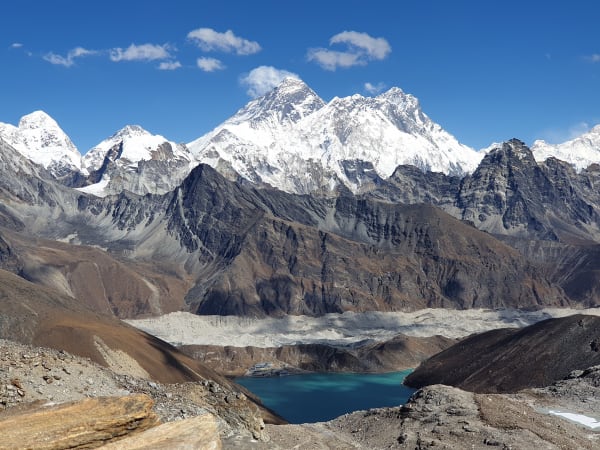
From Gokyo Ri at 5,357 m you get Everest, Lhotse, Makalu, and Cho Oyu in one panorama, with the lakes below. A good number of trekkers who have stood on both Gokyo Ri and Kala Patthar prefer this one, and the trail to it carries perhaps a quarter of the traffic.
The Trek at a Glance
| Duration | 12 days Kathmandu to Kathmandu, 10 days walking |
| Highest point | Gokyo Ri, 5,357 m |
| Highest night | Gokyo, 4,800 m |
| Difficulty | Moderate — similar to Everest Base Camp, slightly lower |
| Best seasons | Late September to November, March to mid May |
| Access | Flight to Lukla |
| Permits | Sagarmatha National Park and the Khumbu rural municipality fee |
| Accommodation | Teahouse lodges throughout |
Our 12-day Gokyo Lake Trek diverges from the Base Camp route above Namche, climbing the Dudh Koshi's western branch through Dole and Machhermo to Gokyo, with an acclimatisation day at Namche and the Gokyo Ri climb on arrival day.
The Lakes and the Glacier
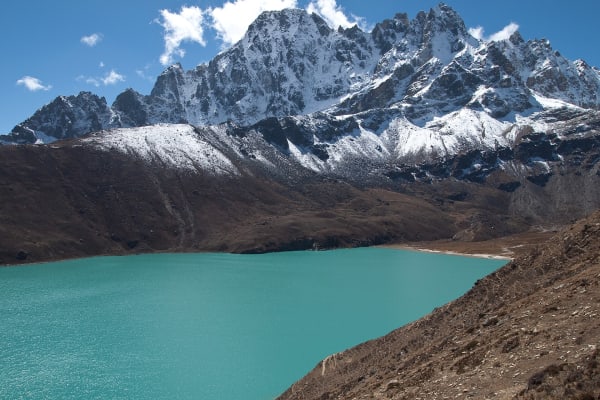
There are six main lakes in the Gokyo chain — Nepali numbering runs from the lowest upward — held in moraine dams beside the Ngozumpa glacier and fed by its meltwater. Their colour is genuinely startling: a saturated turquoise from suspended glacial flour, against grey moraine and brown hillside.
- First lake, Longpongo (4,690 m) — the first you reach, with mani stones on its shore.
- Second lake, Taboche Tsho (4,710 m) — the most photographed of the lower lakes.
- Third lake, Dudh Pokhari (4,750 m) — Gokyo village sits on its shore; this is where you stay.
- Fourth lake, Thonak Tsho (4,870 m) — a 90-minute walk north, and the usual side trip from Gokyo.
- Fifth lake, Ngozumba Tsho (4,980 m) — a further hour, with Scoundrel's Viewpoint above it giving an Everest view from the north-west.
- Sixth lake (5,000 m) — reached by strong walkers on a long day, and almost never busy.
The lakes are sacred to both Hindus and Buddhists, and pilgrims bathe in them at Janai Purnima in August. Do not swim, and keep soap and waste well away from the shore.
The Ngozumpa glacier beside them is around 36 km long and Nepal's largest. From the fourth and fifth lakes you look straight down onto its chaos of debris-covered ice and meltwater ponds — a better view of a Himalayan glacier system than anything on the Base Camp trail.
Gokyo Ri
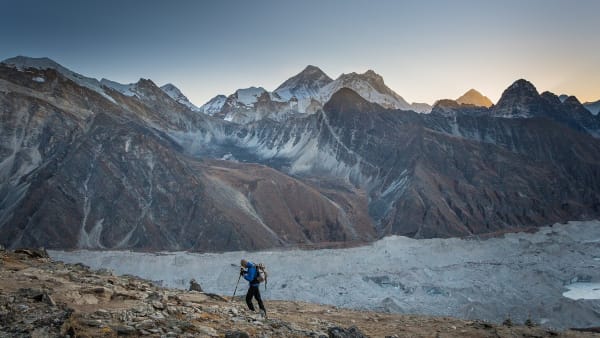
The climb is 550 m from the village, steep and unrelenting, taking two to three hours up. Most groups go at dawn or in the late afternoon. From the summit at 5,357 m:
- Four eight-thousanders — Everest, Lhotse, Makalu, and Cho Oyu, visible simultaneously. No other trekking viewpoint in Nepal offers that.
- The Ngozumpa glacier running south below you, and the lake chain strung along its eastern edge.
- Cholatse and Taboche across the valley, and the Gyachung Kang wall on the Tibet border.
Kala Patthar is closer to Everest and gives a more intimate view of the south-west face. Gokyo Ri is further back, which gives a wider, more composed panorama with the lakes and glacier in the foreground. If you want the mountain, go to Kala Patthar; if you want the Himalaya, come here. Our Kala Patthar comparison covers the other side.
Gokyo or Base Camp?
| Gokyo Lakes | Everest Base Camp | |
|---|---|---|
| Days | 12 | 14 |
| Highest point | 5,357 m | 5,545 m |
| Highest night | 4,800 m | 5,160 m |
| Trail traffic | Around a quarter of the Base Camp route | The busiest trail in Nepal |
| Best view | Four 8,000 m peaks plus lakes and glacier | Everest's south-west face from close range |
| The draw | Turquoise lakes, the Ngozumpa, solitude | Standing at the foot of the Icefall |
| Cost | Lower — shorter trek, same flights | Higher |
You do not strictly have to choose. The Base Camp with Gokyo and Cho La itinerary links both valleys over the 5,420 m Cho La in 17 days, and the Three Passes route adds Kongma La and Renjo La on top. Both are harder than either trek alone, and both are the best walking in the Khumbu.
Practicalities
- Lodges — good at Dole and Machhermo, and a handful at Gokyo itself, which fill in peak October. Your guide calls ahead.
- Cold — Gokyo at 4,800 m falls to -10 to -18 °C at night in the main seasons. A -20 °C sleeping bag is the right choice.
- Altitude — the gain from Machhermo to Gokyo is 930 m, the biggest jump of the trek, which is why the Namche acclimatisation day and the dawn climb of Gokyo Ri both matter.
- Machhermo has an HRA aid post staffed in season, which runs free afternoon altitude talks. Go to one.
- Water — treat everything. Do not draw water from the lakes, both for your sake and theirs.
- Insurance — cover to 6,000 m with helicopter evacuation, as for any Khumbu trek.
One route note: the direct crossing from Gokyo to the Base Camp trail over Cho La is a serious pass, not a shortcut. It involves a glacier crossing, can hold significant snow, and needs a guide who has been over it recently. It should be part of a planned itinerary rather than a decision made at Gokyo.