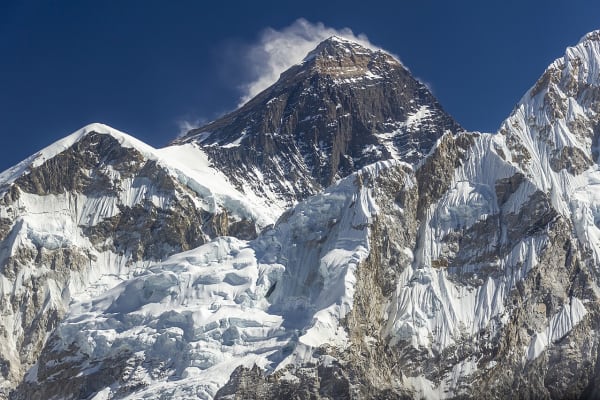
It surprises almost everyone: Everest is not visible from Everest Base Camp. The camp sits at 5,364 m directly beneath the Khumbu Icefall, where the west shoulder of Everest and the huge wall of Nuptse block the summit completely. What you see is ice, moraine, and the Icefall climbing away above you — magnificent, but not the mountain.
The view is from Kala Patthar, a rocky shoulder of Pumori at 5,545 m on the other side of the Khumbu glacier. From there the whole south-west face stands clear, from the Western Cwm to the summit pyramid. Any good itinerary, including ours, includes both — but they are genuinely different experiences.

The Two Compared
| Kala Patthar | Everest Base Camp | |
|---|---|---|
| Altitude | 5,545 m | 5,364 m |
| Everest visible | Yes — the full south-west face and summit | No — hidden by Nuptse and the west shoulder |
| From Gorak Shep | 400 m of steep climbing, 2–3 hours up | Undulating moraine, 2–3 hours each way |
| Ground underfoot | Steep but solid rock and scree path | Rough glacial moraine, rock and ice |
| Best time of day | Dawn or late afternoon for light on the summit | Mid-morning, once the sun is on the Icefall |
| What makes it special | The definitive Everest view and a 360° Khumbu panorama | Standing at the foot of the Icefall, and in spring the expedition camp |
| Hardest part | Relentless steepness at 5,400 m | Length, and the rough ground on the way back |
What You Actually See from Kala Patthar
Kala Patthar is the best viewpoint reachable on foot without a climbing permit in the Everest region, and it is an unusually complete panorama rather than a single mountain.
- Everest (8,848 m) — the whole south-west face, the Western Cwm, the South Col, and the summit pyramid with its permanent plume.
- Nuptse (7,861 m) — closest and most dominant, a wall of fluted ice directly across the glacier.
- Lhotse (8,516 m) — the fourth highest mountain in the world, just right of Everest.
- Pumori (7,161 m) — immediately above you; Kala Patthar is its lower shoulder.
- Changtse, Lingtren and Khumbutse — the Tibet border peaks at the head of the valley.
- The Khumbu glacier and Icefall — the whole system laid out below, with Base Camp visible as a scatter of colour in spring.
The climb is short in distance and hard in effect: 400 m of steady, steep ground at over 5,200 m, where you will stop every twenty or thirty steps. Most people take two to three hours up and an hour down.
What Base Camp Gives You Instead
Base Camp is not a viewpoint. It is a place, and its power is proximity. You walk across the glacier on rock and ice, the Icefall towers above, and the sound of the glacier shifting and seracs collapsing in the distance is constant. In spring you arrive at a working expedition city — several hundred tents, climbers on rotation through the Icefall, helicopters ferrying loads, and the Icefall doctors' fixed route visible above.
For many trekkers it is the emotional end of the journey in a way Kala Patthar is not: this is where the Everest story happens, and you have walked here from a 2,860 m airstrip in ten days. Whether you prefer it to the view from Kala Patthar is personal, and our guests split roughly evenly.
A practical note: you cannot stay at Base Camp, and you cannot enter the expedition camp area. Trekkers reach the marker at the edge of the camp, spend half an hour or so, and walk back.
How Itineraries Sequence Them
Our 14-day itinerary does both from Gorak Shep over two days:
- Day 9 — walk from Lobuche to Gorak Shep in the morning, then climb Kala Patthar in the afternoon for the light on the summit from the west.
- Day 10 — an early start across the moraine to Base Camp, back to Gorak Shep, then descend to Pheriche.
Some groups invert it, climbing Kala Patthar at dawn on day 10 and visiting Base Camp afterwards. Your guide decides on the forecast: if tomorrow's dawn looks clear, wait; if cloud is building, go this afternoon. Either way, both are in the plan.
One thing to resist: trying to do both on the same day. It is around 12 hours of effort above 5,100 m, and the second half is done on empty.
If You Can Only Do One
It happens — a bad night, a headache, a weather day, or simply legs that are finished. The honest advice:
- If you came for the view of Everest: choose Kala Patthar. It is the only place on the trek where you see the mountain properly.
- If you came for the experience of being there: choose Base Camp. Standing under the Icefall is irreplaceable, and in spring the camp is extraordinary.
- If you are unwell: choose neither, and descend. Both are above 5,300 m. Nothing you will see is worth pushing through altitude symptoms for, and both will still be there next time.
For the record, if our guides had to pick one, most would say Kala Patthar at dawn — and then add that the half hour at Base Camp is the part the guests talk about afterwards. Our day-by-day itinerary explains how both fit into the week.