

Lower Mustang Trek From Pokhara
The Lower Mustang Trek From Pokhara covers the whole of accessible Mustang in seven days without a single Kathmandu day.
Porter
$231 $210/porter
No payment required yet
Trip Overview
The Lower Mustang Trek From Pokhara covers the whole of accessible Mustang in seven days without a single Kathmandu day. A short mountain flight over the Himalayan crest lands at Jomsom (2,700 m), and from the moment you step off the aircraft the landscape is different from anything else in Nepal — ochre cliffs, wide gravel river flats, whitewashed flat-roofed villages, and a horizon of bare Tibetan hills.
The route takes in the walled medieval village of Kagbeni, a full exploration day at the sacred temple complex of Muktinath (3,800 m), and a night in Marpha (2,640 m), the beautifully kept Thakali village famous for its apple orchards and flagstone streets. A free day back in Pokhara rounds off the trip, making this an efficient and unusually comfortable week in the Himalaya.
Trip Highlights
Seven Days from Pokhara: A complete Mustang trek with return mountain flights and no Kathmandu transfer days.
A Full Day at Muktinath (3,800 m): Explore the 108 water spouts, the eternal flame, and the temple complex at an unhurried pace.
Marpha, the Apple Village: Sleep in a preserved Thakali village of flagstone streets, whitewashed houses, and orchards.
Medieval Kagbeni: Walk the mud-brick alleys of the walled village at the gateway to Upper Mustang.
The Deepest Gorge on Earth: Trek the Kali Gandaki between Dhaulagiri (8,167 m) and Annapurna I (8,091 m).
Itinerary
A 7-day Pokhara-to-Pokhara trek with return Jomsom flights, taking in Kagbeni, a full day at Muktinath, Marpha, and a free day in Pokhara.
1Day 1Fly from Pokhara (822 m) to Jomsom (2,700 m) and Trek to Kagbeni (2,800 m)
Fly from Pokhara (822 m) to Jomsom (2,700 m) and Trek to Kagbeni (2,800 m)
This version skips the Kathmandu travel days entirely and begins with a dawn flight from Pokhara. The early departure is not optional: the wind funnelling up the Kali Gandaki closes the Jomsom airstrip by mid-morning nearly every day of the year.
The 20-minute flight is one of the most spectacular anywhere — the aircraft flies straight up the world's deepest gorge, between Dhaulagiri (8,167 m) and Annapurna I (8,091 m), with both eight-thousanders filling the windows on either side.
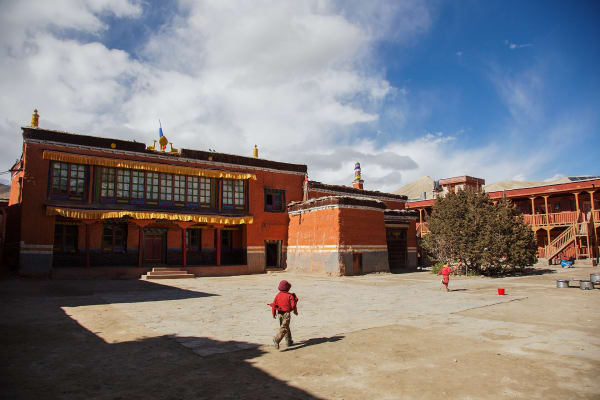
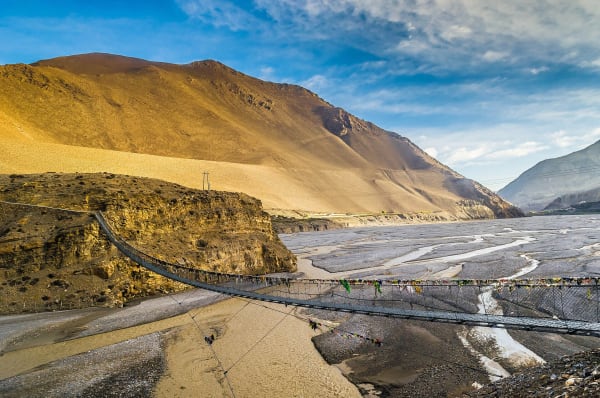
You land at Jomsom (2,700 m) in the Himalayan rain shadow — bare brown hills, a vast gravel riverbed, and hardly a tree. After breakfast we walk north for about three hours on level ground beside the river to Kagbeni (2,800 m), a medieval village of mud-brick houses, tunnelled alleyways and a red-walled monastery at the gateway to Upper Mustang. Overnight in Kagbeni.
2Day 2Trek from Kagbeni (2,800 m) to Muktinath (3,800 m)
Trek from Kagbeni (2,800 m) to Muktinath (3,800 m)
The one substantial climbing day — a full kilometre of ascent out of the main valley into the Jhong Khola.
The trail leaves Kagbeni heading east and climbs steadily through wind-carved, almost lunar terrain. It passes through Khingar and then Jharkot (3,550 m), which is worth a proper stop: a ruined fort on a bluff, a red-walled Sakya monastery, and apple and apricot orchards that make an extraordinary splash of green in an otherwise bare landscape.
A final climb brings you to Muktinath (3,800 m) in the afternoon. The Thorong La (5,416 m) descends into the village from the north — this is where Annapurna Circuit trekkers finish their pass crossing, and you will usually meet a few of them looking suitably wrung out. The evening view south to Dhaulagiri and Nilgiri is superb. Overnight in Muktinath.
3Day 3Exploration and Visit of Muktinath (3,800 m)
Exploration and Visit of Muktinath (3,800 m)
A full day at a site sacred to two religions. To Hindus this is Mukti Kshetra, the place of liberation, one of the 108 Divya Desams of Vishnu and one of the most important pilgrimage destinations in the Himalaya; to Buddhists it is Chumig Gyatsa, the hundred waters, linked to Guru Rinpoche.
The temple stands in a poplar grove. Behind it, spring water is channelled through 108 bull-headed spouts set into a curved wall, and pilgrims bathe under every one in turn — a serious undertaking at 3,800 m before sunrise. Close by, the Jwala Mai temple shelters a natural gas flame that burns over running spring water: fire and water together, which is why the site is understood as the meeting point of all five elements.
The rest of the day is unstructured — the Buddhist gompa, the surrounding villages, or the ridge walk behind the settlement for the wide view. Overnight in Muktinath.
4Day 4Trek from Muktinath (3,800 m) to Marpha (2,670 m)
Trek from Muktinath (3,800 m) to Marpha (2,670 m)
A long descent back to the main valley. The trail drops from Muktinath through Jharkot and Khingar and down the Jhong Khola to rejoin the Kali Gandaki near Ekle Bhatti.
Turning south, the walk puts the famous valley wind squarely in your face, and by early afternoon it takes real effort — a buff or scarf against the grit is worth having. As you go, watch the gravel of the riverbed for shaligrams: black spiral ammonite fossils, marine animals from the Tethys Sea that lay here before the Himalaya rose, and revered by Hindus as forms of Vishnu.
The day ends at Marpha (2,670 m), the prettiest village in the valley — whitewashed flat-roofed houses along paved lanes, a gompa on the hill above, and orchards on every side. Marpha apples, and Marpha apple brandy, are known across Nepal. Overnight in Marpha.
5Day 5Trek from Marpha (2,670 m) to Jomsom (2,700 m)
Trek from Marpha (2,670 m) to Jomsom (2,700 m)
A short, easy walk of roughly two hours, best started early before the wind builds.
The trail runs north along the Kali Gandaki through orchards and pine, passing Syang and other Thakali villages. The Thakali people of this valley gave Nepal its most celebrated version of dal bhat, and if you get the chance to eat one here, take it.
Reaching Jomsom (2,700 m) before midday leaves a free afternoon. The Mustang Eco Museum is genuinely worth an hour on Thakali culture, Tibetan medicine and the region's geology, and there is a short climb to the viewpoint above town for a final look at Nilgiri and Dhaulagiri. Overnight in Jomsom.
6Day 6Fly from Jomsom (2,700 m) to Pokhara (822 m)
Fly from Jomsom (2,700 m) to Pokhara (822 m)
An early flight again — Jomsom's wind window is a morning one, so departures go at first light.
The 20-minute flight runs back down the gorge between Dhaulagiri and Annapurna, and the change of world visible from the window is remarkable: within a few minutes the brown high desert gives way to the green, terraced, humid hills around Pokhara (822 m).
You transfer to your hotel with the whole day free — a hot shower, lunch by the lake, and an afternoon doing very little. Pokhara is a good place to be at the end of a trek: the lakeside is full of cafés, and the Annapurna skyline you have just flown through stands above the far shore. Overnight in Pokhara.
7Day 7Free Day in Pokhara (822 m)
Free Day in Pokhara (822 m)
A deliberate buffer day, and a genuinely useful one. Jomsom flights are entirely weather-dependent and cancellations are common, so this day exists to absorb a delay without threatening your onward travel. If yesterday's flight went as planned, it is simply a free day in one of the pleasantest towns in Nepal.
There is plenty to fill it. Phewa Lake can be crossed by rowing boat to the Tal Barahi temple on its island, and from the far shore a footpath climbs to the World Peace Pagoda for a panorama over the lake to the Annapurnas. Sarangkot is the classic sunrise viewpoint, and one of the best paragliding sites in the world if that appeals.
Closer in, the International Mountain Museum covers Himalayan climbing history and the peoples of the range, and Devi's Falls and the Gupteshwor Cave sit opposite each other on the south side of town. Overnight in Pokhara.
Inclusions & Exclusions
Return Pokhara-Jomsom flights, Pokhara accommodation, teahouse lodging, all trekking meals, conservation area permits, a licensed guide, trekking map, first aid, and government taxes are included, while international flights, visa, insurance, personal gear, porter service, city meals, personal expenses, and tips are excluded.
What's Included
Domestic flights from Pokhara to Jomsom and Jomsom to Pokhara as per the itinerary.
Accommodation in local teahouses during the trek.
Annapurna Conservation Area Permit (ACAP) and required trekking permits.
Professional English-speaking licensed trekking guide.
Three meals a day (breakfast, lunch, and dinner) during the trek.
Group trekking map for route guidance.
First aid kit carried by the guide.
All government taxes, permit fees, and service charges.
What's Excluded
Travel insurance, including emergency helicopter evacuation coverage.
Personal trekking equipment and clothing.
Porter services (available at an additional cost).
Lunch and dinner in Pokhara.
Snacks, bottled water, hot showers, Wi-Fi, charging fees, and alcoholic or soft drinks.
Personal expenses such as laundry, phone calls, and souvenirs.
Tips for guides, drivers, and support staff.
Any additional accommodation, transportation, or expenses caused by domestic flight delays, bad weather, or other unforeseen circumstances beyond the itinerary.
Route Map
Explore the terrain map showing the trek route.
Loading map...
Altitude Profile
Pricing
Transparent per-person pricing based on group size, covering the services listed in the itinerary with no hidden charges.
Add-ons
Customize your trek with optional services such as porter support and other personalized arrangements at an additional cost.
Best Time to Trek
Because Mustang lies in the Annapurna rain shadow, the season here is longer than almost anywhere else in Nepal. March to May and September to November are the classic windows, with clear skies and the most reliable flights. Late September and October coincide with the Marpha apple harvest, which is a genuinely good reason to time the trip then.
The route is also walkable during the monsoon (June to August), since the mountains block most of the rain, although flights are more often cancelled by cloud on the Pokhara side. Winter is cold, windy, and very quiet but perfectly feasible. In every season, expect strong up-valley wind from late morning — it is the defining characteristic of the Kali Gandaki.
For a month-by-month look at weather and trail conditions, see our guide to the best time to trek in Nepal.
Trek Difficulty & Who This Suits
This is an easy to moderate trek, one of the most accessible genuine Himalayan itineraries in Nepal. Five walking days of three to six hours each, road-accessible lodges of unusually good quality, and a maximum altitude of 3,800 m mean it works well for first-time trekkers, families, older travellers in good health, and pilgrims of any walking background.
The main thing to plan for is wind rather than terrain — the afternoon gale carries dust and makes walking unpleasant, so days start early and finish by early afternoon. The trail is largely gentle river flats with one sustained climb to Muktinath. A month of regular walking is enough preparation for most people.
To see where this trek sits among Nepal's routes, read our guide to Nepal trek difficulty grades.
Travel Insurance
Travel insurance covering trekking to at least 4,500 m is required, comfortably above the Muktinath high point of 3,800 m. Read the altitude clause explicitly, and confirm that travel on small domestic aircraft is covered — the Pokhara-Jomsom sector uses turboprops landing on a short mountain airstrip and some policies exclude it.
Cover for emergency helicopter evacuation, medical treatment, and delayed or cancelled domestic flights is essential on this itinerary, which is built around two flights in seven days. Jomsom flights are regularly grounded by wind and cloud, and the alternative is a full-day jeep journey. Send us your policy number and the insurer's emergency contact before departure.
Our guide to travel insurance for trekking in Nepal explains the altitude limits, evacuation terms and common exclusions to check before you buy.
Packing List
Wind, sun, and dry air shape the list here. Bring waterproof trekking boots, two or three base layers, a fleece, a light down jacket for Muktinath, and a genuine windproof shell jacket and trousers, which will see more use on this trek than anywhere else in Nepal. Add trekking trousers, a warm hat, a sun hat that will not blow away, gloves, and wool socks. A sleeping bag rated to -5°C is sufficient.
Sun and dust protection matter as much as insulation: high-SPF sunscreen, lip balm, wraparound sunglasses, and a buff for blowing dust. Also pack a 25-litre daypack, trekking poles, a headlamp, a reusable bottle with purification tablets or a filter, moisturiser for the dry air, a small first aid kit, quick-dry towel, toiletries, and a power bank. The Jomsom flight limits checked baggage to roughly 15 kg.
For the complete kit list, organised by the altitude you will reach, see our Nepal trekking packing list.
Accommodation, Food & Drinking Water
The five trek nights are spent in teahouses at Kagbeni, Muktinath, Marpha, and Jomsom. The trip begins and ends in Pokhara, and your hotel there is not included — this itinerary is sold to travellers already in the city, so the Pokhara nights are yours to arrange. Lodges in the Kali Gandaki benefit from road access and mains electricity and are among the most comfortable in Nepal — twin rooms, many with attached bathrooms, dependable hot showers, and heated dining rooms. Marpha has several characterful lodges in converted Thakali houses.
Three meals a day are included on the trek. The food here is a highlight rather than a necessity: the classic Thakali khana set is widely regarded as the best regional cooking in Nepal, and menus also cover Tibetan bread, momos, thukpa, noodles, fried rice, and pasta, with apple dishes throughout the valley. Refill your bottle at the lodges and treat it with tablets, a filter, or a UV pen; the dry air means you will drink far more than usual.
What the lodges are really like, from rooms and meals to showers and charging, is covered in our guide to teahouse trekking in Nepal.
Frequently Asked Questions
Find quick answers to common questions about the Lower Mustang Trek From Pokhara.
1Is there a baggage limit on the flight?
Yes, typically around 15 kg checked plus a small carry-on, and it is enforced. Leave anything you do not need at your Pokhara hotel, which stores luggage free of charge.
2How many hours do we walk each day?
Three to six hours. The Jomsom to Kagbeni leg is around three hours, Kagbeni to Muktinath four to five with a steady climb, Muktinath to Marpha five to six hours of mostly descent, and Marpha to Jomsom a gentle two to three hours.
3Which permits are required and do you arrange them?
The Annapurna Conservation Area Permit and trekking registration are included and arranged by our team from passport copies and photographs sent before departure. Travelling north of Kagbeni into Upper Mustang requires a separate restricted-area permit not covered here.
4What is the difference between Lower and Upper Mustang?
Lower Mustang, south of Kagbeni, is open to all trekkers on a standard conservation permit. Upper Mustang, running north toward Lo Manthang, is restricted and requires an expensive special permit, a licensed guide, and a minimum group size. This trek covers the accessible lower half.
5What happens if the Jomsom flight is cancelled?
Flights operate only in the early morning and are frequently grounded by wind or cloud. If yours is cancelled, the alternative is a jeep journey taking most of a day. Keeping a spare day at each end of your travel plans is strongly recommended.
6Why is the wind so strong here?
The Kali Gandaki channels air between Dhaulagiri and Annapurna, creating a powerful up-valley wind that starts mid-morning and blows through the afternoon. It is why the walking day begins early and why flights only run in the morning.
7Is this trek suitable for families and older travellers?
Yes, it is one of the best options in Nepal for both. Short walking days, comfortable lodges, road access along most of the route for emergencies, and a moderate maximum altitude make it forgiving without feeling like a soft option.
8Is mobile network and Wi-Fi available?
Yes, and better than on almost any other trek. The valley has mains electricity and good coverage throughout, and lodges in Jomsom, Kagbeni, Muktinath, and Marpha sell Wi-Fi at usable speeds.
9Where can I withdraw cash and charge devices?
There is a reasonably reliable ATM in Jomsom, and charging is available at every lodge from mains power, often free. Carry Nepalese rupees from Pokhara regardless, as village shops take cash only.
10What is there to do on the free day in Pokhara?
Plenty — boating on Phewa Lake, the World Peace Pagoda, Sarangkot for sunrise, the International Mountain Museum, or simply resting by the lakeside. Your guide can suggest options and arrange transport, though activities on that day are not included in the package.
Gallery
Explore authentic moments, landscapes, and mountain views from the Lower Mustang Trek From Pokhara.
Trekking Guides & Articles
Lower Mustang Trek: The Complete Guide — Ten days in the accessible half of Mustang — the walled medieval village of Kagbeni, a full day at the Muktinath temple complex, and the Thakali apple village of Marpha.
Fix Departure
This trek runs every week on the selected day. Choose custom dates for one-off departures.
Showing fixed departures in Oct 2026
Guest Reviews
We loved every moment
“From our first enquiry to the drive home, Lower Mustang Trek From Pokhara was brilliantly organised. The whole team looked after us brilliantly — nothing was ever too much trouble. The itinerary was w...
Gabriel Miller
Get in Touch
Tell us the dates you have in mind and roughly what you want out of the trek — one of our guides will reply, usually within 24 hours.
Email Us
info@greencompasstreks.com
Call Us
+977 9864379436
Office
Lakeside, Pokhara, Nepal
Office Hours
Sunday – Friday, 9:00 AM – 9:00 PM
Similar Treks
You might also like these treks
Porter
$231 $210/porter
No payment required yet