

Khopra Danda Trek From Pokhara
The Khopra Danda Trek From Pokhara delivers the full Khopra ridge experience in nine days by starting and finishing dire
Porter
$347 $315/porter
No payment required yet
Trip Overview
The Khopra Danda Trek From Pokhara delivers the full Khopra ridge experience in nine days by starting and finishing directly in Pokhara, with no Kathmandu transfer days. From Nayapul the trail climbs to the Gurung village of Ghandruk, continues through Tadapani and Dobato to the Muldai viewpoint, then follows the quiet community trail via Chistibung to Khopra Danda (4,020 m).
The ridge lodge faces Dhaulagiri, Annapurna South, and Nilgiri across the Kali Gandaki gorge, and from it a long day hike reaches the sacred glacial Khayer Lake (4,827 m). The return drops through the farming village of Swanta to Ghorepani for a sunrise at Poon Hill before descending to Birethanti. It is the most efficient version of this route for travellers already in Pokhara who want high-ridge views without the crowds of the standard circuit.
Trip Highlights
Nine Days, Pokhara to Pokhara: Skip the Kathmandu transfers entirely and spend every day of the trip on the trail.
Khopra Ridge at 4,020 m: Sleep on an open ridge with Dhaulagiri, Annapurna South, and Nilgiri filling the horizon.
Sacred Khayer Lake (4,827 m): Hike to a glacial pilgrimage lake set beneath the south face of Annapurna, the trek's highest point.
Two Sunrise Viewpoints: Watch dawn from the Muldai viewpoint (3,637 m) and from Poon Hill (3,210 m) on the same trek.
Gurung and Magar Villages: Pass through Ghandruk, Swanta, and Chistibung, where community lodges return income directly to local families.
Itinerary
A 9-day Pokhara-to-Pokhara trek to Khopra Danda (4,020 m) via Ghandruk, Dobato, and Muldai, with the Khayer Lake hike and a Poon Hill sunrise.
1Day 1Drive from Pokhara (822 m) to Nayapul (1,070 m) and Trek to Ghandruk (1,940 m)
Drive from Pokhara (822 m) to Nayapul (1,070 m) and Trek to Ghandruk (1,940 m)
The trek opens with a drive of around an hour and a half from Pokhara to Nayapul (1,070 m), the traditional roadhead for the southern Annapurna trails.
From Nayapul the trail follows the Modi Khola upstream through Birethanti, a pleasant riverside village with a checkpoint where permits are registered. The walking begins gently along the river before turning uphill.
The climb to Ghandruk is a steady ascent on stone staircases through terraced farmland — rice and millet in the lower fields, worked by hand — with scattered houses and small teashops along the way.
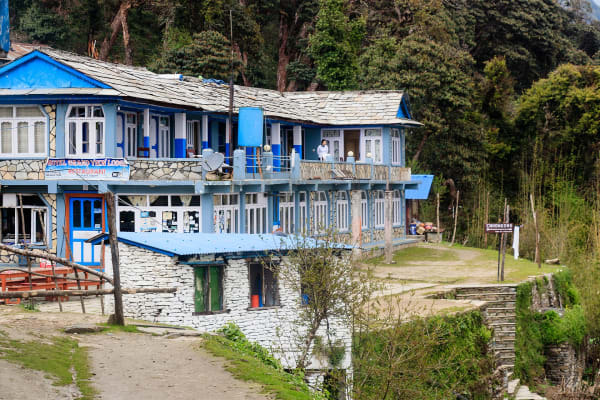
Ghandruk (1,940 m) is one of the largest and best-preserved Gurung villages in Nepal: slate-roofed stone houses stacked in tiers, paved lanes and stone staircases, and a strong Gurkha soldiering tradition. From the upper village, Annapurna South, Hiunchuli and Machhapuchhre stand directly above. Around 4–5 hours of walking. Overnight in Ghandruk.
2Day 2Trek from Ghandruk (1,940 m) to Tadapani (2,630 m)
Trek from Ghandruk (1,940 m) to Tadapani (2,630 m)
A climb of around 690 m through some of the finest forest in the Annapurna foothills.
The trail leaves Ghandruk by stone staircase through the upper village and climbs steadily into thick rhododendron and oak forest. This is classic middle-hill woodland — moss-hung, damp and shaded, with the trees closing overhead for much of the way.
In spring, from roughly late March through April, this section is the reason many people come: the rhododendrons flower red, pink and white right across the hillside, and the forest floor is carpeted with fallen blooms. In autumn the appeal is clearer air and better mountain visibility.
The forest is good for wildlife — langur monkeys are common in the canopy, and the birdlife includes pheasants and the Himalayan monal, Nepal's national bird.
Tadapani (2,630 m) means "far water", and sits in a clearing with an open view of Annapurna South and Machhapuchhre. Around 4–5 hours. Overnight in Tadapani.
3Day 3Trek from Tadapani (2,630 m) to Dobato (3,350 m)
Trek from Tadapani (2,630 m) to Dobato (3,350 m)
The day the trek leaves the busy trails behind and turns onto the quiet Khopra route.
Most trekkers at Tadapani head west to Ghorepani or south to Ghandruk. You instead climb north on a far less frequented path, and the change in traffic is immediate — from a busy circuit to a trail where you may see only a handful of other people all day.
The route climbs steadily through rhododendron forest, which thins as you gain height, opening onto grassy clearings and meadows. Above around 3,000 m the trees become stunted and gnarled, and the views begin to open in earnest across the valleys toward the Annapurna wall.
This is a substantial climb of around 720 m, and the first day on which altitude begins to be a consideration. Keep the pace steady.
Dobato (3,350 m) is a small, basic collection of lodges on a ridge, positioned for the Muldai sunrise hike. Around 5–6 hours. Overnight in Dobato.
4Day 4Sunrise Hike to Muldai Viewpoint (3,637 m) and Trek to Chistibung (3,000 m)
Sunrise Hike to Muldai Viewpoint (3,637 m) and Trek to Chistibung (3,000 m)
An early start for one of the best viewpoints in the region, followed by a descent into the next valley.
You leave Dobato in the dark for the climb of around 290 m to Muldai Viewpoint (3,637 m), roughly an hour uphill. It is cold and steep, but the payoff is exceptional and — unlike Poon Hill — you are likely to have it almost to yourself.
The panorama from the top is a full sweep of the Himalaya: Dhaulagiri (8,167 m) to the west, then Annapurna South, Hiunchuli, Annapurna I, Machhapuchhre and the Manaslu range far to the east. The light comes up behind the peaks and works west along the range.
After returning to Dobato for breakfast, the trail descends north-west through rhododendron forest and open hillside into a quieter valley.
Chistibung (3,000 m) is a small herders' settlement in a meadow. Around 5–6 hours in total. Overnight in Chistibung.
5Day 5Trek from Chistibung (3,000 m) to Khopra Danda (4,020 m)
Trek from Chistibung (3,000 m) to Khopra Danda (4,020 m)
A serious climbing day of over 1,000 m onto the ridge that gives the trek its name.
The trail leaves Chistibung and climbs steadily, leaving the last of the forest behind within the first couple of hours. Above the treeline the landscape becomes open alpine pasture — grass, low scrub and rock, grazed by sheep and goats in summer — with the views expanding continuously as you gain height.
The final section follows the ridge itself, exposed and often windy, with the ground falling away steeply on both sides.
Khopra Danda (4,020 m) is one of the great viewpoints of the Annapurna region and the reason for the whole route. The Kali Gandaki gorge drops away directly below the ridge, and across it Dhaulagiri (8,167 m) rises in a single uninterrupted sweep. To the east are Annapurna South, Fang, Annapurna I and Nilgiri.
The community-run lodge sits right on the ridge. Around 5–6 hours. Overnight at Khopra Danda.
6Day 6Hike from Khopra Danda (4,020 m) to Khayer Lake (4,827 m) and Back to Khopra Danda (4,020 m)
Hike from Khopra Danda (4,020 m) to Khayer Lake (4,827 m) and Back to Khopra Danda (4,020 m)
The highest and hardest day of the trek: a long return hike to the sacred lake at 4,827 m.
You start before dawn with a light pack. The trail climbs from the ridge into a high alpine basin, gaining more than 800 m over rough ground — grass at first, then scree, boulder fields and, often, snow. There is no shelter and no water on the route, and at this altitude the pace is necessarily slow. It typically takes four to five hours up.
Khayer Lake (Khayer Barah) sits in a bowl directly beneath Annapurna South, with the mountain wall rising immediately behind it. It is a sacred site: Hindu pilgrims come here during the Janai Purnima festival in August, and there is a small shrine on the shore.
The lake is frozen for much of the year and the surroundings are entirely barren.
Return by the same route. A long day of 8–9 hours. Overnight at Khopra Danda.
7Day 7Trek from Khopra Danda (4,020 m) to Swanta Village (2,270 m)
Trek from Khopra Danda (4,020 m) to Swanta Village (2,270 m)
A long descent of around 1,750 m off the ridge and back into farmed, inhabited country.
The trail drops steeply from Khopra Danda, losing the alpine terrain quickly. Within a couple of hours you are back among rhododendron and juniper, and below that the forest thickens into oak and mixed broadleaf. The descent is sustained and hard on the knees — poles are worth using.
As you lose height the temperature climbs noticeably, and after two nights above 4,000 m the thicker air is a distinct relief.
Swanta (2,270 m) is a small farming village of stone houses set among terraced fields, and it is one of the highlights of the trek for reasons that have nothing to do with mountains. It is a genuine working village with very few visitors, known locally for its cheese factory and its apple and vegetable production, and the community-run lodges here channel income directly back into the village.
Around 6 hours. Overnight in Swanta.
8Day 8Trek from Swanta Village (2,270 m) to Ghorepani (2,860 m)
Trek from Swanta Village (2,270 m) to Ghorepani (2,860 m)
A moderate day climbing around 590 m to rejoin the main Poon Hill circuit.
The trail leaves Swanta and descends briefly to cross a river before beginning the climb toward Ghorepani. The route passes through terraced fields, small settlements and patches of forest, following paths used daily by local people between villages.
Partway along you reach Chitre, where the trail joins the main Ghorepani–Poon Hill route. The contrast is immediate: after four days on trails where you met almost nobody, you are back on one of the busiest circuits in Nepal, with lodges, shops and a steady flow of trekkers.
The final section climbs through rhododendron forest to Ghorepani (2,860 m), a substantial village of lodges strung along a ridge at the head of the valley. The name means "horse water" — it was a watering stop on the old trading route to Tibet.
Around 5 hours. Overnight in Ghorepani.
9Day 9Sunrise at Poon Hill (3,210 m), Trek to Birethanti (1,025 m) and Drive to Pokhara (822 m)
Sunrise at Poon Hill (3,210 m), Trek to Birethanti (1,025 m) and Drive to Pokhara (822 m)
A final sunrise, a long descent, and the drive back to Pokhara.
You leave Ghorepani around 4:30 a.m. for the climb of roughly 350 m to Poon Hill (3,210 m), about an hour on a well-made staircase trail. It is the most popular viewpoint in Nepal and you will not be alone, but the panorama justifies it: Dhaulagiri (8,167 m), Annapurna South, Hiunchuli, Annapurna I, Machhapuchhre and Nilgiri lit in sequence as the sun rises.
After returning to Ghorepani for breakfast, the trail descends the long stone staircase through Ulleri — several thousand steps, and famously punishing on the way down — into warmer, greener country of terraced fields and villages.
From Birethanti (1,025 m) on the Modi Khola, a vehicle takes you back to Pokhara (822 m), arriving in the afternoon. Around 6 hours of walking. Overnight in Pokhara.
Inclusions & Exclusions
Private transport to and from the trailheads, teahouse and community lodge stays, all trekking meals, conservation area permits, a licensed guide, trekking map, first aid, and government taxes are included, while international flights, visa, insurance, personal gear, porter service, city accommodation and meals, personal expenses, and tips are excluded.
What's Included
Private transportation from Pokhara to Nayapul and from Birethanti back to Pokhara as per the itinerary.
Accommodation in local teahouses during the trek.
Annapurna Conservation Area Permit (ACAP) and required trekking permits.
Professional English-speaking licensed trekking guide.
Three meals a day (breakfast, lunch, and dinner) during the trek.
Group trekking map for route guidance.
First aid kit carried by the guide.
All government taxes, permit fees, and service charges.
What's Excluded
Travel insurance, including emergency helicopter evacuation coverage.
Personal trekking equipment and clothing.
Porter services (available at an additional cost).
Accommodation and meals in Kathmandu or Pokhara unless mentioned in the itinerary.
Snacks, bottled water, hot showers, Wi-Fi, charging fees, and alcoholic or soft drinks.
Personal expenses such as laundry, phone calls, and souvenirs.
Tips for guides, drivers, and support staff.
Any additional accommodation, transportation, or expenses caused by unforeseen circumstances beyond the itinerary.
Route Map
Explore the terrain map showing the trek route.
Loading map...
Altitude Profile
Pricing
Transparent per-person pricing based on group size, covering the services listed in the itinerary with no hidden charges.
Add-ons
Customize your trek with optional services such as porter support and other personalized arrangements at an additional cost.
Best Time to Trek
March to May and October to November are the seasons to aim for. Autumn is the sharpest for views — and since this trek exists for its views, that matters. The air after the monsoon is exceptionally clear and Dhaulagiri stands out across the gorge in a way it rarely does at other times of year.
Spring is warmer, with rhododendron flowering through the forest between Ghandruk and Dobato, though afternoon haze builds as the season progresses. Winter is quiet and clear but often blocks the Khayer Lake hike with snow, and the monsoon brings cloud, leeches below Tadapani, and slippery ground on the steep descent to Swanta.
For a month-by-month look at weather and trail conditions, see our guide to the best time to trek in Nepal.
Trek Difficulty & Fitness
This is a moderate trek with a demanding optional day. Nine consecutive walking days with no rest day means the cumulative load is higher than the daily distances suggest, and the climb from Chistibung to Khopra Danda gains more than 1,000 m in a single push. The Khayer Lake hike is the hardest day by a wide margin — eight to ten hours with 800 m of ascent starting above 4,000 m.
Be ready to walk five to seven hours a day on consecutive days, much of it on stone staircases that are hard on the knees going down. Six to eight weeks of hill walking with a loaded daypack, plus general cardiovascular training, is sensible preparation. Trekking poles make a substantial difference on the Swanta and Ulleri descents.
To build that fitness step by step, follow our 12-week training plan for a Nepal trek.
Altitude & Acclimatization
The route gains altitude gradually across the first five days — Ghandruk at 1,960 m, Tadapani at 2,610 m, Dobato at 3,350 m, Chistibung at 3,000 m, and finally Khopra Danda at 4,020 m — which gives the body a reasonable profile to work with. The night at Chistibung, slightly lower than Dobato, is a useful sleep-low step before the big climb.
The one point of caution is the Khayer Lake day, which takes you to 4,827 m from a base of 4,020 m in a single push. That is a significant gain, and it is entirely reasonable to turn back partway or skip it. Your guide checks the group each evening for headache, poor sleep, and appetite loss, and will advise against the lake hike if anyone is not adapting well. Drink at least three litres a day and keep your pace conversational on the climb from Chistibung.
Prevention, symptoms and treatment are covered in depth in our guide to altitude sickness in Nepal.
Packing List
Pack for a warm forest walk at 2,000 m and a cold, windy ridge at 4,000 m. Bring waterproof trekking boots, three base layers, a fleece, an insulated down jacket, a windproof and waterproof shell jacket and trousers, trekking trousers, a warm hat, sun hat, gloves, and wool socks. A sleeping bag rated to -10°C is right for the Khopra dormitory, which is unheated overnight.
You will also want a 30-litre daypack, trekking poles, a headlamp with spare batteries for the pre-dawn Muldai and Poon Hill starts, high-SPF sunscreen and lip balm, sunglasses, a reusable bottle with purification tablets or a filter, a personal first aid kit with blister care, quick-dry towel, toiletries, and a power bank, since charging at the community lodges is solar-only and limited.
For the complete kit list, organised by the altitude you will reach, see our Nepal trekking packing list.
Accommodation, Food & Drinking Water
All nine nights are spent in teahouses. Ghandruk, Tadapani, and Ghorepani have established commercial lodges with private twin rooms, hot showers, and broad menus. Dobato, Chistibung, and Khopra Danda are community-managed — simpler buildings with shared or dormitory rooms, basic bathrooms, and dining rooms heated only in the evening, but run to a good standard and directly funded by the villages that maintain the trail.
Three meals a day are included on the trek. Menus on the community section are shorter and built around dal bhat, noodle soup, fried rice, eggs, chapati, and porridge, much of it grown in Swanta and Chistibung. Let us know about vegetarian, vegan, or allergy needs in advance so the lodges can prepare. Water comes from spring-fed taps and must be treated with tablets, a filter, or a UV pen — bottled water is discouraged across the conservation area and simply is not sold on the ridge.
What the lodges are really like, from rooms and meals to showers and charging, is covered in our guide to teahouse trekking in Nepal.
Frequently Asked Questions
Find quick answers to common questions about the Khopra Danda Trek From Pokhara.
1How many hours do we walk each day?
Four to six hours on most days. The climb from Chistibung to Khopra Danda takes around five hours with over 1,000 m of ascent, and the optional Khayer Lake round trip runs eight to ten hours, making it the longest day of the trek.
2Do I have to do the Khayer Lake hike?
No. It is entirely optional and you can rest at the Khopra lodge instead. Snow often closes it between December and March, and deciding on the morning based on conditions and how you feel is normal and expected.
3Which permits are required and do you arrange them?
The Annapurna Conservation Area Permit and trekking registration are both included and arranged by our team. We need passport copies and passport-sized photographs from you before departure.
4Is this trek suitable for a first Himalayan trip?
Yes, for reasonably fit first-timers. The trail is well marked, teahouses are frequent, and the maximum sleeping altitude of 4,020 m is manageable for most people. The Khayer Lake hike is the one section better suited to those with previous altitude experience.
5Is mobile network and Wi-Fi available?
Coverage is reasonable at Ghandruk, Tadapani, and Ghorepani and intermittent on the ridge. The community lodges have limited or no Wi-Fi, so expect to be largely offline between Dobato and Swanta.
6Can I charge my devices on the trail?
Commercial lodges offer charging for a small fee. On the community section it runs on solar power and is limited, especially after cloudy days, so bring a fully charged power bank for the Dobato to Khopra stretch.
7Where can I withdraw cash?
Pokhara has plenty of ATMs and there are none on the trail. Carry all your Nepalese rupees from Pokhara — the community lodges take cash only, for snacks, drinks, charging, showers, and tips.
8How cold does it get at Khopra Danda?
Nights on the ridge typically fall to between -5°C and -10°C in spring and autumn, and the wind along the ridge makes it feel colder. It is noticeably chillier than lower villages at comparable elevation because there is nothing to shelter it.
9How large are the groups and who leads the trek?
Groups are capped at twelve trekkers and led by a licensed English-speaking guide from the Annapurna region. We add an assistant guide for larger groups so the party can split by walking pace on the Khayer Lake day.
10Can I leave extra luggage in Pokhara?
Yes. Your Pokhara hotel stores anything you do not need on the trail free of charge until you return, so you can leave city clothes and valuables behind and carry only trekking kit.
Gallery
Explore authentic moments, landscapes, and mountain views from the Khopra Danda Trek From Pokhara.
Trekking Guides & Articles
Khopra Danda Trek: A Ridge with Dhaulagiri in Front of You — A community-owned lodge on a 3,660 m ridge with Dhaulagiri and Annapurna South directly opposite, an optional walk to the sacred Khayer Lake at 4,600 m.
Yoga for Trekkers: What to Do Before and After the Trail — Trekking loads the same muscles for six hours a day, two weeks running.
Walking Meditation: How to Trek Mindfully in Nepal — You are already walking six hours a day.
Short Treks from Pokhara: Himalayan Walks in 3 to 10 Days — Pokhara is the best trekking base in Nepal: the Annapurna trailheads are under two hours away, and there is no mountain flight to catch.
Fix Departure
This trek runs every week on the selected day. Choose custom dates for one-off departures.
Showing fixed departures in Oct 2026
Guest Reviews
A highlight of our Nepal trip
“We picked Khopra Danda Trek From Pokhara after a lot of research and it did not disappoint. The itinerary was well paced with proper acclimatisation days built in. Every sunset and mountain view along...
Emery Perry
Get in Touch
Tell us the dates you have in mind and roughly what you want out of the trek — one of our guides will reply, usually within 24 hours.
Email Us
info@greencompasstreks.com
Call Us
+977 9864379436
Office
Lakeside, Pokhara, Nepal
Office Hours
Sunday – Friday, 9:00 AM – 9:00 PM
Similar Treks
You might also like these treks


Porter
$347 $315/porter
No payment required yet