

Gokyo Lake Trek
The Gokyo Lake Trek follows a quieter branch of the Khumbu into one of the most photogenic corners of the Everest region
Porter
$385 $350/porter
No payment required yet
Trip Overview
The Gokyo Lake Trek follows a quieter branch of the Khumbu into one of the most photogenic corners of the Everest region. Leaving the main Base Camp trail above Namche Bazaar, the route climbs the Dudh Koshi valley through Dole and Machhermo to Gokyo (4,800 m), a small settlement set beside a chain of brilliant turquoise glacial lakes at the edge of the Ngozumpa Glacier, the longest in the Himalaya.
The centrepiece of the trek is the climb to Gokyo Ri (5,357 m), a viewpoint that takes in four of the world's six highest mountains — Everest, Lhotse, Makalu, and Cho Oyu — above the lakes and the glacier below. A morning walk to the fourth lake adds a further perspective on Cho Oyu's north face. With fewer trekkers than the Base Camp route, comfortable teahouses, and an acclimatization day in Namche, this 12-day itinerary is an excellent alternative for those who want high Khumbu scenery away from the crowds.
Trip Highlights
Climb Gokyo Ri (5,357 m): Take in Everest, Lhotse, Makalu, and Cho Oyu from a single viewpoint above the turquoise lakes.
The Gokyo Lakes: Walk beside Nepal's highest freshwater lake system, a chain of glacial lakes at nearly 5,000 m.
The Ngozumpa Glacier: Stand on the lateral moraine of the longest glacier in the Himalaya, stretching down from Cho Oyu.
A Quieter Khumbu Trail: Branch away from the Base Camp route above Namche for far fewer trekkers and the same calibre of scenery.
Sherpa Villages and Namche Bazaar: Acclimatize in the Sherpa capital and pass through Dole, Machhermo, and traditional summer yak pastures.
Itinerary
A 12-day trek up the quieter Dudh Koshi valley to the Gokyo Lakes at 4,800 m, with an acclimatization day in Namche Bazaar and the Gokyo Ri sunrise climb.
1Day 1Arrival in Kathmandu (1,400 m)
Arrival in Kathmandu (1,400 m)
You arrive at Tribhuvan International Airport in Kathmandu (1,400 m), where our representative meets you and drives you to your hotel in Thamel.
Your guide runs the pre-trek briefing later in the day. The Gokyo Lakes trek follows the quieter Dudh Koshi tributary rather than the main base camp trail, reaching a string of turquoise glacial lakes and the summit of Gokyo Ri (5,357 m), which many trekkers consider a better Everest viewpoint than Kala Patthar. We walk through the acclimatisation plan, the daily stages and the altitude symptoms everyone should watch for.
Your kit is checked against the list — a warm down jacket, four-season sleeping bag, sunglasses rated for glacier glare and well-worn boots all matter above 4,000 m. Thamel's gear shops are minutes away for anything missing. The rest of the day is free to rest after the flight. Overnight in Kathmandu.
2Day 2Fly from Kathmandu (1,400 m) to Lukla (2,860 m) and Trek to Phakding (2,651 m)
Fly from Kathmandu (1,400 m) to Lukla (2,860 m) and Trek to Phakding (2,651 m)
An early transfer for the mountain flight — from Kathmandu itself, or from Ramechhap after a pre-dawn road transfer, depending on the season. The 30-minute flight runs along the flank of the Himalaya with an unbroken line of peaks out of the left-hand windows.
The landing at Lukla (2,860 m) is famous: a 527 m runway on a 12% uphill gradient, ending at a mountainside. After tea while the porters sort loads, the walking begins.
Usefully, the first day goes downhill. The trail follows the Dudh Koshi — the milk river, named for the glacial silt that colours it — through Chheplung and Ghat, past mani walls carved in Tibetan script, spinning prayer wheels and suspension bridges hung with faded flags. You reach Phakding (2,651 m) in the early afternoon having lost 200 m, which is exactly the right way to start. Overnight in a riverside teahouse.
3Day 3Trek from Phakding (2,651 m) to Namche Bazaar (3,440 m)
Trek from Phakding (2,651 m) to Namche Bazaar (3,440 m)
The first hard day. The trail follows the Dudh Koshi upstream through pine forest, crossing the river repeatedly on high suspension bridges. At Monjo you register at the entrance to Sagarmatha National Park, the UNESCO World Heritage site covering the whole Everest region.
Past Jorsalle the valley narrows and the route crosses the Hillary Bridge, slung high above the junction of the Dudh Koshi and Bhote Koshi. From the far side begins the climb everyone remembers — roughly 600 m of switchbacks through forest. It is steep, sustained, and the point at which most trekkers first properly notice the altitude. About halfway up a clearing gives the first distant view of Mount Everest (8,849 m) behind the Nuptse ridge.
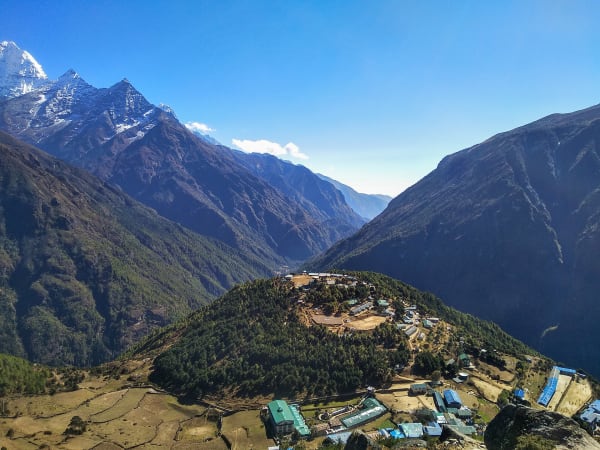
Namche Bazaar (3,440 m) fills a natural horseshoe amphitheatre and is the trading centre of Sherpa country, with bakeries, cafés, gear shops and a Saturday market. Overnight in Namche.
4Day 4Acclimatization and Exploration in Namche Bazaar (3,440 m)
Acclimatization and Exploration in Namche Bazaar (3,440 m)
A rest day that involves walking uphill — climb high, sleep low is the rule that gets people safely to 5,000 m.
The morning excursion climbs to the Everest View Hotel (3,880 m), whose terrace looks straight out at Everest, Lhotse, Thamserku and the extraordinary spire of Ama Dablam (6,812 m). From there we continue to the Sherpa villages of Khumjung and Khunde beneath the sacred peak of Khumbila. Khumjung's monastery is said to hold a yeti scalp, and its school was founded by Sir Edmund Hillary in 1961.
Back in Namche for the afternoon, the Sherpa Culture Museum and the national park visitor centre are both worth an hour, and there is good coffee and a bakery or two. Drink steadily through the day and eat well. Overnight in Namche Bazaar.
5Day 5Trek from Namche Bazaar (3,440 m) to Dole (4,110 m)
Trek from Namche Bazaar (3,440 m) to Dole (4,110 m)
Today the route diverges from the crowds. Where the base camp trail turns east toward Tengboche, we head north-west into the Gokyo valley, and the number of trekkers drops away noticeably.
The trail climbs out of Namche on the high traverse with the same superb views of Everest, Lhotse and Ama Dablam, then branches at Sanasa and continues up through Mong La — a small pass at around 3,975 m marked by a chorten, with a fine view back down the valley. From Mong La the path drops steeply to the Dudh Koshi at Phortse Thanga before climbing again.
The afternoon's climb goes through rhododendron and birch that thins rapidly as you gain height, ending at Dole (4,110 m), a small summer settlement of a few lodges on the hillside. Watch the opposite slopes for Himalayan tahr and musk deer, both common in this valley. Overnight in Dole.
6Day 6Trek from Dole (4,110 m) to Machhermo (3,870 m)
Trek from Dole (4,110 m) to Machhermo (3,870 m)
A short, deliberately gentle day. Distance is not the point at this altitude — the value of today is spending time above 4,000 m without pushing hard.
The trail climbs steadily along the side of the valley through Lhabarma and Luza, crossing summer yak pastures with stone-walled corrals and the occasional herder's hut. The vegetation is now reduced to juniper scrub and low azalea, and the views open north up the valley toward the peaks that ring the Gokyo basin — Cho Oyu (8,188 m), the world's sixth-highest mountain, comes into view ahead, along with Kangtega and Thamserku behind.
Machhermo (3,870 m) sits in a broad side valley beneath a striking rock ridge. There is a Himalayan Rescue Association aid post here that runs a free altitude-sickness talk most afternoons — worth attending before you go higher. Overnight in Machhermo.
7Day 7Trek from Machhermo (3,870 m) to Gokyo (4,800 m) and Hike to Gokyo Ri (5,357 m)
Trek from Machhermo (3,870 m) to Gokyo (4,800 m) and Hike to Gokyo Ri (5,357 m)
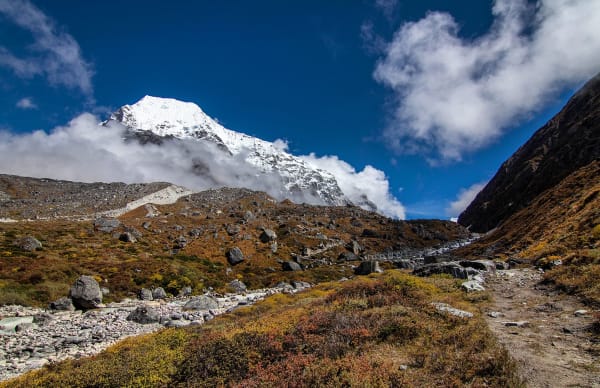
A big day. The trail climbs out of Machhermo to a ridge at Pangka, then turns up beside the terminal moraine of the Ngozumpa Glacier — the longest glacier in Nepal, a vast grey river of rubble-covered ice.
The climb passes the first Gokyo lake (Longpongo) and the second (Taboche Tsho), both an astonishing opaque turquoise from suspended glacial flour, before reaching the village beside the third lake, Dudh Pokhari, at Gokyo (4,800 m). The colour of these lakes against bare brown rock and white ice is unlike anything else on the trek.
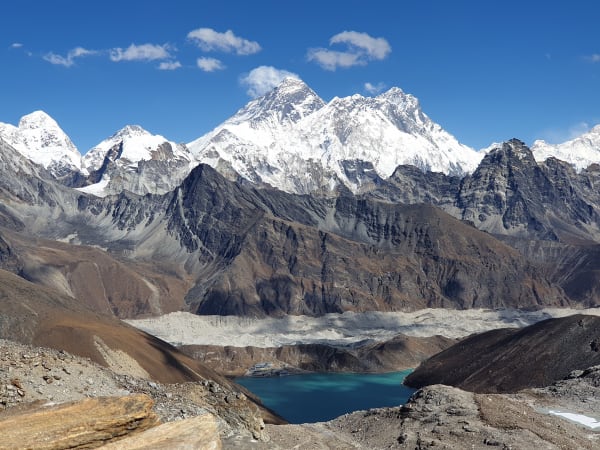
After lunch and a rest, those feeling strong climb Gokyo Ri (5,357 m) — a steep 550 m ascent taking two to three hours. The summit panorama is arguably the best in Nepal: four eight-thousanders in one view — Everest, Lhotse, Makalu and Cho Oyu — with the Ngozumpa Glacier and the chain of lakes below. If cloud closes in, we climb it at sunrise tomorrow instead. Overnight in Gokyo.
8Day 8Morning Hike from Gokyo (4,800 m) to the Fourth Gokyo Lake (4,870 m) and Trek to Machhermo (3,870 m)
Morning Hike from Gokyo (4,800 m) to the Fourth Gokyo Lake (4,870 m) and Trek to Machhermo (3,870 m)
A morning excursion north along the eastern shore of Dudh Pokhari and up the valley beside the Ngozumpa Glacier to the fourth lake, Thonak Tsho (4,870 m). It is an easy, mostly level walk of about an hour and a half, and far fewer trekkers make it this far — most turn round at Gokyo Ri.
The fourth lake is the largest and, for many people, the most beautiful of the chain. From the small ridge above its northern shore there is a direct view of the north face of Cho Oyu (8,188 m) and, on a clear morning, a glimpse toward Everest across the glacier. The scale and the emptiness here are the point; you may well have it entirely to yourself.
We return to Gokyo for an early lunch and then begin the descent, retracing the trail past the lakes and down the valley to Machhermo (3,870 m). Losing nearly a kilometre of altitude makes for a far better night's sleep. Overnight in Machhermo.
9Day 9Trek from Machhermo (3,870 m) to Namche Bazaar (3,440 m)
Trek from Machhermo (3,870 m) to Namche Bazaar (3,440 m)
A long descending day, and a pleasant one — the air thickens with every hour and the landscape gets greener as you drop.
The trail retraces the route down the Gokyo valley through Luza and Lhabarma to Dole, then descends steeply to the river at Phortse Thanga. From there comes the one real climb of the day, back up to the chorten at Mong La, which is hard work but short.
From Mong La the path descends to Sanasa and rejoins the main Everest trail for the high traverse back into Namche Bazaar (3,440 m), with Everest, Lhotse and Ama Dablam in view for much of the way. After a week in simple high-altitude lodges, Namche's hot showers, bakeries and cafés feel like genuine luxury. Overnight in Namche.
10Day 10Trek from Namche Bazaar (3,440 m) to Lukla (2,860 m)
Trek from Namche Bazaar (3,440 m) to Lukla (2,860 m)
The final walking day. From Namche the trail drops steeply down the switchbacks you climbed on day three, losing around 600 m to the Hillary Bridge over the Dudh Koshi. Descending is quicker but harder on the knees, and poles are worth having.
From the bridge the route follows the river through Jorsalle and Monjo, where you check out of Sagarmatha National Park, and continues through Phakding. The valley is warm and green again, thick with pine and rhododendron, and busy with villages, mani walls and prayer wheels.
A last undulating section — with one final climb that always feels unfair — brings you into Lukla (2,860 m). Tonight is the celebration dinner with your guide and porter team, traditionally the evening the whole crew relaxes. Overnight in Lukla.
11Day 11Fly from Lukla (2,860 m) to Kathmandu (1,400 m)
Fly from Lukla (2,860 m) to Kathmandu (1,400 m)
An early flight, because Lukla's weather window is a morning one and the airstrip routinely closes to traffic by midday. The take-off — accelerating downhill toward the edge of the shelf — is every bit as memorable as the landing.
The flight returns you to Kathmandu (1,400 m) in about 30 minutes, or to Ramechhap with an onward road transfer depending on the season. On a clear morning the Himalaya line the northern horizon the whole way.
Lukla flights depend entirely on the weather and delays of a day or more do happen, which is why we always recommend keeping a buffer day before an international connection. Once in Kathmandu you transfer to your hotel with the afternoon free — a hot shower, a proper meal and a wander through Thamel. Overnight in Kathmandu.
12Day 12Final Departure from Kathmandu (1,400 m)
Final Departure from Kathmandu (1,400 m)
Your last day in Nepal. If your flight leaves later, there is time to see more of the Kathmandu Valley — Boudhanath Stupa is the natural choice after two weeks in Sherpa country, being the heart of the city's Tibetan Buddhist community, with Pashupatinath and Swayambhunath both close by.
Our representative collects you from your hotel and transfers you to Tribhuvan International Airport around three hours before departure.
The Gokyo Lakes trek gives you the Khumbu at its best without the crowds of the base camp trail: a chain of turquoise glacial lakes, the longest glacier in Nepal, and a summit at 5,357 m with four of the world's fourteen eight-thousanders in a single view. If you want to link it with Everest Base Camp next time, the Three Passes route joins both. Safe travels.
Inclusions & Exclusions
Lukla flights, Kathmandu accommodation, teahouse lodging, all trekking meals, national park and municipality permits, a licensed guide, and government taxes are included, while international flights, visa, insurance, personal gear, porter service, city meals, personal expenses, and tips are excluded.
What's Included
Airport pickup and drop-off services in Kathmandu.
Domestic flights from Kathmandu to Lukla and Lukla to Kathmandu, including airport transfers.
Accommodation in Kathmandu with breakfast.
Accommodation in local teahouses during the trek.
Sagarmatha National Park Entry Permit and Khumbu Pasang Lhamu Rural Municipality Entry Permit.
Professional English-speaking licensed trekking guide.
Three meals a day (breakfast, lunch, and dinner) during the trek.
Group trekking map for route guidance.
First aid kit carried by the guide.
All government taxes, permit fees, and service charges.
What's Excluded
International flight tickets to and from Nepal.
Nepal entry visa fees.
Travel insurance, including emergency helicopter evacuation coverage.
Personal trekking equipment and clothing.
Porter services (available at an additional cost).
Lunch and dinner in Kathmandu.
Snacks, bottled water, hot showers, Wi-Fi, charging fees, and alcoholic or soft drinks.
Personal expenses such as laundry, phone calls, and souvenirs.
Tips for guides, drivers, and support staff.
Any additional accommodation, transportation, or expenses caused by Lukla flight delays, bad weather, or other unforeseen circumstances beyond the itinerary.
Route Map
Explore the terrain map showing the trek route.
Loading map...
Altitude Profile
Pricing
Transparent per-person pricing based on group size, covering the services listed in the itinerary with no hidden charges.
Add-ons
Customize your trek with optional services such as porter support and other personalized arrangements at an additional cost.
Best Time to Trek
Spring (March to May) and autumn (September to November) are the two seasons that make sense for Gokyo. Autumn is the classic window, with settled post-monsoon weather, exceptionally clear air, and the lakes at their most vividly blue. Spring is warmer, the days are longer, and rhododendron forest below Namche is in flower, though afternoon haze can build.
Winter is genuinely spectacular here — the lakes freeze and the light is superb — but nights at Gokyo drop below -20°C and a number of lodges close, so it is only worth considering with proper cold-weather gear. The monsoon (June to August) is not recommended: the mountains stay hidden, the trail from Dole upward becomes slippery, and Lukla flights are regularly grounded.
For a month-by-month look at weather and trail conditions, see our guide to the best time to trek in Nepal.
Altitude & Acclimatization
The itinerary includes a full acclimatization day at Namche Bazaar (3,438 m) and then follows a measured profile up the Dudh Koshi valley, gaining only two to three hundred metres of sleeping altitude a day between Dole, Machhermo, and Gokyo. That gradual approach is deliberate, because Gokyo itself sits at 4,800 m and the Gokyo Ri climb tops out at 5,357 m.
Gokyo Ri is done as a climb-high, sleep-low ascent — you gain over 500 m and return to the village to sleep, which is exactly the pattern that aids adaptation. Your guide checks the group each evening for headache, disturbed sleep, appetite loss, and breathlessness at rest. Drink three to four litres a day, walk slowly enough to talk comfortably, avoid alcohol above Namche, and report symptoms early. Descent resolves altitude illness quickly and reliably, and there is no shame in taking it.
Prevention, symptoms and treatment are covered in depth in our guide to altitude sickness in Nepal.
Travel Insurance
Travel insurance is mandatory and must cover trekking to at least 5,500 m to bracket the Gokyo Ri ascent at 5,357 m and your sleeping altitude of 4,800 m. Ordinary policies routinely cap at 3,000 m or 4,000 m, which would leave you without cover for the most committing half of the route, so read the altitude clause before purchasing.
The clause that matters most is emergency helicopter evacuation and repatriation. The Gokyo valley has no road access and evacuation from Machhermo or above means a helicopter, which operators will not dispatch without a guarantee of payment. Also check for medical treatment cover, trip cancellation, and delayed or cancelled domestic flights. Send us your policy number and the insurer's 24-hour emergency contact before you travel.
Our guide to travel insurance for trekking in Nepal explains the altitude limits, evacuation terms and common exclusions to check before you buy.
Packing List
Gokyo is colder than the equivalent altitude on the Base Camp trail because of the glacier and the valley's exposure to wind. Bring waterproof trekking boots, three or four base layers, a fleece or light down mid-layer, a proper insulated down jacket, a waterproof shell jacket and trousers, trekking trousers, a warm hat, sun hat, liner and insulated gloves, and several pairs of wool socks.
Also pack a sleeping bag rated to -15°C, a 30-40 litre daypack, trekking poles, a headlamp with spare batteries for the pre-dawn Gokyo Ri start, high-SPF sunscreen and lip balm, category 3 or 4 sunglasses (glare off the lakes and snow is intense), a reusable bottle with purification tablets or a filter, a personal first aid kit, quick-dry towel, toiletries, and a power bank. Keep the porter-carried duffel under 15 kg.
For the complete kit list, organised by the altitude you will reach, see our Nepal trekking packing list.
Accommodation, Food & Drinking Water
You stay in a tourist-standard Kathmandu hotel and in teahouses throughout the trek. Lodges in Phakding and Namche are comfortable, often with attached bathrooms and hot showers. From Dole upward they become simpler — twin rooms with foam mattresses, shared toilets, and a communal dining room warmed by a stove in the evening. Gokyo has several lodges with good dining rooms and windows facing straight onto the lake.
Three meals a day are included on the trek. Breakfast is porridge, eggs, Tibetan bread, or pancakes; lunch and dinner are ordered from the lodge menu, where dal bhat with unlimited refills is the best value, alongside noodles, fried rice, soups, momos, pasta, and potato dishes. We recommend eating vegetarian above Namche. Fill your bottle at the lodges and treat it with tablets, a filter, or a UV pen — plastic bottles are restricted in Sagarmatha National Park, and boiled water at Gokyo is expensive.
What the lodges are really like, from rooms and meals to showers and charging, is covered in our guide to teahouse trekking in Nepal.
Frequently Asked Questions
Find quick answers to common questions about the Gokyo Lake Trek.
1How does the Gokyo trek compare with Everest Base Camp?
Gokyo is quieter, slightly shorter, and reaches a comparable maximum altitude, but the viewpoint is arguably better — Gokyo Ri shows you four eight-thousanders at once, while Kala Patthar focuses on Everest. Base Camp has the historical draw; Gokyo has the lakes, the glacier, and far fewer people on the trail.
2How difficult is the Gokyo Lake Trek?
Moderate to challenging. There is no technical ground, but you walk five to seven hours a day for nine days and spend several nights above 4,000 m. The Gokyo Ri climb is steep and takes three to four hours up from the village, done before dawn.
3How many hours do we walk each day?
Typically five to seven hours. The Phakding to Namche day and the Machhermo to Gokyo day are the longest. The Gokyo Ri ascent adds a separate three to four hour pre-dawn round trip on the day you arrive.
4What happens if the Lukla flight is delayed or cancelled?
Lukla flights depend entirely on visibility and delays of a day or two are common. We recommend keeping two spare days in Kathmandu at the end of your trip. If your schedule is tight, a helicopter transfer can usually be arranged at additional cost.
5Which permits are required and do you arrange them?
You need the Sagarmatha National Park Entry Permit and the Khumbu Pasang Lhamu Rural Municipality Entry Permit. Both are included in your package and arranged by our team from passport copies and photographs you send in advance.
6Can I combine Gokyo with Everest Base Camp?
Yes, by crossing the Cho La pass (5,420 m) between the two valleys, which adds roughly four to five days and considerable difficulty. Our Everest Three Pass Trek covers that route in full. Tell us before booking if you would like the combined itinerary instead.
7Is mobile network and Wi-Fi available in the Gokyo valley?
Coverage is patchier than on the Base Camp trail. Ncell and NTC reach Dole and Machhermo intermittently, and Gokyo lodges sell Everest Link Wi-Fi. Expect slow, unreliable service and plan on being offline for stretches.
8Can I charge my devices and are ATMs available?
Lodges offer charging from solar power for a fee that rises with altitude. Namche Bazaar has the only ATMs on the route and they are not dependable, so carry all the Nepalese rupees you will need from Kathmandu for snacks, drinks, charging, Wi-Fi, showers, and tips.
9How large are the groups and who leads the trek?
Groups are capped at twelve trekkers and led by a licensed English-speaking guide from the Everest region. We add an assistant guide for larger groups so the party can split by walking pace without anyone being left alone.
10Can I leave extra luggage in Kathmandu?
Yes. Your Kathmandu hotel stores whatever you do not need on the trail free of charge until you return, so you can leave city clothes, spare gear, and valuables behind.
Gallery
Explore authentic moments, landscapes, and mountain views from the Gokyo Lake Trek.
Trekking Guides & Articles
Gokyo Lakes Trek: A Complete Guide to the Khumbu's Quieter Valley — Six turquoise lakes at 4,700 to 5,000 m, Nepal's longest glacier, and a summit view from Gokyo Ri that many trekkers rate above Kala Patthar.
Khumbu Cough, Colds and Chest Infections on a Nepal Trek — By day ten on a high trek, half the dining room is coughing.
Everest Three Passes Trek: The Complete Khumbu Circuit — Kongma La, Cho La and Renjo La, plus Everest Base Camp, Kala Patthar, Gokyo Ri and the Gokyo lakes — the most complete trek in the Everest region, in 17 days.
Namche Bazaar: The Khumbu's Capital and Your First Rest Day — Namche Bazaar at 3,440 m is where every Khumbu trek pauses, and how you spend the rest day matters more than most people realise.
Mani Rimdu Festival at Tengboche: Dates, Trek Timing and What to Expect — Mani Rimdu is the Sherpa festival of masked dances held at Tengboche monastery, four days' walk up the Everest trail.
Best Time for the Everest Base Camp Trek: Season by Season — October and November give the clearest Everest views; April and May put you in the valley during the climbing season.
Fix Departure
This trek runs every week on the selected day. Choose custom dates for one-off departures.
Showing fixed departures in Oct 2026
Guest Reviews
We will be back
“Gokyo Lake Trek was everything we hoped for and so much more. We learned so much about the villages, monasteries and local life from our guide. I would not hesitate to book with them again and hope to...
Alice Patel
Get in Touch
Tell us the dates you have in mind and roughly what you want out of the trek — one of our guides will reply, usually within 24 hours.
Email Us
info@greencompasstreks.com
Call Us
+977 9864379436
Office
Lakeside, Pokhara, Nepal
Office Hours
Sunday – Friday, 9:00 AM – 9:00 PM
Similar Treks
You might also like these treks

Porter
$385 $350/porter
No payment required yet