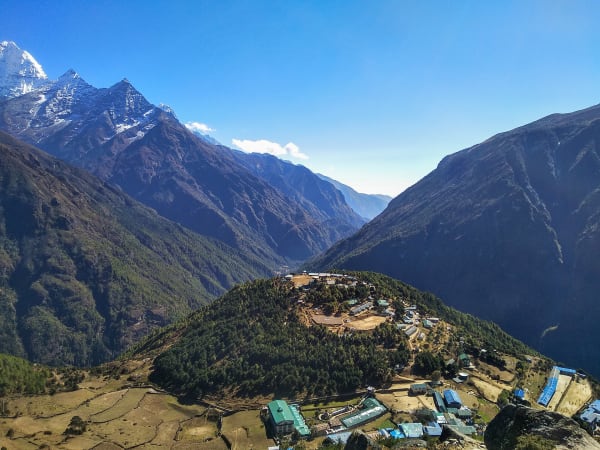
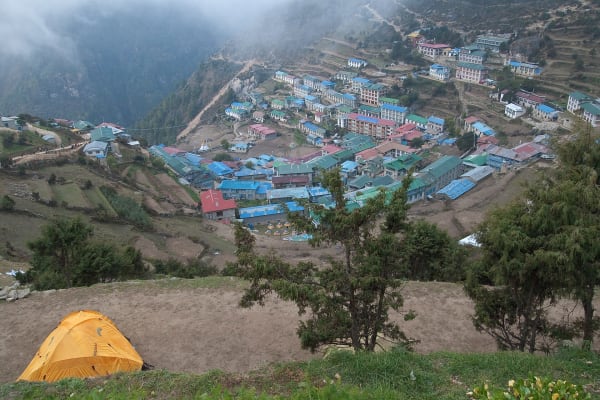
Namche Bazaar is the administrative, commercial, and cultural capital of the Khumbu — a horseshoe of Sherpa lodges and shops built into a steep amphitheatre at 3,440 m, with Kongde Ri opposite and Thamserku above. Every trek in the region passes through it, and every well-built itinerary stops for a full day.
That day is the most important rest day of your trek, and it is not a rest day. Here is how to use it.
Why the Rest Day Exists
You arrive in Namche having gained nearly 800 m from Phakding, most of it in a steep two-hour climb. At 3,440 m, oxygen availability is around 64% of sea level, and this is the first altitude at which most trekkers notice something — a headache, a poor night's sleep, a dull appetite.
The rest day lets your body catch up before the next three nights take you to 3,956 m, 4,380 m, and eventually 5,160 m. Skipping it — as 11 and 12-day itineraries do — is the single biggest reason trekkers turn back lower down. Our altitude profile guide shows the difference in numbers.
The key principle is climb high, sleep low. You walk several hundred metres above the village and return to sleep at 3,440 m. Sitting in a bakery all day feels restful and does almost nothing for acclimatisation.
The Acclimatisation Walks
| Walk | High point | Time | What you get |
|---|---|---|---|
| Hotel Everest View and Syangboche | 3,880 m | 3–4 hours return | The classic Everest, Lhotse, Nuptse and Ama Dablam panorama from the terrace |
| Khumjung village | 3,790 m | 4–5 hours return | A traditional Sherpa village, Hillary's school, and the Khumjung monastery |
| Thame | 3,800 m | 6–7 hours return | A quiet Bhote Koshi village, home to many Everest summiters, and a cliffside monastery |
| Sagarmatha National Park museum viewpoint | 3,550 m | 1 hour return | The shortest option, with a first Everest view and good interpretation |
The standard choice is the Everest View Hotel and Khumjung as a loop — up through Syangboche to the hotel terrace for morning tea with Everest in front of you, then down to Khumjung and back to Namche. Four to five hours, about 450 m of gain, and one of the best half days in Nepal.
Do not skip it because you feel fine. Feeling fine at 3,440 m is exactly when the walk does its work.
What Else to Do in Namche
- Sherpa Culture Museum and the Sagarmatha National Park visitor centre — on the ridge above the village, with a first view of Everest and the best interpretation of Sherpa history and Khumbu ecology you will find anywhere.
- The Saturday market — traders come up from the lower valleys, and it is the real working market that gives the village its name.
- Bakeries and coffee — Namche genuinely has good coffee and apple pie, and after two days walking this registers as a significant cultural achievement.
- Gear shops — everything from lost gloves to a replacement down jacket, at higher prices than Kathmandu but lower than you would expect.
- The gompa — the village monastery, modest and active.
- ATMs — they exist and they are unreliable. Do not rely on them; bring cash from Kathmandu.
- Irish pub at 3,440 m — it is there, and one drink is fine. A heavy night at altitude is not.
A word on Wi-Fi and phones: Namche has the best connectivity in the Khumbu, and this is the sensible place to send your last messages home before the upper valley.
Practical Notes
- Lodges: the widest choice on the trek, many with attached bathrooms and hot showers. In peak October the good ones fill early, which is why guides call ahead.
- Temperature: daytime 8 to 15 °C in the main seasons, nights around -5 to 0 °C. Your first properly cold night.
- Laundry: available, and the last practical chance before the descent.
- Shower: take one here. Above Dingboche, washing becomes a bowl of hot water.
- Altitude warning signs: a persistent headache that does not respond to fluid and paracetamol, vomiting, or breathlessness at rest means you tell your guide and you do not go higher the next day.
- Hydration: three to four litres. The climb to Namche is where most people first fall behind on fluid.
Namche is also the last place on the trek where you can genuinely fix a kit problem. The gear shops carry gloves, hats, socks, sunglasses, headlamps, batteries, and sometimes boots, and several will hire out a warmer sleeping bag for the upper valley if yours turns out to be optimistic. If anything in your kit has already proved inadequate on the climb from Phakding, deal with it here rather than at Dingboche.
On the way down, Namche arrives like a city — hot showers, beer, pizza, and thick oxygen-rich air — and almost every trekker spends an extra evening there feeling extraordinarily pleased with themselves. That is part of the design too.