

Annapurna Base Camp Trek with Mardi Himal Trek
The Mardi Himal and Annapurna Base Camp Trek is a 14-day Himalayan adventure combining two of Nepal’s most spectacular t
Porter
$385 $350/porter
Flight form Kathmandu to Pokhara
$127 $115/person
Flight form Pokhara to Kathmandu
$127 $115/person
No payment required yet
Trip Overview
The Mardi Himal and Annapurna Base Camp Trek is a 14-day Himalayan adventure combining two of Nepal’s most spectacular trekking routes. The journey begins in Kathmandu and continues to Pokhara before heading to Kande and trekking through beautiful forests, traditional mountain landscapes, and scenic ridges. The Mardi Himal section passes through Pitam Deurali, Forest Camp, and High Camp, culminating in an early-morning hike to Mardi Himal Base Camp (4,500 m), with breathtaking views of Machhapuchhre and the Annapurna range.
After descending to Badal Danda and continuing to Jhinu Danda, the trail connects with the Annapurna Base Camp route. The trek passes through Lower Sinuwa and Deurali before reaching the spectacular Annapurna Base Camp (4,130 m), surrounded by towering Himalayan peaks. The journey then descends through Bamboo before returning to Pokhara and Kathmandu. This combined trek offers an incredible blend of mountain scenery, lush forests, traditional villages, high-altitude landscapes, and two iconic Himalayan base camps in one unforgettable adventure.
Trip Higlight
Two Iconic Himalayan Base Camps: Experience both Mardi Himal Base Camp at 4,500 m and Annapurna Base Camp at 4,130 m in one unforgettable journey.
Spectacular Mardi Himal Ridge: Trek through peaceful forests and scenic ridges toward High Camp, with breathtaking views of Machhapuchhre and the Annapurna range.
Explore the Annapurna Sanctuary: Enter the dramatic mountain amphitheater surrounded by towering Himalayan peaks and rugged alpine landscapes.
Diverse Landscapes and Villages: Experience rhododendron forests, traditional mountain settlements, terraced hillsides, suspension bridges, and changing Himalayan scenery.
Sunrise and Panoramic Mountain Views: Enjoy early-morning mountain vistas from Mardi Himal Base Camp and spectacular close-up views of the Annapurna massif.
Itinerary
A 14-day adventure combining the spectacular Mardi Himal and Annapurna Base Camp trails with stunning mountain views, scenic villages, lush forests, and unforgettable Himalayan landscapes.
1Day 1Arrival in Kathmandu (1,400 m)
Arrival in Kathmandu (1,400 m)
You land at Tribhuvan International Airport in Kathmandu (1,400 m) and are met by our representative for the transfer to your hotel in Thamel.
Your guide runs the pre-trek briefing. This itinerary is the most complete way to see the Annapurna south side: it walks the Mardi Himal ridge to a base camp at 4,500 m, drops all the way down to the Modi Khola, and then climbs the gorge into the Annapurna Sanctuary. Two base camps, two very different kinds of terrain, in one trip.
That structure means the altitude profile goes up, right down and up again, which is demanding but excellent for acclimatisation. Your guide goes through the daily stages and checks your kit — you will need warm layers for two nights above 3,500 m and boots that can take a lot of stone steps. Overnight in Kathmandu.
2Day 2Drive from Kathmandu (1,400 m) to Pokhara (822 m)
Drive from Kathmandu (1,400 m) to Pokhara (822 m)
We leave after breakfast on the Prithvi Highway, dropping out of the Kathmandu Valley and following the Trishuli River west through its gorge for most of the 200 km to Pokhara (822 m).
The drive fills the day and is consistently good to watch: terraced hillsides stacked up the valley walls, roadside towns, suspension footbridges, and rafting groups on the green water below. We stop for lunch at a riverside restaurant.
Pokhara appears in the late afternoon on the shore of Phewa Lake, with the Annapurna massif standing directly above the town. From the lakeside you can pick out almost the entire route ahead — the Mardi ridge on the right, the fishtail summit of Machhapuchhre in the centre, and the Sanctuary hidden behind it. Overnight in Pokhara.
3Day 3Drive from Pokhara (822 m) to Kande (1,770 m) and Trek to Pitam Deurali (2,100 m)
Drive from Pokhara (822 m) to Kande (1,770 m) and Trek to Pitam Deurali (2,100 m)
A short drive of about an hour north-west along the Baglung highway brings you to the trailhead at Kande (1,770 m). Boots on, and the climbing starts immediately.
The trail ascends through terraced fields and pine to Australian Camp (2,060 m), a grassy shoulder with the first wide mountain view of the trip — Annapurna South, Hiunchuli and Machhapuchhre lined up across the northern skyline. It is a natural place to stop for tea.
From there the path contours through oak and rhododendron to Pothana and climbs to Pitam Deurali (2,100 m), the junction where the Mardi Himal ridge route branches away from the main Annapurna trails. Beyond this point the traffic thins out sharply and you have the ridge largely to yourself. Overnight in a teahouse.
4Day 4Trek from Pitam Deurali (2,100 m) to Forest Camp (2,600 m)
Trek from Pitam Deurali (2,100 m) to Forest Camp (2,600 m)
A day inside the forest, and one of the most atmospheric stretches of walking in the Annapurna region.
From Pitam Deurali the trail turns north onto the Mardi ridge and climbs into old-growth rhododendron and oak. The canopy closes overhead within minutes and stays closed: moss on every trunk, lichen hanging in long curtains, deep leaf litter underfoot, and mist drifting through for much of the day. There are no villages, no farmland and no views — this is a completely different character from the busy Sanctuary trail you will join later in the week.
The gradient is steady rather than punishing, gaining around 500 m. Watch for langur monkeys overhead and listen for Himalayan monal in the undergrowth. The day ends at Forest Camp (2,600 m), also called Kokar, a handful of lodges in a clearing hemmed in by trees on every side. Overnight at Forest Camp.
5Day 5Trek from Forest Camp (2,600 m) to High Camp (3,580 m)
Trek from Forest Camp (2,600 m) to High Camp (3,580 m)
The transformation day. From Forest Camp the trail continues up the ridge through thinning rhododendron to Low Camp (2,970 m), where the trees stop abruptly and Machhapuchhre (6,993 m) appears dead ahead — close enough to make out the ice flutings on its south face.
Above Low Camp the vegetation drops to dwarf rhododendron and juniper scrub, then to open alpine grass. The ridge narrows and the walking becomes genuinely exposed and airy, with the Modi Khola valley falling away west and the Seti valley east. The panorama widens with every hundred metres of ascent — Annapurna South, Hiunchuli, Mardi Himal and the full wall of the fishtail.
A steep final pull reaches High Camp (3,580 m), a few simple lodges pitched on the open ridge with nothing above them. Nearly 1,000 m gained today, and you are sleeping high — drink plenty and get to bed early. Overnight at High Camp.
6Day 6Early Morning Hike from High Camp (3,580 m) to Mardi Himal Base Camp (4,500 m) and Trek Back to Badal Danda (3,210 m)
Early Morning Hike from High Camp (3,580 m) to Mardi Himal Base Camp (4,500 m) and Trek Back to Badal Danda (3,210 m)
An alpine start around 4:00 am by head torch. The trail climbs the narrowing ridge above High Camp over grass and loose rock, passing the Mardi Himal View Point (4,200 m) as the sky begins to lighten. Cold, steep, and completely silent.
You reach Mardi Himal Base Camp (4,500 m) for sunrise, and it is one of the great close-range viewpoints in Nepal. The basin sits directly beneath the south face of Mardi Himal (5,587 m), with Machhapuchhre (6,993 m) immediately east, Annapurna South (7,219 m) and Hiunchuli (6,441 m) west, and Annapurna I (8,091 m) beyond. Very little walking anywhere puts you this close to peaks this size.
After time at the top we descend to High Camp for a late breakfast, then continue down the ridge to Badal Danda (3,210 m) — 'cloud hill' — an open grassy shoulder that frequently sits just above a sea of cloud at sunset. Overnight at Badal Danda.
7Day 7Trek from Badal Danda (3,210 m) to Jhinu Danda (1,780 m)
Trek from Badal Danda (3,210 m) to Jhinu Danda (1,780 m)
The linking day, and a long one — this is the descent that takes you off the Mardi ridge and across into the Modi Khola valley to begin the second half of the trek.
From Badal Danda the trail drops off the open ridge into rhododendron forest, losing height quickly on a rooty, uneven path. Lower down it emerges into terraced farmland and passes through Gurung settlements — Siding and Ghalel among them — where far fewer trekkers pass than on the main Annapurna trails, and village life carries on largely unaffected by them.
The route then contours west toward the Modi Khola and descends to Jhinu Danda (1,780 m). You have lost nearly 1,500 m, and the reward is directly below the village: the Jhinu hot springs, three stone pools of naturally heated water on the bank of the river, twenty minutes' walk down. Overnight in Jhinu Danda.
8Day 8Trek from Jhinu Danda (1,780 m) to Lower Sinuwa (2,340 m)
Trek from Jhinu Danda (1,780 m) to Lower Sinuwa (2,340 m)
The Sanctuary half of the trek begins here, and the trail joins the main Annapurna Base Camp route for the first time.
From Jhinu Danda the path drops to a suspension bridge over the Modi Khola and then climbs a long flight of stone steps to Chhomrong (2,170 m). This is the last permanent Gurung village before the Sanctuary and the largest settlement you will pass — stone-paved lanes, slate roofs, bakeries, gear shops and hot showers. Its terraces look straight up the valley to Annapurna South and Hiunchuli.
Beyond Chhomrong the trail descends sharply to the Chhomrong Khola, crosses on a steel bridge, and climbs again through bamboo and rhododendron to Lower Sinuwa (2,340 m). The net height gain is modest but the up-and-down adds up, and after yesterday's long descent the legs will notice. Overnight at Lower Sinuwa.
9Day 9Trek from Lower Sinuwa (2,340 m) to Deurali (3,230 m)
Trek from Lower Sinuwa (2,340 m) to Deurali (3,230 m)
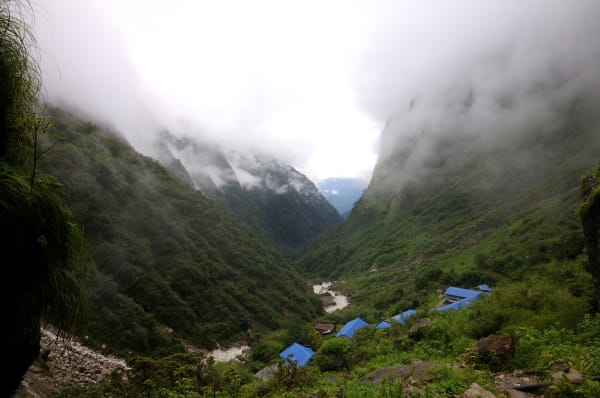
Today the valley narrows and the trek turns properly upward. From Sinuwa the trail contours through thick forest and drops slightly into Bamboo (2,310 m), a damp green hollow where the canopy closes right over the path.
From Bamboo the climb is steady and near-continuous, following the west bank of the Modi Khola through Dovan (2,600 m) and past the small shrine set beneath a rock overhang at Himalaya, dedicated to the goddess said to guard the Sanctuary. The gorge tightens, the trees thin, and waterfalls spill directly across the trail. The stone underfoot is often wet — take it steadily.
The last section breaks out above the treeline into a corridor of bare rock and reaches Deurali (3,230 m). Nearly 900 m of ascent, and the altitude is now noticeable on the final steps. Hydrate well, eat a full dinner and sleep early. Overnight at Deurali.
10Day 10Trek from Deurali (3,230 m) to Annapurna Base Camp (4,130 m)
Trek from Deurali (3,230 m) to Annapurna Base Camp (4,130 m)
The second base camp of the trip. From Deurali the trail climbs through the head of the gorge, crossing open slopes that carry avalanche risk in late winter and spring — your guide checks conditions before committing to a line.
The valley then opens dramatically at Machhapuchhre Base Camp (3,700 m), a few lodges on grass beneath the ice flutings of the fishtail. Four days ago you were looking at this same mountain from the other side, from Mardi Himal Base Camp; today you approach it from the west. We stop for tea and let the altitude settle.
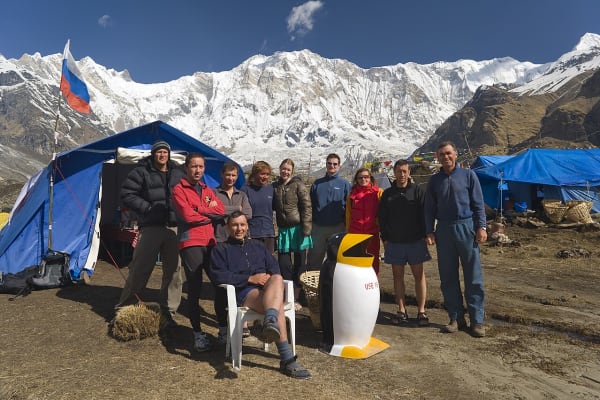
The final 430 m is a gradual climb over glacial moraine and alpine meadow into the Annapurna Sanctuary, ending at Annapurna Base Camp (4,130 m) — an enclosed amphitheatre ringed by Annapurna I (8,091 m), Annapurna South, Hiunchuli, Gangapurna, Tent Peak and Machhapuchhre. Sunset lights the rim peak by peak. Overnight at base camp.
11Day 11Trek from Annapurna Base Camp (4,130 m) to Bamboo (2,310 m)
Trek from Annapurna Base Camp (4,130 m) to Bamboo (2,310 m)
Be outside before sunrise. Annapurna I catches light first while the Sanctuary floor is still in blue shadow, and over about twenty minutes the glow travels around the whole rim. Bitterly cold, and the best twenty minutes of the trip.
After breakfast the long descent begins. We retrace the meadow to Machhapuchhre Base Camp, drop back into the gorge and follow the Modi Khola down past Deurali and Himalaya. The altitude comes off fast and breathing eases noticeably within the first hour.
Continuing through Dovan, rock gives way to forest and the air turns warm and humid again. The day finishes at Bamboo (2,310 m) after more than 1,800 m of descent, almost all on uneven stone steps. Poles make a genuine difference today, particularly with two weeks of walking already in the legs. Overnight at Bamboo.
12Day 12Trek from Bamboo (2,310 m) to Jhinu Danda (1,780 m) and drive to Pokhara (822 m)
Trek from Bamboo (2,310 m) to Jhinu Danda (1,780 m) and drive to Pokhara (822 m)
The final walking morning retraces the forest trail through Upper and Lower Sinuwa, drops to the Chhomrong Khola, and climbs the stone staircase one last time to Chhomrong (2,170 m) — the last real climb of the trek, and a short one.
From Chhomrong the path descends through terraced fields to Jhinu Danda (1,780 m). If the schedule allows, walk the twenty minutes down to the hot springs on the bank of the Modi Khola. Having now completed both the Mardi ridge and the Sanctuary, you have earned it more than most.
A jeep meets us at Jhinu Danda for the drive back down the valley to Pokhara (822 m), arriving in the late afternoon. Tonight is the celebration dinner by the lake. Overnight in Pokhara.
13Day 13Drive from Pokhara (822 m) to Kathmandu (1,400 m)
Drive from Pokhara (822 m) to Kathmandu (1,400 m)
An unhurried morning. If you are awake at dawn, the Annapurna skyline from the lakeside is worth stepping outside for — you can now identify almost every peak on it by name and by the angle you saw it from.
We then drive east on the Prithvi Highway to Kathmandu (1,400 m), following the Marsyangdi and Trishuli rivers back through the gorge country. It is a full day on the road with a lunch stop, arriving in the capital in the late afternoon.
After transferring to your hotel the evening is free. Thamel is a few minutes away for last-minute shopping — pashmina, singing bowls, Himalayan tea and prayer flags are all within easy reach. Overnight in Kathmandu.
14Day 14Departure from Nepal
Departure from Nepal
Your final day in Nepal. If your flight is later in the day there is time for one more part of the Kathmandu Valley — Boudhanath Stupa, Pashupatinath Temple and Swayambhunath are all a short drive away and each worth an hour.
Our representative will collect you from your hotel and transfer you to Tribhuvan International Airport about three hours before your scheduled departure.
Over fourteen days this itinerary has covered both sides of the same massif — the quiet, forested Mardi Himal ridge to a base camp at 4,500 m, and the busy, dramatic gorge into the Annapurna Sanctuary at 4,130 m. Very few trips let you stand beneath Machhapuchhre from two completely different directions in one week. If you would like to return, the Annapurna Circuit and Everest Base Camp are the natural next steps. Safe travels.
Inclusions & Exclusions
A clear overview of the services, permits, accommodation, meals, transportation, and personal expenses included and excluded from the Mardi Himal and Annapurna Base Camp Trek.
What's Included
Private transportation from Kathmandu to Pokhara, Pokhara to Kande, Siding to Pokhara, and Pokhara to Kathmandu as per the itinerary.
Accommodation in local teahouses during the trek.
All required Annapurna Conservation Area permits and trekking permits.
Professional English-speaking licensed trekking guide.
Three meals a day (breakfast, lunch, and dinner) during the trek.
Group trekking map for route guidance.
First aid kit carried by the guide.
All government taxes, permit fees, and service charges.
What's Excluded
International flight tickets to and from Nepal.
Nepal entry visa fees.
Travel insurance, including emergency helicopter evacuation coverage.
Personal trekking equipment and clothing.
Porter services (available at an additional cost).
Accommodation and meals in Kathmandu or Pokhara unless mentioned in the itinerary.
Snacks, bottled water, hot showers, Wi-Fi, charging fees, and alcoholic or soft drinks.
Personal expenses such as laundry, phone calls, and souvenirs.
Tips for guides, drivers, and support staff.
Any additional accommodation, transportation, or expenses caused by unforeseen circumstances beyond the itinerary.
Route Map
A detailed trekking map showing the complete route from Kathmandu to Pokhara, Mardi Himal Base Camp, Annapurna Base Camp, and back to Kathmandu.
Loading map...
Altitude Profile
Pricing
The trek price covers the services and facilities mentioned in the inclusions, while additional costs may apply for optional services and personal requirements.
Add-ons
Optional services such as extra accommodation, private transportation, or other customized arrangements can be added at an additional cost.
Travel Insurance
Travel insurance is an important part of preparing for the Mardi Himal and Annapurna Base Camp Trek. Since the journey reaches 4,500 m at Mardi Himal Base Camp and 4,130 m at Annapurna Base Camp, your policy should cover high-altitude trekking, emergency medical treatment, and helicopter evacuation if required. It is also recommended to have coverage for trip cancellation, baggage loss, and unexpected travel disruptions.
Our guide to travel insurance for trekking in Nepal explains the altitude limits, evacuation terms and common exclusions to check before you buy.
Food & Meals
Three meals a day—breakfast, lunch, and dinner—are included throughout the trekking portion of the journey. Meals are served mainly at local teahouses and lodges along the route. You can expect a variety of filling dishes such as dal bhat, noodles, pasta, rice, potatoes, soups, Tibetan-style breads, eggs, and seasonal vegetables. Dal bhat is particularly popular among trekkers because it provides a good source of energy for long walking days. Snacks, bottled water, soft drinks, and alcoholic beverages are not included and can be purchased separately.
What the lodges are really like, from rooms and meals to showers and charging, is covered in our guide to teahouse trekking in Nepal.
Accommodation
Accommodation during the trek is provided in local teahouses and mountain lodges. These are simple but comfortable establishments designed specifically for trekkers. Rooms generally have beds, mattresses, blankets, and basic furnishings, while bathrooms may be shared depending on the location. As you reach higher elevations, facilities become more basic and charging, hot showers, and Wi-Fi may be available at an additional cost. Staying in local teahouses also gives you an opportunity to experience the traditional hospitality and atmosphere of the Himalayan villages.
Trekking Guide
A professional, English-speaking, licensed trekking guide accompanies you throughout the trekking section. The guide manages the daily route, helps with navigation, coordinates accommodation and meals, and provides information about the local culture, villages, mountains, and trekking environment. Your guide also carries a basic first-aid kit and assists with monitoring your general condition, particularly as you gain altitude. Their experience is especially valuable on the high-altitude sections toward Mardi Himal Base Camp and Annapurna Base Camp.
Permits & Documentation
The necessary trekking permits and conservation-area documentation are arranged as part of the trekking package. This includes the required Annapurna Conservation Area Permit (ACAP) and other applicable trekking documentation for the itinerary. Having the correct permits allows you to legally access the protected trekking areas and helps ensure a smooth journey through the Mardi Himal and Annapurna regions. The trekking team handles the permit arrangements so you can focus on enjoying the trail and Himalayan scenery.
Our guide to Annapurna region permits explains the ACAP permit and the checkpoints where it is inspected.
Frequently Asked Questions
Find answers to common questions about the Mardi Himal and Annapurna Base Camp Trek, including difficulty, seasons, altitude, facilities, and preparation.
1How difficult is the Mardi Himal and Annapurna Base Camp Trek?
The trek is considered moderate to challenging because of the long walking days, steep ascents and descents, and high-altitude sections. Good physical fitness and regular walking or hiking preparation are recommended.
2What is the best season for this combined trek?
The best seasons are spring (March to May) and autumn (September to November). These months generally offer clearer skies, stable weather, and excellent mountain visibility.
3How many hours do we walk each day?
Walking time varies according to the itinerary and terrain, but most trekking days involve approximately 5–7 hours of walking. The Mardi Himal Base Camp day can be longer because of the early-morning ascent and descent.
4Do I need previous trekking experience?
Previous high-altitude trekking experience is helpful but not mandatory. However, you should be comfortable walking for several hours on consecutive days and be prepared for steep and uneven mountain trails.
5What happens if I have difficulty with altitude?
If you experience symptoms of altitude sickness, your guide will assess your condition and recommend appropriate action, which may include resting, descending to a lower altitude, or seeking medical assistance. The itinerary should never be continued at altitude if serious symptoms develop.
6Can I charge my phone and camera during the trek?
Charging facilities are available at many teahouses, particularly in the lower settlements. At higher elevations, charging can be limited and usually comes with an additional fee, so carrying a power bank or spare batteries is recommended.
7Is Wi-Fi available during the trek?
Wi-Fi may be available at some teahouses along the route, but the connection can be slow or unreliable, especially at higher elevations. It is best to consider internet access a convenience rather than something guaranteed.
8Is hot water available for showers?
Hot showers are available at many teahouses along the trail, but availability becomes more limited at higher elevations. Hot showers generally require an additional payment.
9Can I customize the itinerary?
Yes, the itinerary can generally be customized according to your available time, fitness level, preferred walking distance, transportation requirements, or additional rest days, subject to trail conditions and accommodation availability.
10What should I do if the weather affects the trekking route?
Mountain weather can change quickly, particularly at higher elevations. Your guide will monitor local conditions and make decisions regarding the safest route or schedule. If necessary, the itinerary may be adjusted to prioritize safety and suitable trekking conditions.
Gallery
Explore realistic views of the trails, villages, forests, mountain landscapes, Mardi Himal Base Camp, and Annapurna Base Camp along the journey.
Trekking Guides & Articles
Mardi Himal Trek: The Complete Guide to Nepal's Best Short Ridge Walk — A high ridge directly under Machhapuchhre, opened to trekkers only in 2012 and still quieter than anything else in Annapurna.
Annapurna Base Camp Trek: The Complete Guide — A walk from rice terraces into a glacial amphitheatre ringed by 7,000 and 8,000 m peaks, in nine days from Kathmandu or five from Pokhara.
Annapurna Base Camp Trek Itinerary: Day by Day — The full Annapurna Base Camp itinerary day by day, with altitudes, walking hours and what each stage is actually like.
Mardi Himal vs Poon Hill vs Annapurna Base Camp: Which to Choose — The three treks most visitors to Pokhara choose between, compared on days, altitude, difficulty, crowds, cost and what you actually see.
Post-Trek Recovery: What Your Body Needs in the First Two Weeks — You come down from a trek lighter, short of sleep, a little dehydrated and with an immune system that has taken a knock.
Fix Departure
This trek runs every week on the selected day(s). Choose custom dates for one-off departures.
Showing fixed departures in Oct 2026
Guest Reviews
Beyond our expectations
“We picked Annapurna Base Camp Trek with Mardi Himal Trek after a lot of research and it did not disappoint. The itinerary was well paced with proper acclimatisation days built in. Already recommending...
Robert Murray
Get in Touch
Tell us the dates you have in mind and roughly what you want out of the trek — one of our guides will reply, usually within 24 hours.
Email Us
info@greencompasstreks.com
Call Us
+977 9864379436
Office
Lakeside, Pokhara, Nepal
Office Hours
Sunday – Friday, 9:00 AM – 9:00 PM
Similar Treks
You might also like these treks


Porter
$385 $350/porter
Flight form Kathmandu to Pokhara
$127 $115/person
Flight form Pokhara to Kathmandu
$127 $115/person
No payment required yet