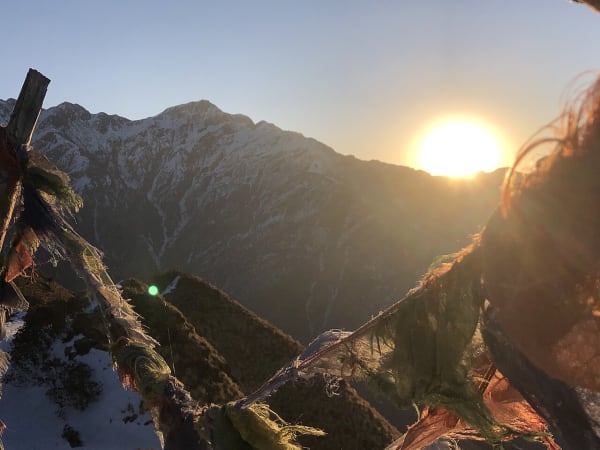
The Annapurna Sanctuary is the best-value high-mountain trek in Nepal, and arguably the most dramatic arrival on any trail in the country. For four days you climb a deepening gorge between two huge ridges, seeing almost nothing above you — and then the valley opens without warning into a glacial amphitheatre surrounded by Annapurna I, Annapurna South, Hiunchuli, Gangapurna, and Machhapuchhre, all of them apparently overhead.
It reaches 4,130 m, which is high enough to be a real mountain trek and low enough that altitude is manageable. It is reached by road from Pokhara, which removes the flight risk that shapes every Everest itinerary. And it costs roughly half what the Khumbu does.

The Trek at a Glance
| Duration | 9 days from Kathmandu, or 5 days from Pokhara |
| Highest point | Annapurna Base Camp, 4,130 m |
| Highest night | Annapurna Base Camp, 4,130 m |
| Difficulty | Moderate — significant ascent and descent on stone staircases |
| Best seasons | March to May, September to November |
| Access | Road from Pokhara to Nayapul or Kande, no flight needed |
| Permits | Annapurna Conservation Area Permit and trekking registration |
| Accommodation | Teahouse lodges throughout |
| Altitude risk | Low — descent is always within a few hours |
We run it as a 9-day trek from Kathmandu, a 5-day trek from Pokhara for travellers already in the city, and a compact 5-day ABC trek. Adding Poon Hill makes it a 12-day trip, and linking it to the Mardi Himal ridge gives a 14-day double base camp route.
The Route
Pokhara to Chhomrong (1,100 m to 2,170 m)
A road transfer to Nayapul or Kande, then two days through the middle hills: rice and millet terraces, Gurung villages, and the long stone staircase up to Chhomrong, which is where the serious mountain trek begins. Ghandruk, a large traditional Gurung village with a museum and views of Annapurna South, is a common first or second night.
Chhomrong to Deurali (2,170 m to 3,230 m)
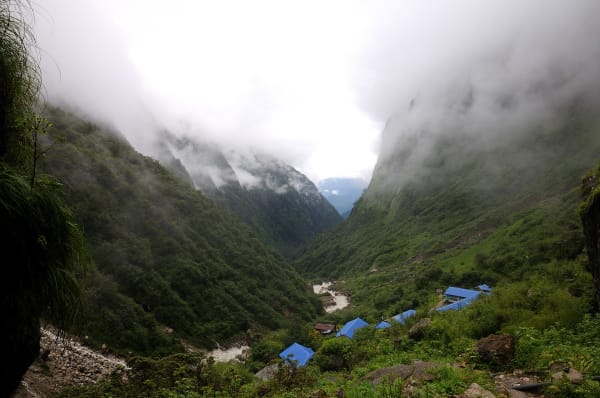
Into the gorge. The trail drops to the Chhomrong Khola, climbs to Sinuwa, then follows the Modi Khola through Bamboo and Dovan — dense, dripping bamboo and rhododendron forest between walls that close in overhead. It is atmospheric rather than scenic; the mountains are hidden almost the whole way.
Deurali to Annapurna Base Camp (3,230 m to 4,130 m)
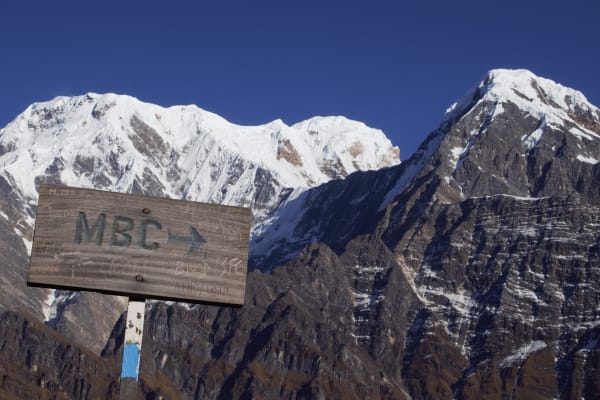
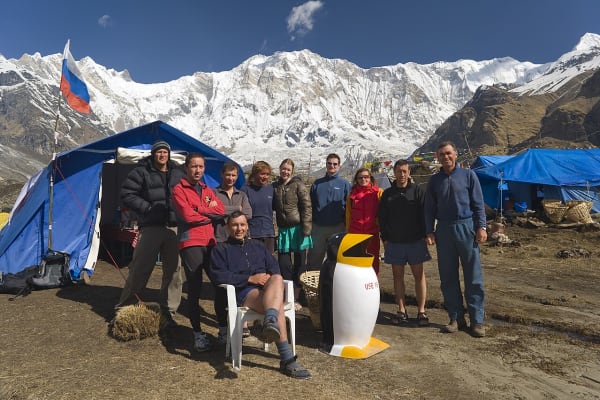
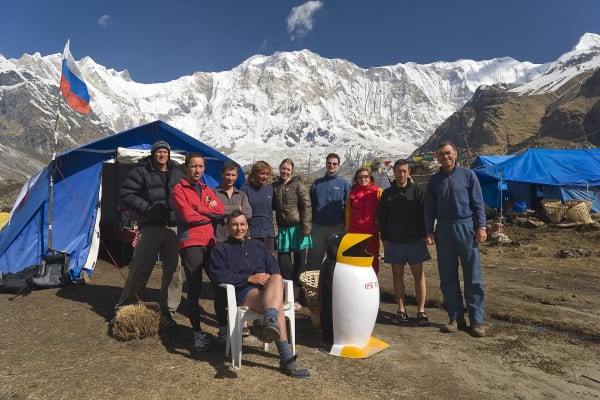
The payoff day. Above Deurali the gorge narrows to its tightest point, then opens at Machhapuchhre Base Camp (3,700 m) and the whole Sanctuary appears at once. A further two hours of gentle moraine reaches Annapurna Base Camp at 4,130 m, a handful of lodges on the glacier's edge with a 360-degree ring of peaks: Annapurna I at 8,091 m, Annapurna South, Hiunchuli, Gangapurna, Tent Peak, Fluted Peak, and Machhapuchhre.
Sunrise at Base Camp is the thing people come for — Annapurna South turning gold while the floor of the Sanctuary is still in shadow. Get up for it.
The descent
Back down the gorge, usually with a night at Bamboo or Sinuwa, and a stop at the Jhinu Danda hot springs on the Modi Khola — natural riverside pools, and the best hour of the entire trek after four days of walking.
Difficulty: Stone Staircases, Not Altitude
Annapurna Base Camp is graded moderate, but what makes it moderate is different from Everest. The altitude is manageable: 4,130 m is high enough for mild symptoms but low enough that a couple of hours of descent resolves anything. What it demands is legs.
- 5 to 6 hours a day, with 700 to 1,100 m of ascent or descent on most of them.
- Stone staircases. The climbs to Ulleri, Chhomrong, and Sinuwa are thousands of stone steps, and the descents are the same steps in reverse.
- Cumulative up and down. The gorge section loses and regains height repeatedly, so the net gain understates the work considerably.
- No rest day needed — the profile is gradual enough, which is why the trek fits into nine days.
The practical consequence: train your descent, and bring trekking poles. Knees, not lungs, are what trekkers complain about on the Annapurna trail. Our training plan covers the eccentric strength work that helps.
The Avalanche Question
The gorge between Deurali and Machhapuchhre Base Camp is a narrow corridor below steep, loaded slopes, and it is genuinely avalanche-prone after heavy snowfall — most commonly in late winter and early spring. There have been fatal incidents in that section.
This is not a reason to avoid the trek, and it is a reason to go with a guide who is checking conditions rather than a schedule. What we do:
- Call lodges higher up the valley daily for snow conditions.
- Cross the corridor early in the morning, before the day's warming.
- Hold the group at Deurali or Dovan for a day rather than cross a loaded slope.
- Turn around at Machhapuchhre Base Camp if the upper section is unsafe, which still gives you the Sanctuary view.
If you are trekking in February or March after a heavy winter, accept from the outset that the itinerary may need a spare day. That flexibility is the safety system.
Permits, Lodges, and Cost
You need the Annapurna Conservation Area Permit (ACAP) at NPR 3,000 and trekking registration, both arranged by us. There is no restricted-area permit and no flight, which is a large part of why this trek is affordable.
Lodges are good throughout and excellent at Chhomrong and Ghandruk — attached bathrooms, hot showers, bakeries, and in places genuinely comfortable rooms. Deurali and Annapurna Base Camp are simpler and much colder, and Base Camp fills first in peak season, which is why our guides start that day early and book ahead.
Bring a sleeping bag rated to -10 °C; Base Camp nights run to around -10 °C in the main seasons. Meals are included on our trips, and trail extras — showers, charging, Wi-Fi, the hot springs entry — run USD 10 to 15 a day. See our cost guide.
Which Version to Book
| Itinerary | Days | Suits |
|---|---|---|
| Annapurna Base Camp from Kathmandu | 9 | The standard trip, including Kathmandu and Pokhara transfers |
| ABC from Pokhara | 5 | Travellers already in Pokhara who want the Sanctuary and nothing else |
| ABC Trek Nepal | 5 | The compact version, using jeep transfers to shorten the walk in |
| ABC with Ghorepani and Poon Hill | 12 | Adds the Poon Hill sunrise and the Ghorepani rhododendron forest |
| ABC with Poon Hill from Pokhara | 8 | The same combination, Pokhara start and finish |
| ABC with Mardi Himal | 14 | Two base camps, a high ridge, and the hot springs between them |
| ABC with Mardi Himal from Pokhara | 10 | The double base camp route without Kathmandu days |
If you have the days, the combination with Poon Hill is the one we recommend most often — it adds a dawn viewpoint over Dhaulagiri and the Annapurnas at the cost of three days, and the rhododendron forest around Ghorepani in April is spectacular.