

Annapurna Base Camp with Ghorepani Poonhill from Pokhara
The Annapurna Base Camp Trek from Pokhara is an 8-day Himalayan adventure combining stunning mountain scenery, tradition
Porter
$308 $280/porter
No payment required yet
Trip Overview
The Annapurna Base Camp Trek from Pokhara is an 8-day Himalayan adventure combining stunning mountain scenery, traditional villages, lush rhododendron forests, and the dramatic landscapes of the Annapurna Sanctuary. The journey begins with a scenic drive to Ghorepani, followed by an early-morning hike to Poon Hill for spectacular sunrise views. From there, the trail continues through Tadapani, Chhomrong, Bamboo, and Deurali before reaching the iconic Annapurna Base Camp at 4,130 m.
After enjoying the breathtaking panorama of Annapurna and surrounding peaks, the trek descends through the sanctuary toward Bamboo and continues to Jhinu Danda. Here, you can relax at the natural hot springs before driving back to Pokhara. This trek is ideal for travelers looking for a rewarding Himalayan experience that combines mountain scenery, cultural encounters, forest trails, and the unforgettable experience of reaching Annapurna Base Camp.
Trip higlights
Reach Annapurna Base Camp: Trek to the iconic Annapurna Base Camp at 4,130 m, surrounded by towering Himalayan peaks.
Sunrise at Poon Hill: Enjoy spectacular sunrise views over the Annapurna and Dhaulagiri mountain ranges from 3,210 m.
Explore the Annapurna Sanctuary: Walk through dramatic mountain landscapes, lush forests, waterfalls, and diverse terrain.
Experience Gurung Villages: Discover traditional mountain communities and experience the local culture and lifestyle.
Relax at Jhinu Hot Springs: Soothe your muscles in the natural hot springs at Jhinu Danda after completing the trek.
Itinerary
A scenic 8-day Annapurna Base Camp adventure from Pokhara through Poon Hill, traditional villages, lush forests, and the spectacular Annapurna Sanctuary.
1Day 1Drive from Pokhara (822 m) to Ghorepani (2,860 m)
Drive from Pokhara (822 m) to Ghorepani (2,860 m)
This route reaches the Sanctuary the long way round, taking in the Poon Hill sunrise first. We leave Pokhara (822 m) early by jeep, heading west through Nayapul and Birethanti and then up the rough road that climbs the Bhurungdi Khola valley toward Ulleri.
The drive is spectacular and steep in equal measure, switchbacking up terraced hillsides past Tikhedhunga and the famous Ulleri stone staircase — some 3,000 steps that trekkers on the classic itinerary climb on foot. Above Ulleri the road enters magnificent rhododendron forest, which turns crimson and pink across whole hillsides in March and April.
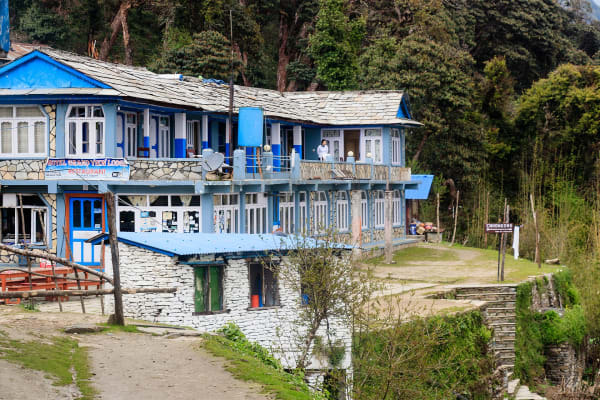
We arrive at Ghorepani (2,860 m) in the afternoon, a ridge-top village of blue-roofed lodges sitting in a saddle at the head of the valley. The altitude gain from Pokhara is over 2,000 m in a single day, so take the evening gently, drink plenty and eat well. Overnight in Ghorepani.
2Day 2Hike to Poon Hill (3,210 m) and Trek from Ghorepani (2,860 m) to Tadapani (2,630 m)
Hike to Poon Hill (3,210 m) and Trek from Ghorepani (2,860 m) to Tadapani (2,630 m)
A pre-dawn start — usually around 4:30 am — for the 45-minute climb up to Poon Hill (3,210 m) by head torch. The viewpoint at the top is the most photographed in Nepal for good reason: sunrise breaks over a 180-degree wall of Himalaya, with Dhaulagiri (8,167 m) and Annapurna I (8,091 m) both visible, along with Nilgiri, Tukuche, Annapurna South, Hiunchuli and Machhapuchhre.
We descend to Ghorepani for a full breakfast, then set off east on the ridge trail toward Tadapani. The path climbs first to Deurali pass at around 3,000 m, then contours and drops through some of the finest old rhododendron forest on the trek — gnarled trunks, hanging moss, and glimpses of the Annapurnas between the branches.
The trail descends through Banthanti to Tadapani (2,630 m), a small cluster of lodges on a forested spur with an exceptional head-on view of Annapurna South and Machhapuchhre. Overnight in Tadapani.
3Day 3Trek from Tadapani (2,630 m) to Chhomrong (2,170 m)
Trek from Tadapani (2,630 m) to Chhomrong (2,170 m)
Step outside at first light — Tadapani's view of Machhapuchhre turning gold is one of the quieter pleasures of this route, and you will usually have it to yourself.
After breakfast the trail drops steeply through dense forest toward Chhomrong Khola, losing height quickly on stone steps and root-bound path. This is prime birding country: watch for Himalayan monal, Nepal's national bird, whose iridescent plumage flashes green and copper when it breaks cover. The forest thins into farmland as you descend, and the trail passes through the Gurung settlement of Ghurjung.
A final climb brings you onto the shelf at Chhomrong (2,170 m), the gateway village to the Annapurna Sanctuary. From its stone-paved lanes the view runs straight up the Modi Khola to Annapurna South and Hiunchuli — tomorrow's direction of travel. Chhomrong has bakeries, gear shops and hot showers, and it is the last village of any size before base camp. Overnight in Chhomrong.
4Day 4Trek from Chhomrong (2,170 m) to Bamboo (2,310 m)
Trek from Chhomrong (2,170 m) to Bamboo (2,310 m)
A short but deceptively demanding day. From Chhomrong the trail immediately descends a long flight of stone steps to the Chhomrong Khola, crosses on a suspension bridge, and then climbs steeply back up the far side to Upper Sinuwa (2,360 m). The net height gain for the day is small, but the up-and-down adds up.
From Sinuwa the path enters the forest properly, contouring along the flank of the valley with the Modi Khola running far below. The vegetation thickens into bamboo groves and moss-hung oak, and the valley walls begin to close in on both sides — the sense of entering somewhere enclosed and remote grows with every kilometre.
The trail descends gently into Bamboo (2,310 m), a small settlement of lodges in a green hollow named for the dense stands that surround it. It sits low enough to be warm and humid, and it is a comfortable altitude to sleep at before the serious climbing starts. Overnight at Bamboo.
5Day 5Trek from Bamboo (2,310 m) to Deurali (3,230 m)
Trek from Bamboo (2,310 m) to Deurali (3,230 m)
Today the trek turns upward and stays there. From Bamboo the trail climbs steadily along the west bank of the Modi Khola through Dovan (2,600 m), a shaded stop with a couple of lodges beside the river.
Above Dovan the gorge narrows sharply. The path passes a small shrine beneath a rock overhang at Himalaya, dedicated to the goddess who is said to guard the Sanctuary, and continues climbing through wet forest with waterfalls dropping directly across the trail. The stone can be slippery here, particularly after rain, and the noise of the river fills the valley.
The last section breaks out above the treeline into a bare rock corridor and arrives at Deurali (3,230 m). At over 900 m of ascent this is the biggest climbing day of the trek, and the altitude is now real — expect to feel short of breath on the final steps. Hydrate, eat properly and sleep early. Overnight at Deurali.
6Day 6Trek from Deurali (3,230 m) to Annapurna Base Camp (4,130 m)
Trek from Deurali (3,230 m) to Annapurna Base Camp (4,130 m)
The day you enter the Sanctuary. From Deurali the trail climbs through the head of the gorge across open slopes that carry avalanche risk in spring, which your guide will assess before setting out.
The valley then opens at Machhapuchhre Base Camp (3,700 m), where a small group of lodges sits on grass beneath the fluted ice walls of the sacred fishtail peak. We break here for tea and to let the altitude settle before the final section.
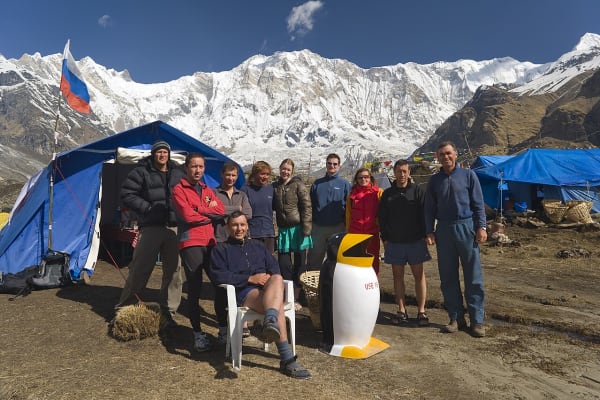
From MBC the last 430 m is a gentle climb over moraine and alpine meadow into the heart of the Annapurna Sanctuary, finishing at Annapurna Base Camp (4,130 m). You are enclosed by Annapurna I (8,091 m), Annapurna South (7,219 m), Hiunchuli, Gangapurna, Tent Peak and Machhapuchhre — a complete ring of giants with the Annapurna Glacier below. Having come via Poon Hill, you have now seen this massif from both outside and in. Overnight at base camp.
7Day 7Trek from Annapurna Base Camp (4,130 m) to Bamboo (2,310 m)
Trek from Annapurna Base Camp (4,130 m) to Bamboo (2,310 m)
Sunrise at base camp is the reason to endure the cold night. Annapurna I lights first, then the glow travels around the rim of the Sanctuary peak by peak while the floor stays in blue shadow. Wrap up and be outside in good time.
After breakfast the long descent begins. We retrace the route across the meadows to Machhapuchhre Base Camp and drop back into the gorge, passing Deurali and Himalaya. The altitude comes off fast and each hour makes breathing easier.
The trail continues through Dovan and down into the warm, humid forest of the lower valley, ending at Bamboo (2,310 m). This is more than 1,800 m of descent in a day, almost all of it on stone steps — poles and a steady pace will save your knees. Overnight at Bamboo.
8Day 8Trek from Bamboo (2,310 m) to Jhinu Danda (1,780 m) and Drive to Pokhara (822 m)
Trek from Bamboo (2,310 m) to Jhinu Danda (1,780 m) and Drive to Pokhara (822 m)
The last walking day retraces the forest trail through Sinuwa, drops to the Chhomrong Khola and climbs the stone steps back to Chhomrong (2,170 m), closing the loop on the village you passed through on the way in.
From Chhomrong it is a steady descent through terraced fields to Jhinu Danda (1,780 m), and from there a twenty-minute path down to the hot springs on the bank of the Modi Khola. Three stone pools of naturally heated water beside a cold, fast river make an excellent final stop after eight days of walking.
A jeep collects us for the drive back to Pokhara (822 m), arriving in the late afternoon. This itinerary has taken you to the Poon Hill sunrise, through rhododendron forest, and into the Annapurna Sanctuary itself — the two best-known walks in the region joined into one. Overnight in Pokhara.
Inclusions & Exclusions
Our Annapurna Base Camp Trek package includes the essential transportation, accommodation, permits, meals, and professional trekking services required for a smooth and enjoyable journey. Personal expenses, optional services, and costs outside the planned itinerary are not included.
What's Included
Private transportation from Pokhara to Ghorepani.
Private transportation from Jhinu Danda to Pokhara.
Accommodation in local teahouses during the trek.
All required Annapurna Conservation Area and trekking permits.
Professional English-speaking licensed trekking guide.
Three meals a day (breakfast, lunch, and dinner) during the trek.
Group trekking map for route guidance.
First aid kit carried by the guide.
All government taxes, permit fees, and service charges.
What's Excluded
Travel insurance, including emergency helicopter evacuation coverage.
Personal trekking equipment and clothing.
Porter services (available at an additional cost).
Lunch and dinner in Pokhara.
Snacks, bottled water, hot showers, Wi-Fi, charging fees, and alcoholic or soft drinks.
Personal expenses such as laundry, phone calls, and souvenirs.
Tips for guides, drivers, and support staff.
Any additional accommodation, transportation, or expenses caused by unforeseen circumstances beyond the itinerary.
Route Map
Follow the scenic route from Pokhara to Ghorepani, Poon Hill, Tadapani, Chhomrong, Bamboo, Deurali, Annapurna Base Camp, Jhinu Danda, and back to Pokhara.
Loading map...
Altitude Profile
Pricing
Our Annapurna Base Camp Trek pricing includes essential trekking services, permits, accommodation, meals, transportation, and guide services for a hassle-free Himalayan adventu
Add-ons
Choose from optional add-ons such as porter service, extra nights, private transportation, and other personalized services to make your trek more comfortable and con
Packing List
Packing properly is important for a comfortable Annapurna Base Camp Trek. Since the trail reaches 4,130 m, you should prepare for changing temperatures, cold nights, rain, and varying trail conditions. Keep your backpack as light as possible while carrying the essentials.
Clothing
Moisture-wicking trekking T-shirts
Long-sleeve thermal base layers
Fleece or warm mid-layer
Down or insulated jacket
Waterproof and windproof jacket
Trekking trousers
Thermal trousers for cold nights
Lightweight waterproof trousers
Warm hat and sun hat
Gloves
Several pairs of trekking and wool socks
Footwear
Comfortable, broken-in trekking boots
Lightweight sandals or slippers for teahouses
Waterproofing spray or treatment for trekking boots
Trekking Equipment
Comfortable daypack
Backpack rain cover
Trekking poles
Sleeping bag suitable for cold temperatures
Headlamp with spare batteries
Water bottles or hydration bladder
Sunglasses with UV protection
Sunscreen and lip balm with SPF
Personal Essentials
Personal medication and basic medicines
Small first-aid supplies
Toiletries and quick-dry towel
Hand sanitizer and wet wipes
Power bank
Universal travel adapter
Passport and necessary documents
Some Nepalese cash for personal expenses
Tip: Avoid overpacking. Most items can be kept to a minimum because basic accommodation and meals are available throughout the trekking route.
For the complete kit list, organised by the altitude you will reach, see our Nepal trekking packing list.
Best Time to Trek
The best seasons for the Annapurna Base Camp Trek are spring (March–May) and autumn (September–November). During these months, the weather is generally stable, skies are clearer, and mountain views are at their best.
Spring – March to May
Spring brings pleasant trekking conditions and colorful rhododendron forests. The lower sections of the trail become particularly beautiful as rhododendrons bloom. Temperatures are comfortable during the day, although mornings and nights become colder at higher elevations.
Autumn – September to November
Autumn is considered one of the best periods for the trek. The monsoon season has generally cleared the atmosphere, resulting in excellent mountain visibility. The weather is usually dry and stable, making the trail comfortable for long trekking days.
Winter – December to February
Winter brings cold temperatures and snowfall at higher elevations. Annapurna Base Camp can become very cold, and snow may affect sections of the trail. Experienced trekkers can still complete the trek with proper equipment and preparation.
Monsoon – June to August
Monsoon brings frequent rainfall, cloudy skies, slippery trails, and a higher possibility of landslides in some areas. However, the landscape becomes exceptionally green, and the trek can still be undertaken with appropriate preparation.
For a month-by-month look at weather and trail conditions, see our guide to the best time to trek in Nepal.
Difficulty & Fitness
The Annapurna Base Camp Trek is generally considered a moderate trek. No technical climbing experience is required, but you should be prepared for several consecutive days of walking on uneven mountain trails with frequent ascents and descents.
You will typically walk for around 5–7 hours per day, depending on the route, terrain, weather, and pace. Some sections include steep stone steps, particularly around Chhomrong, while the trail becomes more demanding as you gain altitude toward Deurali and Annapurna Base Camp.
How to Prepare
Regular walking, hiking, stair climbing, jogging, cycling, or other cardiovascular exercises before the trek can help improve endurance. It is also useful to train with a backpack so your body becomes comfortable carrying your trekking essentials.
You don't need to be an elite athlete, but having good cardiovascular fitness, leg strength, and the ability to walk for several hours continuously will make the journey much more enjoyable.
To build that fitness step by step, follow our 12-week training plan for a Nepal trek.
Accommodation & Food
Accommodation during the Annapurna Base Camp Trek is mainly provided in local teahouses and lodges. These are simple mountain accommodations designed for trekkers and generally provide beds, blankets, shared bathrooms, and communal dining areas. Facilities become more basic as you travel toward higher elevations.
Rooms are typically simple and may have twin beds. Hot showers, Wi-Fi, and charging facilities are available at many lower-elevation lodges for an additional fee, but availability can be limited at higher elevations.
Meals
Three meals are provided during the trekking days: breakfast, lunch, and dinner. Typical meals include dal bhat, noodles, fried rice, pasta, soup, potatoes, eggs, Tibetan bread, pancakes, and other simple local or international dishes.
Dal bhat is a particularly popular choice because it provides a filling combination of rice, lentils, vegetables, and curry, making it a good option for long trekking days.
Drinking Water
Safe drinking water is available at teahouses and local water stations. Trekkers should carry reusable bottles or a hydration bladder and use appropriate water purification methods when necessary.
What the lodges are really like, from rooms and meals to showers and charging, is covered in our guide to teahouse trekking in Nepal.
Altitude & Acclimatization
The highest point of the trek is Annapurna Base Camp at 4,130 m, so altitude is an important consideration. The route gradually gains elevation through Ghorepani, Tadapani, Chhomrong, Bamboo, and Deurali before reaching the base camp.
Altitude-related symptoms can include headache, tiredness, dizziness, nausea, or difficulty sleeping. Everyone responds differently to altitude, so it is important to listen to your body and inform your guide if you experience unusual symptoms.
Tips for Altitude
Walk at a comfortable and steady pace.
Stay properly hydrated.
Avoid excessive alcohol at higher elevations.
Eat regular, nutritious meals.
Get enough rest and sleep.
Follow your guide's recommendations.
Do not ignore worsening altitude-related symptoms.
The descent after reaching Annapurna Base Camp is an important part of the itinerary, allowing you to return to lower elevations relatively quickly after experiencing the highest point of the trek.
Prevention, symptoms and treatment are covered in depth in our guide to altitude sickness in Nepal.
Frequently Asked Questions
Find answers to common questions about the Annapurna Base Camp with Ghorepani Poon Hill Trek, including difficulty, preparation, accommodation, weather, and trekking essentials.
1Do I need previous trekking experience for the Annapurna Base Camp Trek?
No, previous high-altitude trekking experience is not required. However, a reasonable level of fitness and preparation is recommended.
2Do I need a guide for the Annapurna Base Camp Trek?
Yes. A licensed trekking guide is required for this route, and having a guide also provides assistance with navigation, accommodation, safety, and local information.
3How many kilometers is the Annapurna Base Camp Trek?
The total trekking distance varies depending on the exact route and transportation arrangements, but this Pokhara-to-Pokhara itinerary covers approximately 70–75 km of trekking.
4Is there mobile phone coverage during the trek?
Mobile coverage is available in several villages along the route, but the signal can become weak or unavailable in some sections, particularly at higher elevations.
5Can I charge my phone and camera during the trek?
Yes, charging facilities are available at many teahouses, generally for an additional fee. Carrying a power bank is recommended.
6Are there ATMs on the Annapurna Base Camp route?
No, reliable ATM facilities are not available along the trekking route. It is best to withdraw enough Nepalese cash in Pokhara before starting the trek.
7Can I trek to Annapurna Base Camp during the winter?
Yes, the trek is possible during winter, but snow, freezing temperatures, and changing trail conditions can make the journey more challenging.
8Is travel insurance necessary for the trek?
Yes, comprehensive travel insurance covering trekking at high altitude and emergency evacuation is strongly recommended.
9What type of toilet facilities are available during the trek?
Most teahouses have shared toilet facilities, while some lodges offer attached bathrooms. Facilities become more basic at higher elevations.
10Can I extend or customize the Annapurna Base Camp Trek?
Yes, the itinerary can generally be customized with additional nights, different starting or ending points, rest days, porter services, or other arrangements according to your preferences.
Gallery
Explore authentic moments from the Ghorepani, Poon Hill, and Annapurna Base Camp trekking route through real mountain landscapes, villages, trails, and Himalayan views.
Trekking Guides & Articles
Yoga for Trekkers: What to Do Before and After the Trail — Trekking loads the same muscles for six hours a day, two weeks running.
Stomach Illness on a Nepal Trek: Prevention, Medication and Recovery — Stomach trouble is the commonest illness on a Nepal trek — more common than altitude sickness.
Annapurna Base Camp Trek: The Complete Guide — A walk from rice terraces into a glacial amphitheatre ringed by 7,000 and 8,000 m peaks, in nine days from Kathmandu or five from Pokhara.
Fix Departure
This trek runs every week on the selected day(s). Choose custom dates for one-off departures.
Showing fixed departures in Oct 2026
Guest Reviews
Incredible trek, incredible team
“This was my first proper trek and the team made it feel easy and enjoyable. Our guide was fantastic — knowledgeable about the mountains, the culture and exactly when we needed a break. The teahouses a...
Diego Cole
Get in Touch
Tell us the dates you have in mind and roughly what you want out of the trek — one of our guides will reply, usually within 24 hours.
Email Us
info@greencompasstreks.com
Call Us
+977 9864379436
Office
Lakeside, Pokhara, Nepal
Office Hours
Sunday – Friday, 9:00 AM – 9:00 PM
Similar Treks
You might also like these treks


Porter
$308 $280/porter
No payment required yet