

Manaslu Circuit Trek
The Manaslu Circuit Trek is one of Nepal’s most spectacular Himalayan adventures, offering an unforgettable journey arou
Porter
$501 $455/porter
Private Jeep form Kathmandu to Machha Khola
$275 $250/jeep
Private Jeep form Dharapani to Kathmandu
$330 $300/jeep
No payment required yet
Trip Overview
The Manaslu Circuit Trek is one of Nepal’s most spectacular Himalayan adventures, offering an unforgettable journey around Mount Manaslu (8,163 m) through remote mountain villages, lush forests, dramatic valleys, and breathtaking high-altitude landscapes. The trail follows the Budhi Gandaki River through traditional Gurung and Tibetan-influenced communities, providing a wonderful combination of natural beauty, rich culture, and authentic Himalayan experiences away from the busier trekking routes.
The major highlight of the trek is crossing the challenging Larkya La Pass (5,106 m), where trekkers are rewarded with spectacular views of Manaslu, Himlung Himal, Cheo Himal, Kang Guru, and Annapurna II. With its diverse landscapes, remote settlements, mountain scenery, and rewarding high-altitude experience, the Manaslu Circuit Trek is an excellent choice for adventure seekers looking for a less-crowded and culturally rich trekking experience in Nepal.
Trip Higlights
Cross the Challenging Larkya La Pass (5,106 m): Conquer the highest point of the Manaslu Circuit and enjoy spectacular views of snow-covered Himalayan peaks, glaciers, and dramatic mountain landscapes.
Explore Manaslu Base Camp or Pungyen Gompa: Use your acclimatization day in Sama Gaun to hike toward Manaslu Base Camp or visit the peaceful and culturally significant Pungyen Gompa.
Trek Through Remote Himalayan Villages: Walk through traditional villages such as Jagat, Deng, Namrung, Shyala, Sama Gaun, and Samdo while experiencing authentic mountain life and local hospitality.
Experience Diverse Himalayan Landscapes: Trek through lush forests, deep river valleys, alpine meadows, rugged mountain terrain, and spectacular high-altitude landscapes surrounding Mount Manaslu.
Discover Tibetan-Inspired Mountain Culture: Experience the unique Buddhist traditions, monasteries, architecture, and Tibetan-influenced lifestyle of communities in the upper Manaslu region.
Itinerary
A 15-day Manaslu Circuit Trek featuring diverse landscapes, authentic mountain villages, acclimatization days, and the challenging Larkya La Pass at 5,106 m.
1Day 1Day 1: Arrival in Kathmandu (1,400 m)
Day 1: Arrival in Kathmandu (1,400 m)
You arrive at Tribhuvan International Airport in Kathmandu (1,400 m) and are met by our representative for the transfer to your hotel in Thamel.
Your guide runs the pre-trek briefing. The Manaslu Circuit is a restricted-area trek: it requires a special permit, a licensed guide and a minimum group size, and there is no exception to any of that. We go through the permits, the daily stages and — most importantly — the crossing of Larkya La (5,106 m), one of the longest and most committing pass days on any teahouse trek in Nepal.
Kit is checked carefully. The pass demands a proper down jacket, insulated gloves, a four-season sleeping bag and boots with grip on snow; the lodge at Dharmasala is basic and cold. Anything missing can be bought or hired in Thamel. The rest of the day is free. Overnight in Kathmandu.
2Day 2Drive from Kathmandu (1,400 m) to Machha Khola (930 m)
Drive from Kathmandu (1,400 m) to Machha Khola (930 m)
A long day on the road heading west and then north. We leave Kathmandu early on the Prithvi Highway, turn north at Dhading Bensi, and follow increasingly rough roads up the Budhi Gandaki valley.
The first half is straightforward highway through terraced middle-hill country. The second half is not: the track narrows to a single lane cut into steep hillsides above the river, with rockfall in places and river crossings on rough bridges. It is slow, bumpy and frequently spectacular, taking eight to nine hours in total.
Machha Khola (930 m) — the name means 'fish river' — is a small strip of lodges beside the Budhi Gandaki, and this is where the walking begins tomorrow. It is low, warm and humid here, which makes the eventual contrast with Larkya La all the more striking. Overnight in a teahouse.
3Day 3Trek from Machha Khola (930 m) to Jagat (1,340 m)
Trek from Machha Khola (930 m) to Jagat (1,340 m)
The first walking day, following the Budhi Gandaki upstream through a hot, steep-sided gorge. The trail is carved into the valley wall in places and crosses the river repeatedly on suspension bridges.
The route passes Khorlabesi and reaches Tatopani, where natural hot springs emerge beside the trail — a genuinely welcome stop, though it is warm enough at this altitude that most people just soak their feet. Beyond it the path climbs over a ridge on a staircase cut into rock and drops to Dobhan.
The valley here is subtropical: banana and bamboo, waterfalls dropping straight onto the path, and monkeys in the trees. The day ends at Jagat (1,340 m), a neatly paved village of stone houses that marks the official entry to the Manaslu Conservation Area, where your restricted-area permits are checked and registered. Overnight in Jagat.
4Day 4Trek from Jagat (1,340 m) to Deng (1,804 m)
Trek from Jagat (1,340 m) to Deng (1,804 m)
The valley narrows dramatically today and the culture starts to change with it.
From Jagat the trail climbs to Salleri and then contours to Sirdibas and Philim, a substantial village spread across terraced fields. Above Philim the gorge tightens into one of the most impressive sections of the whole route — sheer walls, the river far below, and the trail pinned to the cliff on wooden galleries and suspension bridges in places.
At Lokpa the trail to Tsum Valley branches north-east; the circuit continues west. From here the settlements begin to look Tibetan rather than Nepali: flat-roofed stone houses, chortens at village entrances, and mani walls carved with the six-syllable mantra. The first Buddhist gate marks the transition. Deng (1,804 m) is a tiny village of a few lodges in the gorge. Overnight in Deng.
5Day 5Trek from Deng (1,804 m) to Namrung (2,630 m)
Trek from Deng (1,804 m) to Namrung (2,630 m)
A long climbing day that lifts you out of the gorge and into proper mountain country.
The trail crosses the Budhi Gandaki and climbs through forest to Rana and Bihi Phedi, then continues up the valley past Ghap. The vegetation shifts from subtropical to temperate — pine, fir and rhododendron replace the bamboo — and the air noticeably cools. Along this stretch the mani walls become longer and more elaborate, some of them carved with detailed reliefs of Buddhist deities.
The final climb to Namrung (2,630 m) is steep and comes at the end of a long day. The village sits at a checkpoint with a good lodge or two, and it is the point where the first big peaks appear: Himal Chuli and Ganesh Himal become visible, and on a clear evening you get the first glimpse of Manaslu itself. Overnight in Namrung.
6Day 6Trek from Namrung (2,630 m) to Shyala (3,500 m)
Trek from Namrung (2,630 m) to Shyala (3,500 m)
One of the most rewarding days of the trek, climbing steadily into an increasingly open and Tibetan landscape.
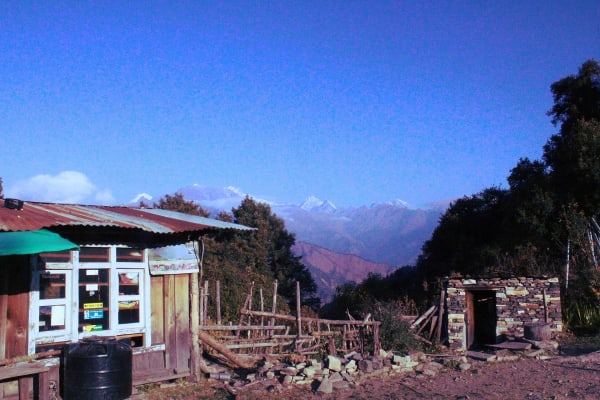
The trail climbs from Namrung through Lihi, with its chortens and barley fields, and on to Lho (3,180 m). Lho is worth the stop: the village has a large monastery, Ribung Gompa, on a rise above it, and from the courtyard there is a famous head-on view of Manaslu (8,163 m) — the eighth-highest mountain in the world — filling the head of the valley.
Beyond Lho the trail continues through pine forest and open pasture to Shyala (3,500 m), a small settlement in a broad, flat-bottomed valley. The setting is extraordinary: Manaslu directly ahead, Himal Chuli and Ngadi Chuli to the south, and Naike Peak and the Larkya massif ahead to the west. You are now high enough that the nights are properly cold. Overnight in Shyala.
7Day 7Trek from Shyala (3,500 m) to Sama Gaun (3,530 m)
Trek from Shyala (3,500 m) to Sama Gaun (3,530 m)
A short and easy day, deliberately so — barely 30 m of net gain, which lets the body catch up before the serious altitude begins.
The trail crosses open pasture from Shyala with Manaslu in view for most of the walk, reaching Sama Gaun (3,530 m) in a couple of hours. Sama is the largest and most traditional village on the route, a substantial Tibetan-influenced settlement of flat-roofed stone houses, with yaks in the lanes and a gompa above.
Arriving before lunch leaves the whole afternoon free, which is exactly the point. Options include the short walk up to Pungyen Gompa, or out to Birendra Lake (3,691 m), a milky turquoise glacial lake below the Manaslu Glacier that takes about an hour each way. Both help acclimatisation. Overnight in Sama Gaun.
8Day 8Acclimatization Day in Sama Gaun (3,530 m) – Day Trip to Manaslu Base Camp (4,800 m) or Pungyen Gompa (4,000 m)
Acclimatization Day in Sama Gaun (3,530 m) – Day Trip to Manaslu Base Camp (4,800 m) or Pungyen Gompa (4,000 m)
A full acclimatisation day, and the one that makes the Larkya La crossing realistic. Climb high, sleep low.
The harder option is Manaslu Base Camp (4,800 m) — around 1,300 m of ascent, five to six hours up on a steep trail past Birendra Lake and up the lateral moraine of the Manaslu Glacier. It is a serious day out, and the reward is standing directly beneath the south face of an eight-thousander, with the icefall tumbling toward you and expedition tents in season.
The gentler option is Pungyen Gompa (4,000 m), a monastery in a side valley east of the village, set beneath the Pungyen Glacier with a fine view of Manaslu's east face. It is around three hours up. Either way, you return to Sama Gaun to sleep. Overnight in Sama Gaun.
9Day 9Trek from Sama Gaun (3,530 m) to Samdo (3,865 m)
Trek from Sama Gaun (3,530 m) to Samdo (3,865 m)
Another short day by design — the itinerary is now pacing the altitude deliberately rather than covering ground.
The trail follows the Budhi Gandaki north-west through a widening, treeless valley. The landscape here is high, dry and open, with juniper scrub, stone-walled potato fields and yak pastures. You pass the ruined village of Kermo Kharka and cross the river on a wooden bridge before the final climb.
Samdo (3,865 m) is the last permanent village on this side of the pass — a compact settlement of around forty households, founded by Tibetan refugees who crossed the border in the 1960s. The Tibetan frontier is only a few hours' walk north, and the villagers still trade over it. The feel here is emphatically not Nepali; it is a Tibetan village that happens to sit in Nepal. Overnight in Samdo.
10Day 10Acclimatization Day in Samdo (3,865 m) – Day Trip Toward the Tibet Border (5,000 m)
Acclimatization Day in Samdo (3,865 m) – Day Trip Toward the Tibet Border (5,000 m)
The second acclimatisation day, and by far the most important preparation for the pass. Two nights at 3,865 m with a high day walk between them is what gets people over Larkya La comfortably.
The standard excursion climbs north up the valley behind the village toward the Tibetan border at around 5,000 m, following an old trading route the people of Samdo still use. It is a steady climb of over 1,100 m taking four to five hours up, on open scree and grass with no shelter.
The view from the top is worth the effort: north into Tibet, and back south over Samdo to Manaslu, Samdo Peak and the Larkya massif you cross tomorrow. It is also a genuine rehearsal for the pass — similar altitude, similar terrain, and a good chance for your guide to see how everyone is coping before committing. We descend to sleep in Samdo. Overnight in Samdo.
11Day 11Trek from Samdo (3,865 m) to Dharmasala (4,460 m)
Trek from Samdo (3,865 m) to Dharmasala (4,460 m)
A short day — three to four hours — because the point is to arrive early, rest, and be ready for a pre-dawn start tomorrow.
The trail drops to cross the Budhi Gandaki on a wooden bridge and then climbs steadily up the exposed valley toward the pass. There is no vegetation to speak of now, just scree, boulders and the occasional patch of alpine grass. The Larkya Glacier appears ahead, and the valley walls close in.
Dharmasala (4,460 m) — also called Larkya Phedi — is not a village but a single basic stone lodge and a few tent platforms in a bare bowl beneath the pass. Facilities are minimal, it is cold, and sleep at this altitude is often broken. Eat as much as you can manage, drink constantly, and get into your bag early: the start tomorrow is around 4:00 am. Overnight in Dharmasala.
12Day 12Trek from Dharmasala (4,460 m) to Bimthang (3,720 m) via Larkya La Pass (5,106 m)
Trek from Dharmasala (4,460 m) to Bimthang (3,720 m) via Larkya La Pass (5,106 m)
The crux of the trek, and one of the longest single days on any teahouse route in Nepal — expect eight to ten hours of walking.
We leave around 4:00 am by head torch, because the wind on the pass strengthens sharply through the morning and afternoon cloud can close the descent entirely. The climb to the pass is long rather than steep, following moraine and then crossing the frozen surface of the glacier basin, with a series of false summits that test everyone's patience. Sunrise on the way up lights Larkya Peak and Cheo Himal.
Larkya La (5,106 m) is a broad saddle strung with prayer flags, with a huge view: Himlung Himal, Cheo Himal, Gyaji Kang, Kang Guru and Annapurna II across the valley. Then comes the descent — nearly 1,400 m, initially steep and loose across moraine, which is the part most people find hardest on tired legs. Bimthang (3,720 m) is a beautiful meadow of lodges beneath the Ponkar Glacier. Overnight in Bimthang.
13Day 13Trek from Bimthang (3,720 m) to Dharapani (1,860 m)
Trek from Bimthang (3,720 m) to Dharapani (1,860 m)
Step outside at dawn: the view from Bimthang back to Manaslu, Himlung and the Ponkar Glacier at first light is the best of the whole circuit, and yesterday you were too tired to appreciate where you had arrived.
The day is then a long descent of nearly 1,900 m into the Marsyangdi valley. The trail drops through rhododendron and pine forest — the first proper trees for a week, and after the bare rock of the pass the green is startling — following the Dudh Khola down past Yak Kharka, Karche and Gho.
The vegetation thickens and the temperature climbs steadily as you lose height, and the villages become Nepali rather than Tibetan again. Dharapani (1,860 m) sits on the Annapurna Circuit trail, and arriving here closes the loop in a satisfying way: this is where circuit trekkers pass on their way up to Chame. Overnight in Dharapani.
14Day 14Drive from Dharapani (1,860 m) to Kathmandu (1,400 m)
Drive from Dharapani (1,860 m) to Kathmandu (1,400 m)
A long day on the road out. A local jeep takes us down the rough track along the Marsyangdi through Tal, Jagat and Bhulbhule to Besisahar (830 m), where the sealed road begins. This first section is slow and bumpy, cut into the gorge wall with the river below.
From Besisahar we transfer to a road vehicle and join the Prithvi Highway east toward the capital, following the Marsyangdi and then the Trishuli through their gorges. The whole journey takes nine to ten hours with stops.
Arriving in Kathmandu (1,400 m) in the evening, you transfer to your hotel. After two weeks in teahouses — the last of them at 4,460 m — a hot shower and a proper meal are genuinely memorable. Overnight in Kathmandu.
15Day 15Departure from Nepal
Departure from Nepal
Your final day in Nepal. If your flight is later there is time for one more part of the Kathmandu Valley — Boudhanath Stupa is a natural close after two weeks among Tibetan Buddhist villages, and Pashupatinath and Swayambhunath are both nearby.
Our representative collects you from your hotel and transfers you to Tribhuvan International Airport around three hours before your scheduled departure.
The Manaslu Circuit is, for many trekkers, the best long route in Nepal — it circles an eight-thousander from subtropical gorge to 5,106 m pass, passes through Tibetan villages where the border is a morning's walk away, and sees a fraction of the traffic of the Annapurna Circuit. If you would like to see more of this region, the Tsum Valley branches directly off it at Lokpa. Safe travels.
Inclusions & Exclusions
Essential transportation, accommodation, meals, permits, licensed guide, trekking map, first aid, and government taxes are included, while international flights, visa, travel insurance, personal gear, porter services, personal expenses, city meals, tips, and unforeseen costs are excluded.
What's Included
Airport pickup and drop-off services in Kathmandu.
Transportation between Kathmandu, Machha Khola, Dharapani, and Kathmandu as per the itinerary.
Accommodation in Kathmandu with breakfast.
Accommodation in local teahouses during the trek.
All required trekking permits and official fees.
Professional English-speaking licensed trekking guide.
Three meals a day (breakfast, lunch, and dinner) during the trek.
Group trekking map for route guidance.
First aid kit carried by the guide.
All government taxes, permit fees, and service charges.
What's Excluded
International flight tickets to and from Nepal.
Nepal entry visa fees.
Travel insurance, including emergency helicopter evacuation coverage.
Personal trekking equipment and clothing.
Porter services (available at an additional cost).
Lunch and dinner in Kathmandu.
Snacks, bottled water, hot showers, Wi-Fi, charging fees, and alcoholic or soft drinks.
Personal expenses such as laundry, phone calls, and souvenirs.
Tips for guides, drivers, and support staff.
Any additional accommodation, transportation, or expenses caused by unforeseen circumstances beyond the itinerary.
Route Map
Explore the terrain map showing the trek route.
Loading map...
Altitude Profile
Pricing
Competitive pricing covering the essential services outlined in the itinerary, with transparent costs and no hidden charges.
Add-ons
Customize your trek with optional services such as porter support, private transportation, and other personalized arrangements at an additional cost.
Food and Accommodation
Food and accommodation are important parts of a comfortable Manaslu Circuit Trek. During the trek, you will stay in local teahouses and lodges along the trail, offering a simple and authentic Himalayan experience. Meals generally include local and international options such as dal bhat, noodles, soups, pasta, rice, vegetables, eggs, and Tibetan-style dishes. Breakfast, lunch, and dinner are provided throughout the trekking days to keep you energized for long hiking hours.
What the lodges are really like, from rooms and meals to showers and charging, is covered in our guide to teahouse trekking in Nepal.
Travel Insurance
Travel insurance is essential for the Manaslu Circuit Trek because the route reaches high altitudes and includes challenging sections such as the Larkya La Pass at 5,106 meters. Your insurance should cover trekking at the maximum altitude of the itinerary, medical treatment, emergency evacuation, and helicopter rescue if required. Having suitable insurance provides peace of mind and financial protection in case of unexpected illness, injury, or other emergencies during the trek.
Our guide to travel insurance for trekking in Nepal explains the altitude limits, evacuation terms and common exclusions to check before you buy.
Trekking Permits
The Manaslu Circuit is a restricted trekking region, so trekkers must obtain the required permits before entering the area. These include the Manaslu Restricted Area Permit and relevant conservation area permits and registration documents. Our team handles the necessary paperwork and permits, allowing you to focus on enjoying the trail, mountain scenery, local villages, and unique Himalayan culture.
The fees and conditions for every restricted area are set out in our guide to restricted area permits in Nepal.
Trekking Equipment
Proper trekking equipment is essential for a safe and enjoyable Manaslu Circuit Trek, particularly during the cold and demanding sections near Larkya La Pass. Trekkers should bring suitable hiking boots, warm layers, a waterproof jacket, gloves, a sleeping bag, trekking poles, a headlamp, and other personal essentials. Good-quality equipment helps you stay warm, comfortable, and prepared for changing Himalayan weather conditions.
For the complete kit list, organised by the altitude you will reach, see our Nepal trekking packing list.
Professional Trekking Guide
A professional, licensed English-speaking guide plays an important role throughout the Manaslu Circuit Trek. Your guide helps with navigation, accommodation, meals, permits, and daily trekking arrangements while also providing valuable information about local culture, traditions, monasteries, and mountain communities. They also monitor your condition during the trek and provide assistance during challenging sections and high-altitude days.
Frequently Asked Questions
Find quick answers to common questions about the Manaslu Circuit Trek.
1How difficult is the Manaslu Circuit Trek?
The Manaslu Circuit Trek is considered a challenging trek because of long hiking days, steep and rugged trails, high altitude, and the crossing of Larkya La Pass at 5,106 meters. Good physical fitness and proper preparation are recommended.
2What is the best time to do the Manaslu Circuit Trek?
The best seasons are spring (March to May) and autumn (September to November), when the weather is generally stable and mountain visibility is excellent. Winter can bring heavy snow around Larkya La, while the monsoon season brings rain and muddy trails.
3How many hours do we walk each day?
Most trekking days involve approximately 5–8 hours of walking, depending on the destination, trail conditions, altitude, and pace of the group. The Larkya La Pass day is one of the longest and most demanding days of the trek.
4Is the Manaslu Circuit Trek suitable for first-time trekkers?
The trek can be completed by first-time trekkers with good physical fitness and proper preparation, but it is more demanding than many beginner-friendly treks. Previous hiking experience is helpful, especially for the long days and high-altitude sections.
5How do I get to the starting point of the Manaslu Circuit Trek?
The trek begins with a drive from Kathmandu to Machha Khola, which takes several hours depending on road and traffic conditions. The journey includes scenic views of rural Nepal and mountain landscapes along the way.
6Is the Manaslu Circuit Trek safe?
The trek is generally safe when undertaken with proper preparation, an experienced guide, appropriate acclimatization, and suitable equipment. Weather, altitude, and trail conditions can change quickly, so following your guide's recommendations is important.
7Can I charge my phone and camera during the trek?
Charging facilities are available at many teahouses along the route, although availability can become limited at higher elevations. Charging usually comes with an additional fee, so carrying a power bank or portable solar charger is recommended.
8Is Wi-Fi or mobile network available on the Manaslu Circuit?
Mobile connectivity and Wi-Fi are available in some villages but can be weak or unavailable in remote and high-altitude sections. The connection generally becomes less reliable as you travel deeper into the Manaslu region.
9Can I use an ATM during the Manaslu Circuit Trek?
ATM facilities are not reliably available along the trekking route, so it is important to carry enough Nepalese cash from Kathmandu for personal expenses and additional services during the trek.
10What should I pack for the Manaslu Circuit Trek?
You should pack lightweight trekking clothes, warm layers, waterproof clothing, sturdy trekking boots, a sleeping bag, gloves, a hat, sunglasses, sunscreen, a headlamp, personal medication, toiletries, and a daypack. Pack according to the season while keeping your luggage as light as possible.
Gallery
Explore authentic moments, landscapes, villages, and Himalayan views from the Manaslu Circuit Trek.
Trekking Guides & Articles
Manaslu Circuit Trek: The Complete Guide — A full Himalayan circuit around the world's eighth-highest mountain, over the 5,106 m Larke La.
Crossing the Larke La: The Manaslu Circuit's Big Day — Eight to ten hours from a single basic lodge at 4,460 m over a 5,106 m pass and down 1,500 m to Bimthang.
Budhi Gandaki Flood, 11 October 2026: What Happened and What It Means for Manaslu Treks — A flash flood came down the Budhi Gandaki in northern Gorkha before dawn on Sunday 11 October 2026.
Manaslu Circuit vs Annapurna Circuit: Which Is the Better Trek? — Two fifteen-day Himalayan circuits, both over a 5,000 m pass, thirty kilometres apart.
Nepal Trekking Permits Explained: TIMS, Park Fees, and Restricted Areas — Every trek in Nepal needs paperwork, and the rules differ by region.
Pre- and Post-Trek Medication for Nepal: The Complete Guide — What to take, when to start it, and what to do afterwards.
Fix Departure
This trek runs every week on the selected day(s). Choose custom dates for one-off departures.
Showing fixed departures in Oct 2026
Guest Reviews
We loved every moment
“Manaslu Circuit Trek was everything we hoped for and so much more. The whole team looked after us brilliantly — nothing was ever too much trouble. I would not hesitate to book with them again and hope...
Freja Perez
Get in Touch
Tell us the dates you have in mind and roughly what you want out of the trek — one of our guides will reply, usually within 24 hours.
Email Us
info@greencompasstreks.com
Call Us
+977 9864379436
Office
Lakeside, Pokhara, Nepal
Office Hours
Sunday – Friday, 9:00 AM – 9:00 PM
Similar Treks
You might also like these treks



Porter
$501 $455/porter
Private Jeep form Kathmandu to Machha Khola
$275 $250/jeep
Private Jeep form Dharapani to Kathmandu
$330 $300/jeep
No payment required yet