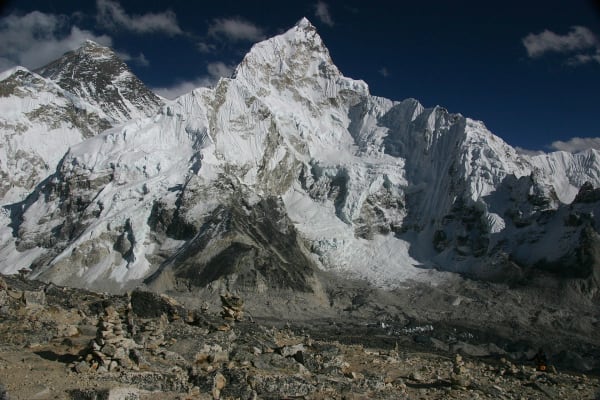
The Larke La — also written Larkya La — at 5,106 m is the crux of the Manaslu Circuit and, in several respects, a harder day than Thorong La. It is slightly lower, but you start from a worse night's sleep in a more basic lodge, the descent is longer, and there is no village on the far side for five hours.
In good conditions it is a magnificent day: glacial lakes below the pass, the Larkya glacier, and a panorama across Himlung, Cheo Himal and Gyaji Kang into the Annapurna range. In bad conditions it is the one place on the circuit where the decision to go or wait genuinely matters.
The Day in Outline
| Time | Where | Altitude | Note |
|---|---|---|---|
| 3.30–4.00 a.m. | Wake at Dharmasala | 4,460 m | Cold, crowded, and nobody slept |
| 4.00–4.30 a.m. | Leave | — | Headlamp, all layers, often -15 °C |
| 6.30–8.00 a.m. | Glacial lakes and the moraine | 4,800–5,000 m | The best scenery of the trek, in first light |
| 8.00–10.00 a.m. | Larke La | 5,106 m | Prayer flags, cairns, 20 minutes in the wind |
| 10.00 a.m.–2.00 p.m. | The descent | to 3,590 m | 1,500 m down, steep and loose at the top |
| Early afternoon | Bimthang | 3,590 m | A meadow basin under Manaslu's western glaciers |
Dharmasala: The Night Before
Dharmasala, sometimes called Larke Phedi, is a single basic lodge at 4,460 m that exists only because the pass needs a staging point. It is the least comfortable night on the circuit and worth preparing for.
- Capacity is small and it fills in October. Expect shared rooms, and in the busiest weeks a mattress in the dining room.
- It is cold — -10 to -18 °C at night, with heating in the dining room only.
- Food is limited. Everything is carried up from Samdo, so the menu is short and prices are the highest on the trek.
- Water is scarce. Buy boiled water or treat what is available; do not count on a tap.
- You will sleep badly. That is normal at 4,460 m and not a reason to abandon the pass.
A practical alternative when Dharmasala is full or the group is struggling: spend an extra night at Samdo (3,875 m) instead, which is more comfortable, better acclimatised and has a good acclimatisation walk toward the Tibet trading pass. It makes the pass day longer but often makes it go better.
What the Crossing Involves
No technical ground in good conditions — no rope, no crampons beyond microspikes — but a long day on high, exposed terrain.
- The climb is about 650 m over four to five hours, on moraine and rough trail, past a series of small glacial lakes that are frozen for much of the season.
- The pass itself is a broad saddle with cairns and prayer flags. It funnels wind, so nobody lingers long.
- The descent is the hard part: steep, loose scree immediately below the pass, then a long gradual drop through moraine and finally into pasture above Bimthang. 1,500 m, four to five hours, and where most injuries on the circuit happen.
- Microspikes are frequently useful, especially early and late in the season.
- Bimthang at the end is worth the day: a wide meadow basin with Manaslu's western glaciers above it, and good lodges.
Preparation
- Take the Samagaun acclimatisation day seriously. Walk to Manaslu Base Camp at around 4,800 m or to Birendra Lake and Pungyen Gompa. This is the single most useful thing you do for the pass.
- Consider the extra Samdo night. 3,875 m is a better sleep than 4,460 m and the acclimatisation walk above Samdo toward the Tibet pass is excellent.
- Pack your daypack at Samdo, not at Dharmasala. At 3.30 a.m. in a crowded dining room at -15 °C, you do not want to be repacking.
- Fill two litres and keep them warm — inside your jacket, not in an outside pocket. A bladder hose freezes.
- Eat at Dharmasala even if you do not want to. The pass day demands calories and the menu is short.
- Wear everything for the first two hours and expect to shed layers after sunrise.
Kit specifics: a -20 °C sleeping bag, two glove layers, category 3 or 4 sunglasses, a headlamp with fresh batteries, trekking poles for the descent, and microspikes if there has been snow. Our packing list covers the rest.
If the Pass Is Closed
This is the scenario worth understanding before you book. Unlike Thorong La, where a retreat to Manang puts you on a road, a closed Larke La means walking back down the entire Budhi Gandaki gorge — five or six days to the road at Soti Khola.
- Waiting. Our itinerary carries spare capacity, and a day at Samdo while the pass clears is the usual outcome. Dharmasala is not a place to wait, so the wait happens lower down.
- Information. Your guide calls lodges at Bimthang and Samdo for conditions, and talks to groups coming the other way.
- Turning back. If the pass stays closed, the retreat down the gorge is long but straightforward, and we reroute and rebook accordingly.
- Helicopter. Possible from Samagaun in an emergency, weather permitting, and expensive. It is a medical option rather than a convenience.
- What we will not do is cross a loaded slope on schedule. If your guide says wait, that is the answer.
In practice, in the main seasons of October to November and April to May, the pass is open the great majority of the time. Winter crossings are a different proposition and we do not schedule them.