

Annapurna Base Camp Trek
The 9-day Annapurna Base Camp Trek is a moderate Himalayan trek that ends inside one of the most dramatic natural amphit
Porter
$193 $175/porter
Flight form Kathmandu to Pokhara
$127 $115/person
Flight from Pokhara to Kathamndu
$127 $115/person
No payment required yet
Trip Overview
The 9-day Annapurna Base Camp Trek is a moderate Himalayan trek that ends inside one of the most dramatic natural amphitheatres on earth. Starting with the drive from Kathmandu to Pokhara, the route climbs the Modi Khola valley through terraced farmland, Gurung villages and dense rhododendron forest before entering the glacial bowl of the Annapurna Sanctuary at 4,130 m.
The walking itself takes five days. From the roadhead at Jhinu Danda (1,780 m) the trail climbs the long stone staircase to Chhomrong (2,170 m), the last permanent village before the sanctuary, then follows the river upstream through Bamboo (2,310 m), Dovan and Deurali (3,230 m) as the gorge narrows and the treeline falls away. The final morning crosses Machhapuchhre Base Camp (3,700 m) before the valley opens completely at base camp.
What makes this trek unusual is how close the mountains stand. At Annapurna Base Camp you are ringed on every side by Annapurna I (8,091 m), Annapurna South (7,219 m), Hiunchuli, Gangapurna, Tent Peak and the unclimbed fishtail summit of Machhapuchhre (6,993 m). Sunrise lights the rim peak by peak, and there is no view out — only up.
The trek is graded moderate. It needs no technical skill and no previous high-altitude experience, but it does involve five to seven hours of walking a day on long flights of stone steps, and the descent is as demanding as the climb. It suits reasonably fit walkers looking for a short itinerary that still reaches genuine high mountain terrain, and it finishes with a soak in the natural hot springs at Jhinu Danda.
Trip Higlights
Reach Annapurna Base Camp (4,130 m): Trek into the spectacular Annapurna Sanctuary and stand beneath towering Himalayan peaks, including Annapurna I, Annapurna South, Hiunchuli, and Machhapuchhre.
Trek Through Diverse Himalayan Landscapes: Experience lush forests, terraced hillsides, waterfalls, river valleys, alpine terrain, and dramatic mountain scenery along the trail.
Explore Traditional Mountain Villages: Pass through charming villages such as Jhinu Danda, Sinuwa, Deurali, and Bamboo while experiencing the local culture and warm Himalayan hospitality.
Enjoy Spectacular Annapurna Mountain Views: Witness breathtaking views of Annapurna, Machhapuchhre, Hiunchuli, and surrounding snow-covered peaks throughout the trek.
Relax at Jhinu Danda Hot Springs: Enjoy the natural hot springs near Jhinu Danda after completing the trek, providing a relaxing way to soothe tired muscles.
Itinerary
A 9-day Annapurna Base Camp adventure combining scenic drives, mountain trails, traditional villages, lush forests, and breathtaking Himalayan views, with an unforgettable stay at Annapurna Base Camp.
1Day 1Arrival in Kathmandu (1,400 m)
Arrival in Kathmandu (1,400 m)
Your trip begins when you land at Tribhuvan International Airport in Kathmandu (1,400 m). A member of our team will be waiting in the arrivals hall with a name board and will drive you to your hotel in Thamel, the compact, walkable quarter that has been the staging post for Himalayan expeditions for more than half a century.
Once you have checked in and had a chance to shower off the flight, we meet for a pre-trek briefing. Your guide runs through the day-by-day plan for the Annapurna Base Camp trek, checks your kit against the packing list, and answers questions about altitude, teahouse life, meals, and how the walking days are paced. This is the moment to sort out anything missing — Thamel's gear shops are a few minutes' walk away and stock everything from down jackets to trekking poles.
The rest of the day is yours. Many trekkers use the afternoon to wander Thamel's alleys, drink coffee in a courtyard garden, or simply sleep off the journey. Overnight in Kathmandu.
2Day 2Drive from Kathmandu (1,400 m) to Pokhara (822 m)
Drive from Kathmandu (1,400 m) to Pokhara (822 m)
After breakfast we leave Kathmandu and follow the Prithvi Highway west toward Pokhara (822 m). The road traces the Trishuli and then the Marsyangdi river for much of its length, with the valley walls rising steeply on either side and the water running green and fast below. It is roughly a 200 km journey and, with traffic and stops, takes most of the day.
The drive is a good introduction to middle-hill Nepal. You pass terraced hillsides stacked like contour lines, roadside towns where buses unload crates of vegetables, suspension footbridges strung across the river, and rafting groups putting in at Charaudi and Kuringhat. We break for lunch at a riverside restaurant along the way.
Pokhara appears in the late afternoon, and the change is immediate: a warm, low-lying lakeside town with the Annapurna massif and the fishtail summit of Machhapuchhre standing directly above it. After checking in we walk down to Phewa Lake for the evening. Overnight in Pokhara.
3Day 3Drive from Pokhara (822 m) to Jhinu Danda (1,780 m) and Trek to Lower Sinuwa (2,340 m)
Drive from Pokhara (822 m) to Jhinu Danda (1,780 m) and Trek to Lower Sinuwa (2,340 m)
An early start takes us out of Pokhara by jeep on the winding road to Jhinu Danda (1,780 m), climbing steadily through Nayapul and up the Modi Khola valley. The road is rough in places and the journey takes around three hours, but it saves a full day of walking on the lower trail.
From Jhinu Danda the trekking begins. The path drops to cross the Modi Khola on a long suspension bridge, then starts the sustained stone-stair climb toward Chhomrong (2,170 m), the last permanent Gurung village before the Sanctuary. Chhomrong sits on a shelf with a clear view up the valley, and it is worth pausing here — this is the point where the trek stops being a walk through farmland and becomes a walk into the mountains.
Beyond Chhomrong the trail descends to the Chhomrong Khola, crosses it, and climbs again through bamboo and rhododendron to Lower Sinuwa (2,340 m). Your first teahouse night is here, with the valley falling away below and Annapurna South visible when the cloud lifts.
4Day 4Trek from Lower Sinuwa (2,340 m) to Deurali (3,230 m)
Trek from Lower Sinuwa (2,340 m) to Deurali (3,230 m)
Today the valley narrows and the walk changes character entirely. From Lower Sinuwa the trail contours through thick forest to Bamboo (2,310 m), a cluster of lodges in a damp, green hollow where the bamboo grows dense enough to close over the path.
From Bamboo the climb is steady and almost continuous, following the Modi Khola upstream through Dovan (2,600 m) and past the sacred overhang at Himalaya. The forest here is oak, rhododendron and moss, often wet underfoot, and the river runs loud in the gorge to your left. Waterfalls drop directly onto the trail in places. Watch for langur monkeys in the canopy and, higher up, for the first Himalayan tahr on the cliffs.
The last section climbs above the treeline into a narrowing rock corridor before reaching Deurali (3,230 m). At almost 900 m of ascent this is the longest climbing day so far, and the air is noticeably thinner. Drink plenty, eat well, and get an early night. Overnight in a teahouse at Deurali.
5Day 5Trek from Deurali (3,230 m) to Annapurna Base Camp (4,130 m)
Trek from Deurali (3,230 m) to Annapurna Base Camp (4,130 m)
This is the day the trek has been building toward. Leaving Deurali early, the trail climbs through the last of the gorge, crosses avalanche terrain that the guides read carefully in spring, and emerges into open, treeless country where the valley finally opens out.
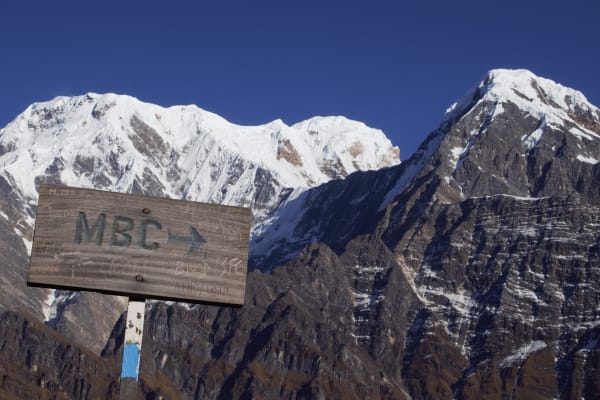
Machhapuchhre Base Camp (3,700 m) comes first, a handful of lodges on a grassy shelf directly beneath the unclimbed fishtail summit. We stop here for tea and to let the altitude settle. From MBC it is a further two hours of gradual climbing across moraine and alpine meadow, gaining another 430 m, with the peaks rising higher around you at every step.
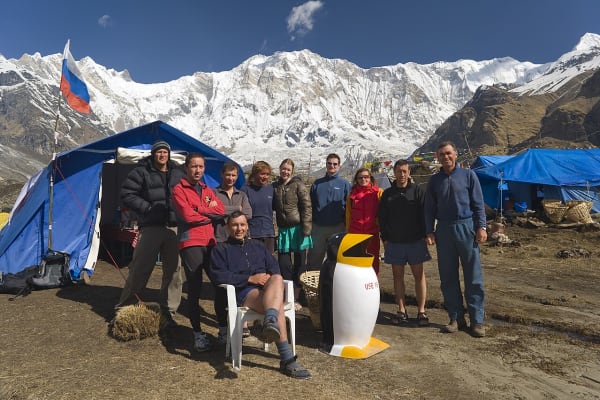
Then the valley opens completely and you are standing inside the Annapurna Sanctuary at Annapurna Base Camp (4,130 m) — a natural amphitheatre ringed by Annapurna I (8,091 m), Annapurna South, Hiunchuli, Gangapurna and Machhapuchhre. Sunset turns the whole rim orange, and on a clear night the glacier cracks audibly in the dark. Overnight at base camp.
6Day 6Trek from Annapurna Base Camp (4,130 m) to Bamboo (2,310 m)
Trek from Annapurna Base Camp (4,130 m) to Bamboo (2,310 m)
Wake before dawn. First light on Annapurna I is the single best moment of the trek — the summit catches the sun long before the valley floor does, and the whole amphitheatre turns from grey to pink to gold over about twenty minutes. Bring gloves; it is genuinely cold until the sun reaches you.
After breakfast we begin the descent, retracing the route past Machhapuchhre Base Camp and down through the gorge to Deurali. Losing altitude quickly is a relief to the lungs, but it is hard on the knees, and the stone steps are uneven — trekking poles earn their keep today.
The trail continues down through Himalaya and Dovan, back into the humid, green world of the lower valley, and finishes at Bamboo (2,310 m). It is a long day covering more than 1,800 m of descent, but the walking is straightforward and the air gets thicker and warmer with every hour. Overnight at Bamboo.
7Day 7Trek from Bamboo (2,310 m) to Jhinu Danda (1,780 m) and Drive to Pokhara (822 m)
Trek from Bamboo (2,310 m) to Jhinu Danda (1,780 m) and Drive to Pokhara (822 m)
The final trekking morning takes you back down the Modi Khola through Upper and Lower Sinuwa, then down the long stone staircase to the Chhomrong Khola and back up the other side — the one genuine climb left in the trek, and a reminder of how much height you have been covering all week.
From Chhomrong the path descends steadily to Jhinu Danda (1,780 m). If time allows, it is a twenty-minute walk down to the natural hot springs on the bank of the Modi Khola, where three stone pools sit right beside the river. Soaking tired legs in hot water after five days of stone steps is, for many trekkers, the highlight of the return leg.
A jeep meets us at Jhinu Danda for the drive back to Pokhara (822 m), arriving in the late afternoon. Tonight is the celebration dinner by the lake. Overnight in Pokhara.
8Day 8Drive from Pokhara (822 m) to Kathmandu (1,400 m)
Drive from Pokhara (822 m) to Kathmandu (1,400 m)
There is no rush this morning. If you are up early, the sunrise view of the Annapurna range from the lakeside is worth the alarm — the same peaks you stood beneath two days ago, now seen from 3,000 m below. Some trekkers take a short boat trip on Phewa Lake or walk up to the World Peace Pagoda before breakfast.
We then begin the drive back east to Kathmandu (1,400 m), retracing the Prithvi Highway along the Marsyangdi and Trishuli rivers. It is a full day on the road with a lunch stop en route, and the valley scenery is just as good in this direction.
You will arrive in Kathmandu in the late afternoon and transfer to your hotel. The evening is free — a good opportunity for last-minute shopping in Thamel, where you can find pashmina, singing bowls, Nepali tea and trekking gear. Overnight in Kathmandu.
9Day 9Departure from Kathmandu (1,400 m)
Departure from Kathmandu (1,400 m)
Today is your final day in Nepal. Depending on your flight time, you may have a free morning to explore a little more of the Kathmandu Valley — Boudhanath Stupa, Pashupatinath Temple and Swayambhunath are all within a short drive and all worth seeing if you have not already.
Our representative will collect you from your hotel and drive you to Tribhuvan International Airport approximately three hours before your scheduled departure, which gives you comfortable margin for check-in and security.
We hope the Annapurna Base Camp trek has given you the Himalaya at close range — a week that started in a city at 1,400 m and ended standing inside a ring of eight-thousanders. If you are already thinking about the next one, our team is happy to talk you through Everest Base Camp, the Manaslu Circuit or Upper Mustang. Safe travels, and we hope to see you back in Nepal.
Inclusions & Exclusions
Everything you need for a comfortable Annapurna Base Camp Trek is included, while personal expenses, international travel, insurance, and optional services are excluded.
What's Included
Airport pickup and drop-off services in Kathmandu.
Tourist bus transportation from Kathmandu to Pokhara and back to Kathmandu.
Private transportation from Pokhara to Jhinu Danda and back to Pokhara as per the itinerary.
Accommodation in Kathmandu with breakfast.
Accommodation in Pokhara with breakfast.
Accommodation in local teahouses during the trek.
All required Annapurna Conservation Area permits and trekking permits.
Professional English-speaking licensed trekking guide.
Three meals a day (breakfast, lunch, and dinner) during the trek.
Group trekking map for route guidance.
First aid kit carried by the guide.
All government taxes, permit fees, and service charges.
What's Excluded
International flight tickets to and from Nepal.
Nepal entry visa fees.
Travel insurance, including emergency helicopter evacuation coverage.
Personal trekking equipment and clothing.
Porter services (available at an additional cost).
Lunch and dinner in Kathmandu and Pokhara.
Snacks, bottled water, hot showers, Wi-Fi, charging fees, and alcoholic or soft drinks.
Personal expenses such as laundry, phone calls, and souvenirs.
Tips for guides, drivers, and support staff.
Any additional accommodation, transportation, or expenses caused by unforeseen circumstances beyond the itinerary.
Route Map
Annapurna Base Camp Trek route map showing the trail, key villages, elevations, and major landmarks.
Loading map...
Altitude Profile
Pricing
Our Annapurna Base Camp Trek price covers essential trekking services, accommodation, meals, permits, transportation, and a professional guide, with optional services available at additional cost.
Add-ons
Enhance your Annapurna Base Camp Trek with optional add-on services for greater comfort and convenience.
Permits and Trekking Requirements
The Annapurna Base Camp Trek requires the necessary trekking permits before entering the Annapurna region. The main requirements generally include the Annapurna Conservation Area Permit (ACAP) and the applicable trekking registration or documentation. Your trekking agency or guide will arrange the required permits and handle the necessary formalities.
Trekkers should carry a valid passport and copies of important travel documents during the trek. Permit checks may take place at designated points along the trail.
Our guide to Annapurna region permits explains the ACAP permit and the checkpoints where it is inspected.
Guide and Porter Services
A professional trekking guide can make the journey safer, easier, and more enjoyable. Your guide assists with navigation, accommodation arrangements, permits, communication, and general support throughout the trek while also sharing information about local culture and the surrounding region.
Porter service is available as an optional add-on. A porter can carry your main luggage, allowing you to trek with only a small daypack containing essentials such as water, snacks, clothing, and personal items.
Communication and Internet
Mobile network coverage and internet access are available in parts of the Annapurna Base Camp route, but the connection can become weak or unavailable in remote and higher-altitude sections. Many teahouses provide Wi-Fi for an additional charge, although speeds may vary.
It is recommended to inform family or friends about limited connectivity before starting the trek. Carrying a power bank is also useful because electricity and charging facilities may cost extra at some teahouses.
Drinking Water and Hydration
Staying properly hydrated is important throughout the trek, particularly as you gain elevation. Drinking water can be obtained from teahouses, shops, and designated water sources along the route. Trekkers can also use reusable bottles or hydration bladders.
For safety, water from natural sources should be treated or filtered before drinking. Water purification tablets, a portable filter, or a UV purifier can be useful. Avoid relying entirely on bottled water, especially during longer trekking days.
The ways to treat water on the trail are compared side by side in our guide to drinking water while trekking.
Travel Insurance and Emergency Support
Travel insurance is strongly recommended for the Annapurna Base Camp Trek. Your policy should cover trekking at the maximum altitude of 4,130 meters and include emergency medical treatment and evacuation where applicable.
Although the Annapurna Base Camp route is a well-established trekking trail, weather conditions, altitude-related problems, injuries, or other unforeseen circumstances can occur. In serious situations, evacuation may be arranged depending on weather, accessibility, and the terms of your insurance policy.
Our guide to travel insurance for trekking in Nepal explains the altitude limits, evacuation terms and common exclusions to check before you buy.
Frequently Asked Questions
Find quick answers to common questions about the Annapurna Base Camp Trek, including the route, duration, difficulty, facilities, safety, and travel arrangements.
1How many days does the Annapurna Base Camp Trek take?
This itinerary takes 9 days, including arrival and departure in Kathmandu, travel between Kathmandu and Pokhara, the trek to Annapurna Base Camp, and the return journey.
2What is the highest point reached during the trek?
The highest point is Annapurna Base Camp at 4,130 meters (13,550 feet), located within the spectacular Annapurna Sanctuary.
3Can beginners do the Annapurna Base Camp Trek?
Yes. The trek is considered moderate and does not require previous mountaineering or technical climbing experience. However, being comfortable with several hours of walking and uphill sections is important.
4How long do we walk each day?
Most trekking days involve approximately 5–7 hours of walking, depending on the route, terrain, pace, and rest stops. Some days may be shorter or longer.
5Is there a risk of altitude sickness on the ABC Trek?
There is some risk because the trail reaches above 4,000 meters. Walking gradually, maintaining a steady pace, staying hydrated, and paying attention to your body's condition can help reduce the risk.
6What type of toilet facilities are available on the trail?
Most teahouses have shared toilet facilities, while some accommodations may offer attached bathrooms. Facilities become more basic at higher elevations.
7Is hot water available during the trek?
Hot showers are available at many teahouses for an additional charge, but availability can vary depending on the location and weather conditions.
8Can I charge my phone and camera during the trek?
Most teahouses provide charging facilities, usually for an additional fee. Charging availability can become more limited at higher elevations, so carrying a power bank is recommended.
9What happens if the weather prevents us from following the planned itinerary?
Mountain weather can sometimes cause delays or changes to the itinerary. Your guide will assess the conditions and make necessary adjustments to prioritize safety and comfort.
10Can the Annapurna Base Camp Trek itinerary be customized?
Yes. The itinerary can generally be adjusted according to your available time, fitness level, preferred transportation, rest requirements, and other travel preferences.
Gallery
Explore authentic moments from the Annapurna Base Camp Trek, featuring scenic trails, mountain villages, lush forests, Himalayan landscapes, and Annapurna Base Camp.
Trekking Guides & Articles
Annapurna Base Camp Trek: The Complete Guide — A walk from rice terraces into a glacial amphitheatre ringed by 7,000 and 8,000 m peaks, in nine days from Kathmandu or five from Pokhara.
Annapurna Base Camp Trek Itinerary: Day by Day — The full Annapurna Base Camp itinerary day by day, with altitudes, walking hours and what each stage is actually like.
Annapurna Region Permits: The ACAP Explained — Every trek in the Annapurna region needs the ACAP and trekking registration, and a few need a restricted-area permit on top.
Food on the Trail in Nepal: What You Will Actually Eat — Teahouse menus across Nepal are more consistent than you would expect, and more limited the higher you go.
Post-Trek Recovery: What Your Body Needs in the First Two Weeks — You come down from a trek lighter, short of sleep, a little dehydrated and with an immune system that has taken a knock.
How to Train for a Nepal Trek: A 12-Week Plan — Nepal treks are not technically hard — they are long, repetitive, and relentlessly uphill and downhill.
Fix Departure
This trek runs every week on the selected day(s). Choose custom dates for one-off departures.
Showing fixed departures in Oct 2026
Guest Reviews
We will be back
“I have done a few Himalayan treks and this one stands out for all the right reasons. The teahouses and lodges were clean and welcoming, and the food was far better than I expected at altitude. Our por...
Piotr Herrera
Get in Touch
Tell us the dates you have in mind and roughly what you want out of the trek — one of our guides will reply, usually within 24 hours.
Email Us
info@greencompasstreks.com
Call Us
+977 9864379436
Office
Lakeside, Pokhara, Nepal
Office Hours
Sunday – Friday, 9:00 AM – 9:00 PM
Similar Treks
You might also like these treks


Porter
$193 $175/porter
Flight form Kathmandu to Pokhara
$127 $115/person
Flight from Pokhara to Kathamndu
$127 $115/person
No payment required yet