

Khori Himal Trek from Pokhara
The Khori Himal Trek from Pokhara is a compact six-day route into the Sikles region that begins and ends in Pokhara, wit
Porter
$231 $210/porter
No payment required yet
Trip Overview
The Khori Himal Trek from Pokhara is a compact six-day route into the Sikles region that begins and ends in Pokhara, with no Kathmandu days involved. A scenic drive north-east through the Madi valley reaches Sikles (1,980 m), a large and beautifully preserved Gurung village of stone houses and slate roofs, from where the trail climbs through oak and rhododendron forest to the pastures at Tasha.
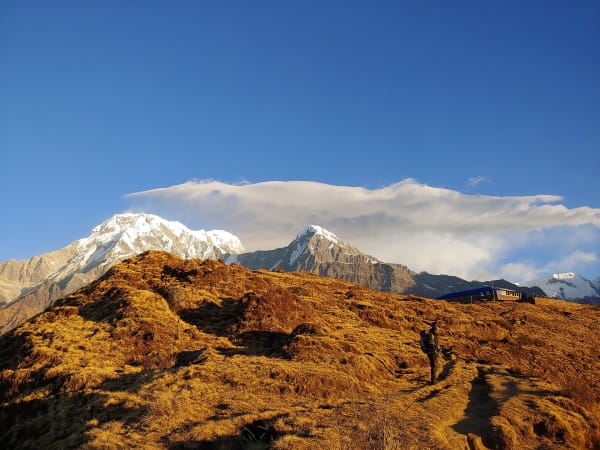
The trek's objective is the open ridge at Kori Danda (3,850 m), which faces Annapurna II, Annapurna IV, Lamjung Himal, and Machhapuchhre at unusually close range for so short a route. With four walking days, no pass to cross, and a maximum altitude under 3,900 m, this is one of the best short treks available from Pokhara for travellers who want serious mountain views without a long commitment.
Trip Highlights
Six Days, Pokhara to Pokhara: A complete Himalayan trek with no Kathmandu transfer days and only one road journey at each end.
The Kori Danda Viewpoint (3,850 m): Stand on an open alpine ridge facing Annapurna II, Annapurna IV, and Lamjung Himal at close range.
The Gurung Village of Sikles: Begin in one of the largest traditional Gurung settlements in Nepal, terraced up a hillside above the Madi valley.
Forest Rich in Birdlife: Climb through dense oak and rhododendron between Sikles and Tasha, one of the best stretches of middle-hill forest in the region.
Almost No Other Trekkers: Walk a recently developed trail where seeing another group on any given day is the exception rather than the rule.
Itinerary
A 6-day Pokhara-to-Pokhara trek from the Gurung village of Sikles to the Kori Danda ridge at 3,850 m, facing Annapurna II and Lamjung Himal.
1Day 1Drive from Pokhara (822 m) to Sikles (1,980 m)
Drive from Pokhara (822 m) to Sikles (1,980 m)
This short version starts and ends in Pokhara. We leave after breakfast and drive north-east up the Madi Khola valley, into a corner of the Annapurna region that very few visitors reach.
The road climbs steadily on rough surface through terraced farmland and scattered settlements, with the Annapurna range appearing and disappearing behind the ridgelines. The final stretch is steep and slow, and the whole journey takes around three hours.
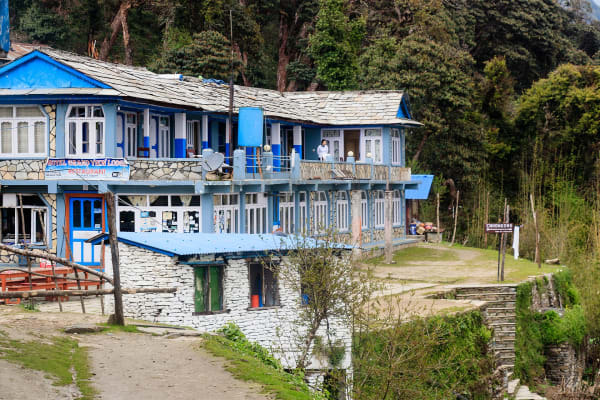
Sikles (1,980 m) is one of the largest and oldest Gurung villages in Nepal — several hundred slate-roofed stone houses stacked in tiers up a steep hillside, linked by paved lanes and stone staircases. It has a long Gurkha soldiering tradition, a small village museum, and terraces that have been farmed for centuries. Arriving in the afternoon leaves plenty of time to walk the lanes and get a feel for the place. Overnight in Sikles.
2Day 2Trek from Sikles (1,980 m) to Tasha (2,700 m)
Trek from Sikles (1,980 m) to Tasha (2,700 m)
The first walking day, climbing around 720 m out of the village and into the forest above it.
The trail leaves Sikles by stone staircase and works up through the terraces — millet, maize and buckwheat, all worked by hand — before entering oak and rhododendron woodland. The forest is mossy and quiet, and the path is narrow and obviously little walked.
As you climb, the views open back down the Madi valley and across to the Annapurna wall. This is part of the Annapurna Conservation Area and the forest is in good condition: langur monkeys are common overhead and the birdlife is excellent, particularly in the early morning.
Tasha (2,700 m) is a small seasonal settlement of herders' huts and one simple lodge in a forest clearing, used by Sikles families grazing livestock through the summer. Overnight in Tasha.
3Day 3Trek from Tasha (2,700 m) to Kori Danda (3,850 m)
Trek from Tasha (2,700 m) to Kori Danda (3,850 m)
The main climbing day, gaining around 1,150 m to the high point of the trek.
The trail continues up through rhododendron forest, which thins steadily into dwarf rhododendron and juniper and then gives out onto open grassy ridge. It is a sustained rather than technical climb, though the altitude makes the last hour hard going.
Kori Danda (3,850 m) is a broad grassy crest with a basic lodge and a viewpoint, and the panorama is the whole point of the route. The Annapurna wall stands directly north at close range — Annapurna II (7,937 m), Annapurna IV (7,525 m), Lamjung Himal (6,983 m) and Machhapuchhre (6,993 m) — with Manaslu (8,163 m) visible to the east on a clear day.
Because so few people walk this trail, the ridge at sunset is usually entirely yours. It is cold and exposed once the sun drops. Overnight at Kori Danda.
4Day 4Trek from Kori Danda (3,850 m) to Tasha (2,700 m)
Trek from Kori Danda (3,850 m) to Tasha (2,700 m)
Be up before dawn for the sunrise — the Annapurna wall lighting up peak by peak, seen from an empty ridge, is the best thing this trek has to offer.
After breakfast, and time to walk the crest for different angles, we start down. The trail drops off the open ridge back into juniper and dwarf rhododendron, then into the forest proper.
Losing over 1,100 m in one day is hard on the knees and the path is rooty and uneven in places, so poles are worth using and a steady rhythm beats speed. The compensation is the air thickening and the temperature climbing with every hour of descent.
Tasha (2,700 m) is reached in the early afternoon, leaving a genuinely relaxed rest of the day among the grazing pastures and herders' huts. Overnight in Tasha.
5Day 5Trek from Tasha (2,700 m) to Sikles (1,980 m)
Trek from Tasha (2,700 m) to Sikles (1,980 m)
An easy final walking morning of around 720 m of descent back to the village.
The trail drops through moss-hung oak and rhododendron forest, with the Madi valley opening up below as the trees thin. Lower down it re-enters the terraced fields above Sikles, where millet and maize are worked by hand and buffalo graze the margins.
The descent finishes down stone staircases into the top of the village. Arriving around midday leaves the whole afternoon to look around properly.
Sikles (1,980 m) deserves that time. It is one of the largest traditional Gurung settlements in Nepal — tiers of slate-roofed houses, paved lanes, a small museum, and a strong Gurkha soldiering history that people are generally happy to talk about over tea. Overnight in Sikles.
6Day 6Drive from Sikles (1,980 m) to Pokhara (822 m)
Drive from Sikles (1,980 m) to Pokhara (822 m)
A last morning in Sikles before the drive out — worth an early walk through the lanes while the village goes about its ordinary business and the light is good on the slate roofs.
The jeep then descends the rough road down the Madi Khola valley, retracing the route in. It is steep and slow for the first hour before the valley widens and the surface improves, with the Annapurnas appearing behind you at intervals.
The drive to Pokhara (822 m) takes around three hours, arriving around midday. Six days after setting out you are back at the lakeside, having climbed a ridge at 3,850 m and looked straight at Annapurna II with nobody else on the hill. The afternoon is free — a hot shower, lunch by the lake, and an easy end to the trip. Overnight in Pokhara.
Inclusions & Exclusions
Private transport to and from Sikles, teahouse and homestay lodging, all trekking meals, conservation area permits, a licensed guide, trekking map, first aid, and government taxes are included, while international flights, visa, insurance, personal gear, porter service, city accommodation and meals, personal expenses, and tips are excluded.
What's Included
Private transportation from Pokhara to Sikles and from Sikles back to Pokhara as per the itinerary.
Accommodation in local teahouses during the trek.
Annapurna Conservation Area Permit (ACAP) and required trekking permits.
Professional English-speaking licensed trekking guide.
Three meals a day (breakfast, lunch, and dinner) during the trek.
Group trekking map for route guidance.
First aid kit carried by the guide.
All government taxes, permit fees, and service charges.
What's Excluded
Travel insurance, including emergency helicopter evacuation coverage.
Personal trekking equipment and clothing.
Porter services (available at an additional cost).
Accommodation and meals in Kathmandu or Pokhara unless mentioned in the itinerary.
Snacks, bottled water, hot showers, Wi-Fi, charging fees, and alcoholic or soft drinks.
Personal expenses such as laundry, phone calls, and souvenirs.
Tips for guides, drivers, and support staff.
Any additional accommodation, transportation, or expenses caused by unforeseen circumstances beyond the itinerary.
Route Map
Explore the terrain map showing the trek route.
Loading map...
Altitude Profile
Pricing
Transparent per-person pricing based on group size, covering the services listed in the itinerary with no hidden charges.
Add-ons
Customize your trek with optional services such as porter support and other personalized arrangements at an additional cost.
Best Time to Trek
March to May and October to December are both excellent. Spring puts the rhododendron forest between Sikles and Tasha into full flower and keeps the ridge pleasant through the afternoon. Autumn and early winter give the sharpest, clearest views of Annapurna II and IV from Kori, which is the whole point of the trek.
The low maximum altitude means the route stays walkable later into winter than most Annapurna trails, although the Kori ridge is exposed and may hold snow from January onward. Avoid the monsoon between June and August, when the forest section is leech-heavy, the ridge sits in cloud, and the road to Sikles is vulnerable to landslides.
For a month-by-month look at weather and trail conditions, see our guide to the best time to trek in Nepal.
Trek Difficulty & Fitness
This is a moderate trek with a short overall commitment. Four walking days, no pass, and a maximum sleeping altitude of 2,700 m at Tasha keep the demands manageable. The exception is the climb from Tasha to Kori Danda, which gains over 1,100 m in five to six hours on a steep forest and ridge trail — a genuinely hard day by any standard.
Aim to be comfortable walking five to seven hours with sustained ascent. Four to six weeks of regular hill walking is enough preparation for most people. Trekking poles are worth bringing for the descent from Kori back to Tasha, which reverses the same 1,100 m in one day and takes a toll on the knees.
To build that fitness step by step, follow our 12-week training plan for a Nepal trek.
Altitude & Acclimatization
Altitude is not the main challenge on this trek, but the profile is worth understanding. You sleep at 1,980 m in Sikles, 2,700 m at Tasha, and then make a day ascent to 3,850 m at Kori before returning to Tasha to sleep. That climb-high, sleep-low pattern is exactly what the body handles best, and serious altitude illness is uncommon on this route.
Even so, gaining 1,150 m in a single day is significant, and mild headache or breathlessness on the ridge is not unusual. Drink at least three litres of water a day, walk the Kori climb at a pace that lets you hold a conversation, and tell your guide if a headache does not settle after resting and rehydrating. Descending 500 m resolves symptoms quickly here, and the Tasha lodge is never far away.
Prevention, symptoms and treatment are covered in depth in our guide to altitude sickness in Nepal.
Packing List
Most of this trek is mild, but the Kori ridge is exposed and cold at dawn. Bring waterproof trekking boots, two or three base layers, a fleece, a light down jacket, a waterproof shell, trekking trousers, a warm hat, sun hat, gloves, and wool socks. A sleeping bag rated to -5°C is ample for Sikles and Tasha, where lodges also provide blankets.
Also pack a 25-30 litre daypack, trekking poles, a headlamp, high-SPF sunscreen and lip balm, sunglasses, a reusable bottle with purification tablets or a filter, a small first aid kit with blister care, insect repellent for the forest section, a quick-dry towel, toiletries, and a power bank. Lodges on this route are small and charging capacity is limited, so arrive with everything topped up in Pokhara.
For the complete kit list, organised by the altitude you will reach, see our Nepal trekking packing list.
Accommodation, Food & Drinking Water
You stay in a homestay or small lodge at Sikles and in simple family-run teahouses at Tasha. This is a developing trekking region and the lodges are basic compared with the Annapurna Circuit — twin rooms with foam mattresses, shared toilets, and limited hot water — but they are welcoming, and your stay puts money directly into villages with very few other sources of visitor income.
Three meals a day are included on the trek. Menus are short and centred on dal bhat, noodle soup, fried rice, eggs, chapati, and porridge, using vegetables grown in the villages. Sikles has a well-earned local reputation for Gurung home cooking and its millet dishes are worth asking for. Water comes from spring-fed taps and streams and must be treated with tablets, a filter, or a UV pen — bottled water is not reliably sold above Sikles.
What the lodges are really like, from rooms and meals to showers and charging, is covered in our guide to teahouse trekking in Nepal.
Frequently Asked Questions
Find quick answers to common questions about the Khori Himal Trek from Pokhara.
1Is mobile network and Wi-Fi available?
Coverage is patchy at Sikles and largely absent above it. Wi-Fi is generally unavailable outside Pokhara, so plan on being offline for the four trekking days.
2How many hours do we walk each day?
Four to six hours on most days. The Tasha to Kori Danda climb is the hardest at five to six hours with over 1,100 m of ascent, and the return descent the next day covers the same ground.
3Which permits are required and do you arrange them?
The Annapurna Conservation Area Permit and trekking registration are both included in your package and arranged by our team from passport copies and passport-sized photographs sent before departure.
4Is this a good first Himalayan trek?
Yes. The short length, absence of any pass, low maximum sleeping altitude, and short road transfers make it one of the more forgiving introductions to trekking in Nepal, while still delivering close-up Annapurna views.
5How long is the drive from Pokhara to Sikles?
Around three to four hours on a mix of sealed and rough mountain road through the Madi valley. It is scenic but bumpy in places, and the journey can be slower in the weeks immediately after the monsoon.
6Can I charge my devices on the trail?
Charging is available at Sikles and limited at Tasha, usually solar-powered and for a small fee. Arrive with a fully charged power bank rather than relying on lodge supply above the village.
7Where can I withdraw cash?
Pokhara has plenty of ATMs and there are none on the trail. Carry all your Nepalese rupees from Pokhara — everything on the route is cash-only, including snacks, drinks, charging, and tips.
8Can this trek be combined with another route?
Yes, and many people do. It pairs naturally with Poon Hill, Mardi Himal, or the Annapurna Base Camp trail from Pokhara. Let us know before booking and we will build the combined itinerary and arrange the permits together.
9How large are the groups and who leads the trek?
Groups are capped at twelve trekkers and led by a licensed English-speaking guide familiar with the Sikles region. Because lodges here are small, we often keep groups below the maximum on this route.
10Can I leave extra luggage in Pokhara?
Yes. Your Pokhara hotel stores anything you do not need on the trail free of charge until you return, so you can travel light for the four walking days.
Gallery
Explore authentic moments, landscapes, and mountain views from the Khori Himal Trek from Pokhara.
Trekking Guides & Articles
Khori Himal Trek: The Complete Guide to Kori Danda — Four walking days from one of Nepal's largest traditional Gurung villages to an empty ridge at 3,850 m, with Annapurna II, Annapurna IV.
Fix Departure
This trek runs every week on the selected day. Choose custom dates for one-off departures.
Showing fixed departures in Oct 2026
Guest Reviews
We loved every moment
“We squeezed Khori Himal Trek from Pokhara into a short Nepal trip and it was the highlight of our whole holiday. The views from the top were incredible and our guide timed it perfectly for clear skies...
Lucia Turner
Get in Touch
Tell us the dates you have in mind and roughly what you want out of the trek — one of our guides will reply, usually within 24 hours.
Email Us
info@greencompasstreks.com
Call Us
+977 9864379436
Office
Lakeside, Pokhara, Nepal
Office Hours
Sunday – Friday, 9:00 AM – 9:00 PM
Similar Treks
You might also like these treks


Porter
$231 $210/porter
No payment required yet