This is the itinerary we run, with the reasoning behind it. Two numbers matter on every line: the sleeping altitude, which is what your body reacts to, and the gain from the previous night, which is what determines whether you acclimatise or get sick.
Walking hours are moving time. Add an hour or so for tea, photographs, and lunch to get the lodge-to-lodge day.
The Itinerary in One Table
| Day | Stage | Sleep at | Gain | Hours |
|---|---|---|---|---|
| 1 | Arrive in Kathmandu | 1,400 m | — | — |
| 2 | Fly to Lukla (2,860 m), trek to Phakding | 2,651 m | −209 m | 3–4 |
| 3 | Phakding to Namche Bazaar | 3,440 m | +789 m | 6–7 |
| 4 | Acclimatisation day at Namche | 3,440 m | 0 | 3–4 |
| 5 | Namche to Tengboche | 3,956 m | +516 m | 5–6 |
| 6 | Tengboche to Dingboche | 4,380 m | +424 m | 5–6 |
| 7 | Acclimatisation day at Dingboche | 4,380 m | 0 | 4–5 |
| 8 | Dingboche to Lobuche | 4,938 m | +558 m | 5–6 |
| 9 | Lobuche to Gorak Shep, then Kala Patthar (5,545 m) | 5,160 m | +222 m | 6–7 |
| 10 | Gorak Shep to Everest Base Camp (5,364 m), descend to Pheriche | 4,371 m | −789 m | 7–8 |
| 11 | Pheriche to Namche Bazaar | 3,440 m | −931 m | 6–7 |
| 12 | Namche to Lukla | 2,860 m | −580 m | 6–7 |
| 13 | Fly Lukla to Kathmandu | 1,400 m | −1,460 m | — |
| 14 | Departure | — | — | — |
Days 1–4: Into the Khumbu
Day 1 — Arrive in Kathmandu (1,400 m)
Met at the airport and transferred to your hotel. Your guide runs the pre-trek briefing and a kit check, and the Lukla departure time is confirmed — which may be very early, or the night before if flights are operating from Ramechhap.
Day 2 — Fly to Lukla, trek to Phakding (2,651 m)
A 25 to 35 minute flight onto Lukla's sloping runway, then a gentle three to four hours downhill along the Dudh Koshi to Phakding. A deliberately easy first day: you have gained 1,400 m by aircraft, and walking down rather than up is the right way to spend the afternoon.
Day 3 — Phakding to Namche Bazaar (3,440 m)
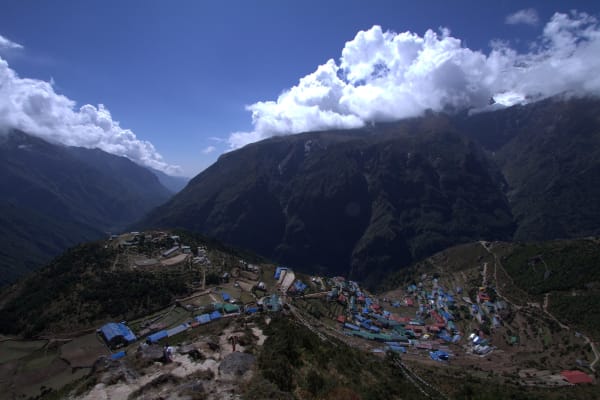
The first substantial day. You cross the Dudh Koshi several times, enter Sagarmatha National Park at Monjo, then cross the high Hillary Bridge and climb steeply for two hours to Namche. The first glimpse of Everest comes from a spur on that climb. Nearly 800 m of gain makes this the day most people first notice the altitude.
Day 4 — Acclimatisation at Namche (3,440 m)
Not a rest day. You walk up to Khumjung village or the Everest View Hotel at around 3,880 m for the Ama Dablam and Everest panorama, then come back down to sleep. Namche itself is worth the afternoon — bakeries, gear shops, the Sherpa Culture Museum, and a Saturday market.
Days 5–7: Ama Dablam and Thin Air
Day 5 — Namche to Tengboche (3,956 m)
A beautiful day. A long level traverse above the Dudh Koshi gorge with Ama Dablam ahead, then a drop to the river at Phunki Tenga and a steady 600 m climb through rhododendron to Tengboche. The monastery at 3,956 m is the religious centre of the Khumbu, and attending the late-afternoon puja is one of the trek's highlights. Everest, Lhotse, and Ama Dablam stand above the courtyard.
Day 6 — Tengboche to Dingboche (4,380 m)
Through Deboche and the last birch forest, across the Imja Khola, then up past Pangboche — the oldest monastery in the Khumbu — and onto open ground. Dingboche is a village of stone-walled potato fields at 4,380 m, and this is where the landscape becomes fully alpine.
Day 7 — Acclimatisation at Dingboche (4,380 m)
The most important day of the trek. You climb Nangkartshang ridge to about 5,080 m — a hard, slow 700 m — and return to sleep at 4,380 m. The view takes in Makalu, Ama Dablam, Island Peak, and the Imja valley. Trekkers who do this day properly cope far better with Lobuche and Gorak Shep.
Days 8–10: Base Camp and Kala Patthar
Day 8 — Dingboche to Lobuche (4,938 m)
Up the Khumbu valley to Thukla, then a steep climb to Thukla Pass and the memorial chortens — stone cairns for climbers lost on Everest, including Scott Fischer and Babu Chiri Sherpa. It is a sobering, windy place. A further hour along the glacier's lateral moraine reaches Lobuche. Cold, bleak, and magnificent.
Day 9 — Lobuche to Gorak Shep (5,160 m) and Kala Patthar (5,545 m)
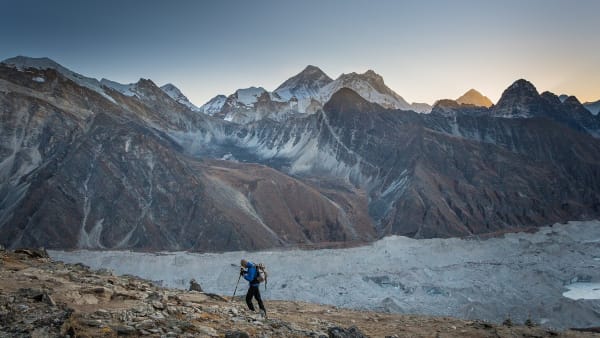
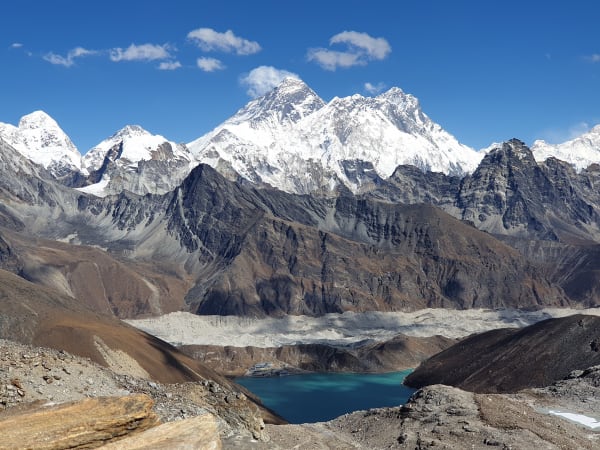
Two to three hours along the moraine to Gorak Shep, a scatter of lodges on a sandy flat beside the Khumbu glacier. After lunch and a rest, the climb to Kala Patthar — 400 m of steep, slow, breathless walking to the best Everest view on the trek, with Nuptse, Changtse, and Pumori around you. Some groups do this at dawn the next morning instead; your guide decides on the weather.
Day 10 — Everest Base Camp (5,364 m), then descend to Pheriche (4,371 m)
An early start across the glacier moraine to Everest Base Camp — two to three hours of undulating rock and ice with the Khumbu Icefall ahead. In spring it is a tent city of expeditions preparing for the summit; in autumn it is empty ice. Then back to Gorak Shep and a long descent to Pheriche. A seven to eight hour day, and the one everybody remembers.
Days 11–14: Out
Day 11 — Pheriche to Namche Bazaar (3,440 m)
A long descent, and a surprisingly emotional one — the air thickens, the forest returns, and you find yourself walking strongly for the first time in a week. Six to seven hours, mostly downhill.
Day 12 — Namche to Lukla (2,860 m)
Back down the Hillary Bridge and along the Dudh Koshi to Lukla. Six to seven hours with one long climb at the end, which always comes as a surprise.
Day 13 — Fly to Kathmandu
Morning flight out, weather permitting. The afternoon is free — Thamel for a long shower, a proper meal, and a beer that has been earned.
Day 14 — Departure
Transfer to the airport. If you have taken our advice and built a buffer day, this is where it sits, and you will be glad of it if Lukla was closed on day 13.
How to Modify the Itinerary
- To go slower: add a night at Pheriche between Dingboche and Lobuche, or a second Namche night. Both reduce altitude risk further.
- To go faster safely: take a helicopter return from Gorak Shep or Pheriche, which removes three walking days without touching the ascent.
- To add the lakes: the Gokyo and Cho La variant joins Base Camp to the Gokyo valley over a 5,420 m pass in 17 days.
- To do everything: the Three Passes route adds Kongma La, Cho La and Renjo La, and is the most complete trek in the Khumbu.
- To climb: Island Peak at 6,189 m is commonly combined with Base Camp, using this same acclimatisation profile.
What we do not recommend is the same route in eleven days. The two acclimatisation days are the itinerary's whole design, and removing either is the reason most failed Everest treks fail.