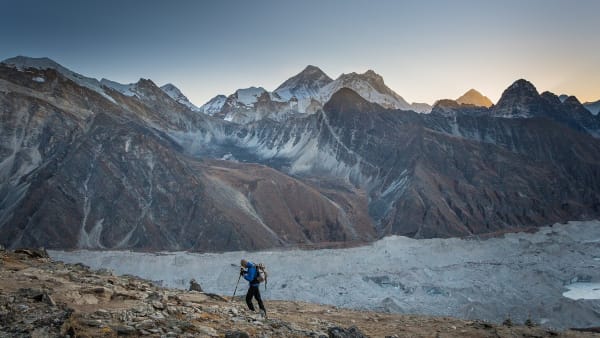
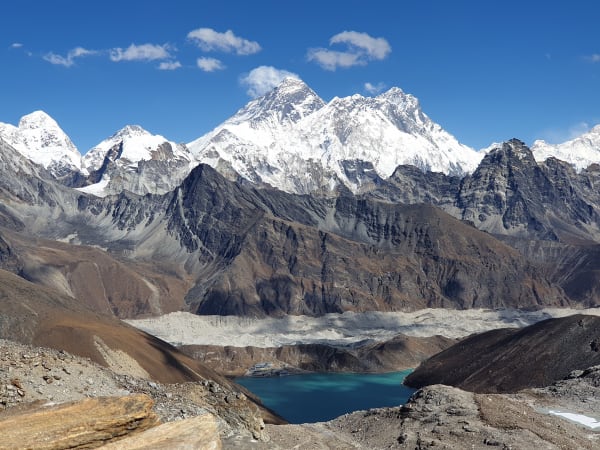
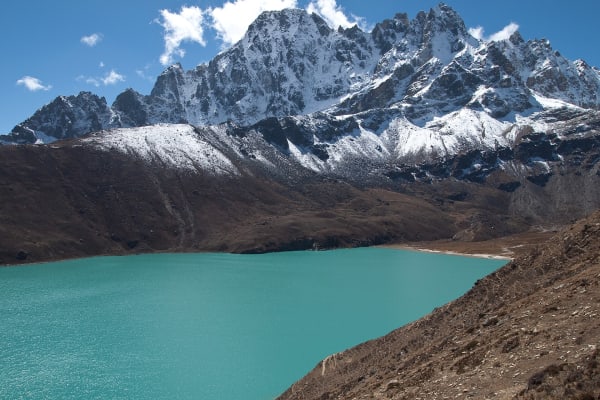
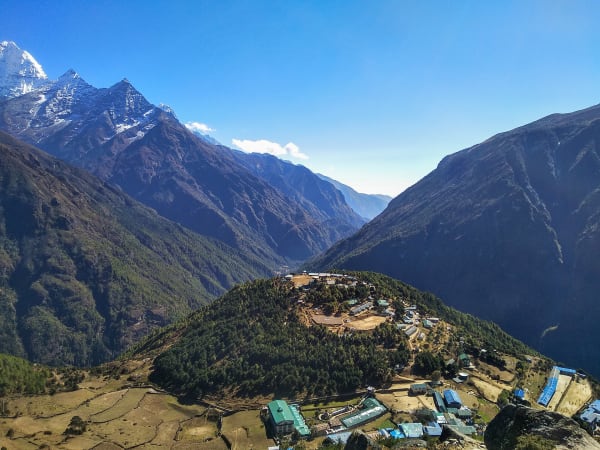
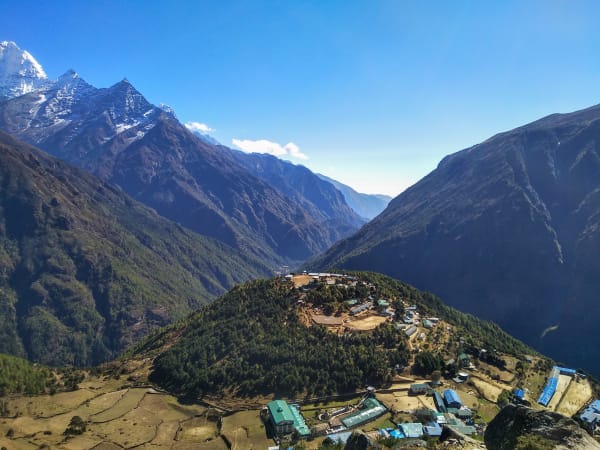
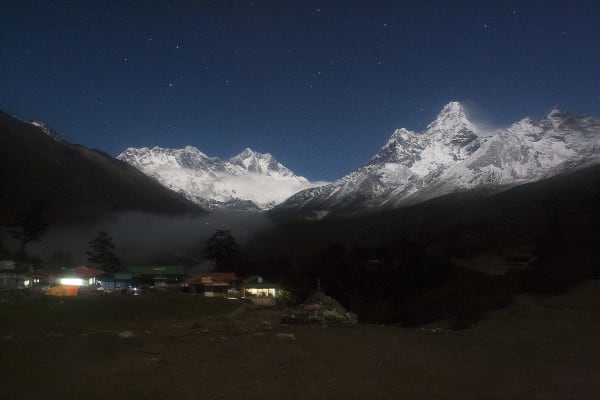
The walk to Everest Base Camp is the most famous trek in the world, and it earns the reputation. Over twelve days you climb from a Sherpa airstrip at 2,860 m to a glacial moraine at 5,364 m, through the heart of the Khumbu: Namche Bazaar, Tengboche monastery, the yak pastures of Dingboche, and the Khumbu glacier under the Lhotse face.
It is also frequently misunderstood. It is not technically difficult — there is no rope, no crampon, no exposure that would trouble a hill walker. What it asks of you is twelve consecutive days of walking at altitude, cold nights, and the patience to climb slowly enough that your body keeps up. That last point is the whole trek.

The Trek at a Glance
| Duration | 14 days Kathmandu to Kathmandu, 12 days walking |
| Highest point | Kala Patthar, 5,545 m |
| Base Camp altitude | 5,364 m |
| Highest night | Gorak Shep, 5,160 m |
| Difficulty | Moderate — long days at altitude, no technical ground |
| Total ascent | Roughly 6,000 m over the trek, and the same again in descent |
| Best seasons | Late September to November, and March to mid May |
| Accommodation | Teahouse lodges every night |
| Permits | Sagarmatha National Park entry and the Khumbu rural municipality fee |
| Access | Flight to Lukla from Kathmandu or Ramechhap |
Our 14-day Everest Base Camp Trek follows the standard route with two full acclimatisation days, at Namche Bazaar and Dingboche. Shorter itineraries exist; they work by removing one of those days, which is the wrong economy.
The Route
The trek divides into four distinct stages, and each one feels like a different landscape.
Lukla to Namche Bazaar (2,860 m to 3,440 m)
Two days through pine forest and Sherpa villages along the Dudh Koshi, crossing the river on a series of suspension bridges, the last and highest of which — the Hillary Bridge — marks the start of the long climb to Namche. You gain about 800 m on the second day, and it is the first day the altitude is noticeable.
Namche to Dingboche (3,440 m to 4,380 m)
Above Namche the treeline thins and the mountains arrive. The traverse to Tengboche gives the classic view of Ama Dablam, and Tengboche monastery at 3,956 m is the spiritual centre of the Khumbu. From there the trail crosses the Imja Khola and climbs to Dingboche, a walled-field village at 4,380 m where the air is unmistakably thin.
Dingboche to Gorak Shep (4,380 m to 5,160 m)
The high stage. Past the memorial chortens at Thukla Pass — a row of stone cairns for climbers who died on Everest — to Lobuche at 4,938 m, then along the lateral moraine of the Khumbu glacier to Gorak Shep. This is the coldest, hardest, and most spectacular part of the walk.
Base Camp, Kala Patthar, and the descent
From Gorak Shep there are two objectives. Kala Patthar (5,545 m) is the viewpoint, usually climbed at dawn for the light on Everest's summit pyramid. Everest Base Camp (5,364 m) is the destination, reached across the moraine — in spring it is a tent city at the foot of the Khumbu Icefall; in autumn it is bare ice and rock. Then you descend fast, reaching Namche in two days and Lukla in three.
Altitude: The Part That Decides Everything
The trek's only real risk is altitude, and it is managed by the shape of the itinerary rather than by fitness. Above 3,000 m, our schedule raises your sleeping altitude by 300 to 500 m a night, with two full rest days where you climb high and sleep low.
- Namche (3,440 m), day 4 — an acclimatisation walk up to Khumjung or the Everest View Hotel at around 3,880 m, then back down.
- Dingboche (4,380 m), day 7 — a climb to Nangkartshang at about 5,080 m, which is both the best acclimatisation on the route and a superb viewpoint.
Those two days are the reason our itinerary is 14 days rather than 11. Cutting them raises the failure rate sharply, and a trekker who turns back at Lobuche has paid for a trek they did not do. Our altitude sickness guide explains the mechanism, and the altitude profile guide walks through the numbers night by night.
Getting There: The Lukla Flight
There is no road to the Khumbu. The trek begins with a 25 to 35 minute flight to Tenzing-Hillary Airport at Lukla, one of the more dramatic arrivals in aviation — a 527 m sloping runway built against a hillside at 2,860 m.
Two things to know. Flights operate in the morning only, because valley winds build by late morning. And in the peak weeks of spring and autumn, Lukla services shift from Kathmandu to Manthali airport at Ramechhap, a four to five hour drive east, which means a very early start or a night on the road.
Delays happen. Build two buffer days in Kathmandu before your international flight home — it is the single most useful planning decision on this trek. Our Lukla flight guide covers the whole picture, and a helicopter return is the option that removes the risk on the way out.
Permits, Cost, and What Is Included
Two documents are needed, both arranged by us: Sagarmatha National Park entry (NPR 3,000 plus VAT) and the Khumbu Pasang Lhamu Rural Municipality fee (NPR 2,000), collected at Lukla or Monjo. The Khumbu fee replaced the TIMS card in this region in 2018, which is why older advice about TIMS for Everest is out of date.
The trip price covers your guide, permits, lodges, three meals a day on the trail, Kathmandu hotel nights, and airport transfers. Outside it sit the Lukla flights, your visa, insurance, tips, and trail extras — showers, charging, Wi-Fi, and snacks, which run USD 10 to 15 a day. See the full cost breakdown.
Insurance needs particular attention here: your policy must cover trekking to 6,000 m and include helicopter evacuation. A standard policy capped at 3,000 m leaves you uninsured from Namche onward.
Lodges, Food, and Conditions
You sleep in teahouses every night. Lodges at Phakding, Namche, and Tengboche are comfortable — twin rooms, thick blankets, hot showers, bakeries, and in Namche something close to a town. Above Dingboche they get progressively simpler and colder: plywood partitions, a single blanket, a stove in the dining room only, and at Gorak Shep a basic room at 5,160 m.
Bring a sleeping bag rated to -20 °C for this route; lodge blankets are not enough above Lobuche. Meals come from the lodge menu and are included — dal bhat, fried rice, noodles, soups, potato dishes, porridge, eggs. Above 3,500 m, eat vegetarian: meat is carried up unrefrigerated, and many Khumbu lodges do not serve it at all.
Expect the Khumbu cough — dry, cold air irritates almost everyone's airway above 4,000 m. Lozenges and a buff over your mouth help more than anything else.
Variations Worth Considering
| Option | Days | Why choose it |
|---|---|---|
| Classic Everest Base Camp | 14 | The standard route with both acclimatisation days. The right default. |
| Base Camp with helicopter return | 12 | Fly out from Gorak Shep or Pheriche — saves three walking days and removes the Lukla return risk |
| Base Camp with Gokyo and Cho La | 17 | Adds the turquoise Gokyo lakes, Gokyo Ri, and a 5,420 m pass crossing |
| Everest Three Passes | 17 | Kongma La, Cho La and Renjo La plus Base Camp — the most complete Khumbu trek |
| Gokyo Lakes alone | 12 | Quieter than the Base Camp trail, with arguably the better Everest view from Gokyo Ri |
| Everest View Trek | 9 | Namche, Khumjung and the Everest View Hotel without going above 3,900 m |
| Base Camp helicopter tour | 1 | A morning from Kathmandu with a Kala Patthar landing, for travellers without two weeks |
If you have the fitness and the time, the Three Passes route is the trek that Khumbu regulars recommend. If you have eight days rather than fourteen, the helicopter return is the honest way to compress it rather than cutting acclimatisation.