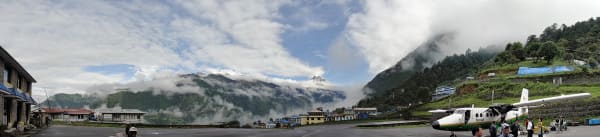
Tenzing-Hillary Airport at Lukla is the gateway to the Khumbu and the most talked-about airstrip in the world: a 527 m runway built on a shelf against a hillside at 2,860 m, sloping uphill to slow landing aircraft and downhill to help them take off. There is no road to the Everest region, so almost every trekker arrives this way.
The flight itself takes 25 to 35 minutes and is, in good weather, one of the great short flights anywhere. The planning around it is what deserves your attention.
How the Flight Works
- Aircraft: 15 to 19 seat turboprops — Dornier 228, Let L-410 — operated by Nepal's domestic carriers.
- Timing: morning only, with the first slots from around 6.15 a.m. Valley winds build after about 11 a.m. and the airstrip closes.
- Duration: 25 to 35 minutes from Kathmandu, 12 to 15 minutes from Ramechhap.
- Baggage: 10 kg checked plus 5 kg hand. This is strictly enforced and is the real constraint on your packing.
- Seating: unassigned in practice. The right side gives the better valley view on the way in.
- Weather rule: visual approach only. If the valley is in cloud, nothing flies, regardless of conditions in Kathmandu.
The approach is genuinely dramatic — a turn into the valley, the runway appearing as a small green shelf, and a short, firm landing that ends well before the hillside. Pilots flying this route are highly experienced on it; the airstrip demands that.
The Ramechhap Question
In the peak weeks of spring and autumn, Kathmandu's single runway cannot absorb the volume of Lukla traffic alongside international flights. In those periods, Lukla services operate from Manthali airport at Ramechhap, roughly 135 km east of Kathmandu.
| From Kathmandu | From Ramechhap | |
|---|---|---|
| Getting there | 30–45 min to the domestic terminal | 4–5 hour drive, usually starting 1–2 a.m. |
| Flight time | 25–35 min | 12–15 min |
| Reliability | Good, but subject to Kathmandu congestion | Better — shorter exposure to weather |
| Cost | Higher fare | Lower fare plus the road transfer |
| The catch | Can be bumped by congestion | A night drive at each end of the trek |
Which applies to your dates is confirmed a few weeks ahead rather than months, so it is covered at your pre-trek briefing. If the night drive does not appeal, we can arrange a hotel at Ramechhap the evening before, or a helicopter transfer instead.
When Flights Are Cancelled
A realistic bad morning: you are at the airport at 5.30 a.m., the first slots depart, cloud closes the valley by 8 a.m., and by 11 a.m. everything is cancelled and rolled to the next day — behind the passengers already booked on it.
What we do:
- Book the earliest available slots, which have the best chance of getting out.
- Hold your hotel room in Kathmandu or Lukla rather than releasing it, so you are not searching for a bed at midday.
- Rebook with priority where the airline allows, and keep you informed rather than leaving you at the terminal.
- Offer a helicopter when the delay starts to threaten your international flight. Shared between five passengers, the per-seat cost is a fraction of a private charter.
- Adjust the trekking itinerary where it can be safely shortened, rather than cancelling the trip.
What you should do: build two buffer days in Kathmandu before your international flight home. This is the single most useful planning decision for any Khumbu trek, and it costs two hotel nights.
Alternatives to the Fixed-Wing Flight
| Option | Time | When it makes sense |
|---|---|---|
| Helicopter, Kathmandu to Lukla | About 1 hour | Avoids the Ramechhap drive, far less weather-sensitive, and the fastest fix for a delay |
| Helicopter, Lukla to Kathmandu | About 1 hour | The return leg when the fixed-wing backlog is days deep |
| Trek with helicopter return | Saves 3 days | Fly out from Gorak Shep or Pheriche — compresses the trek without touching acclimatisation |
| Helicopter from Namche | About 2 hours | A mid-trek exit that does not require walking back to Lukla |
| Walk in from Jiri or Phaplu | Adds 5–7 days | The classic 1950s approach, with no flight at all and superb acclimatisation |
| Pikey Peak Trek | 8 days | Everest views from a road-accessible trek with no mountain flight needed |
The walk-in from Jiri deserves more consideration than it gets. It is how Hillary and Tenzing approached Everest, it removes the flight risk entirely, and the gradual gain through the middle hills is the best acclimatisation available. It costs a week.
Practical Tips
- Wear your boots and down jacket on the flight rather than packing them — it protects you against delayed baggage and saves weight allowance.
- Keep medication, documents, electronics, and one warm layer in your hand baggage.
- Do not book an international flight for the same day you fly out of Lukla. Ever.
- There is no catering at Manthali and almost nothing at Lukla early in the morning. Carry a snack and water.
- Your ticket is issued in your passport name — a mismatch causes a real problem at the counter.
- Motion sickness tablets are worth having if you are prone to it. The approach is turbulent in the last ten minutes.
- If you are nervous about flying, say so to your guide. The flight is short, and knowing what happens when reduces most of it.
One last reassurance and one caveat. The reassurance: Lukla is flown by pilots with extensive experience of this specific approach, in daylight and in visual conditions only. The caveat: weather cancellations are the system working, not failing. An airline that flies into Lukla in marginal cloud is not one you want to be on.