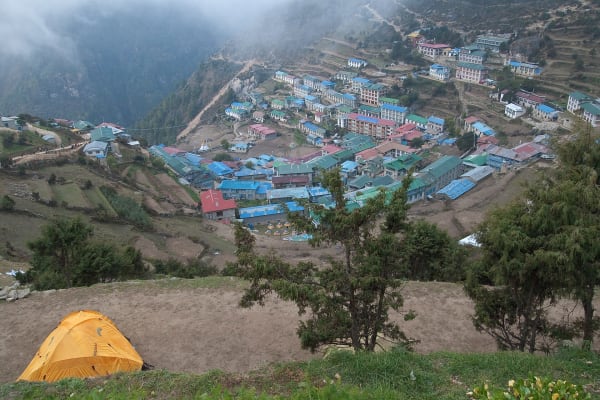
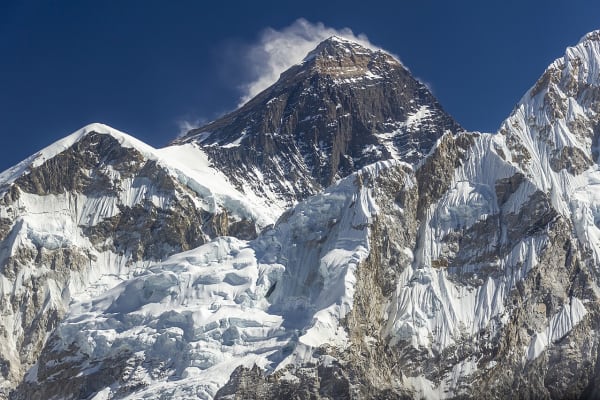
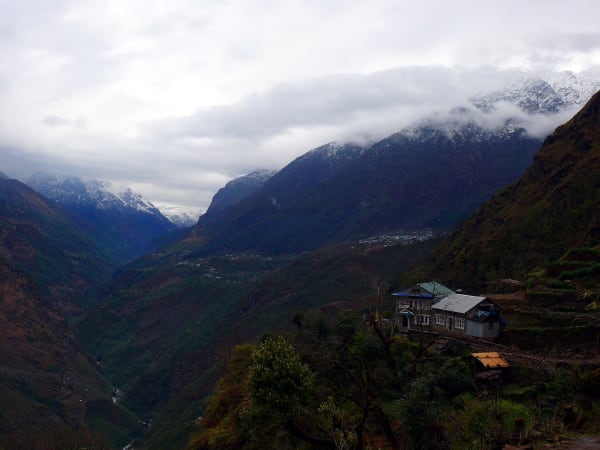
The descent from Gorak Shep to Lukla takes three days and covers ground you have already walked. For trekkers short of time — or short of knees — flying out instead is an increasingly common choice, and a sensible one.
It is worth being clear about what it changes. The walk up is identical, so the acclimatisation profile and the achievement are unchanged. What you give up is the descent, which is genuinely enjoyable and surprisingly restorative. What you gain is three days, an aerial view of the Khumbu, and immunity from the Lukla flight backlog.
How It Works
Our Everest Base Camp Trek with Helicopter Return runs the standard ascent — Lukla, Phakding, Namche with an acclimatisation day, Tengboche, Dingboche with a second rest day, Lobuche, Gorak Shep — then flies you out rather than walking back.
- Pickup point: usually Gorak Shep (5,160 m) or Pheriche (4,371 m), depending on weather and group size.
- Timing: morning, for the same reason fixed-wing flights fly in the morning — valley winds.
- Route: down the Khumbu with Everest, Nuptse, Ama Dablam and the Dudh Koshi valley below, usually with a refuelling stop at Lukla.
- Flight time: around 50 to 60 minutes to Kathmandu, or 12 minutes to Lukla if you are connecting to a fixed-wing flight.
- Capacity: five passengers plus kit at Khumbu altitudes; sometimes fewer at Gorak Shep, where thin air limits payload.
Flights are shared where possible, which is what makes the per-seat cost reasonable. If you are a group of four or five the charter is yours; a solo trekker or a pair is paired with others on the same morning.
What It Saves You
| Walk out | Fly out | |
|---|---|---|
| Total trip length | 14 days | 12 days |
| Days after Base Camp | 3 walking days to Lukla | A morning flight |
| Descent | 1,700 m on foot, hard on knees | None |
| Lukla flight risk | Exposed to the outbound backlog | Removed, or much reduced |
| Extra cost | — | A per-seat helicopter charge on top of the trek |
| What you miss | — | The Pheriche to Namche forest, Tengboche a second time, and the sense of closing the loop |
The Lukla risk point is the underrated one. A fixed-wing backlog after two cloudy days can strand trekkers for 48 hours or more, and a helicopter booked in advance sidesteps that entirely — which matters if your international flight is tight.
Who It Suits
- Trekkers with 12 days rather than 14. This is the right way to compress the trek — it removes descent days rather than acclimatisation days.
- Anyone with knee trouble. The descent is the part that hurts, and skipping it is a legitimate medical decision rather than a shortcut.
- Trekkers on a tight return connection. If you cannot absorb a two-day Lukla delay, fly out.
- Anyone who wants the aerial view. Seeing the route you walked laid out beneath you is genuinely one of the trip's highlights.
- Groups of four or five. The economics work best here, since the charter splits cleanly.
Who it does not suit: trekkers for whom walking the whole thing matters, and anyone on a tight budget, since the helicopter is a significant addition. And it should never be used to justify an 11-day ascent — if you are saving days, save them on the way down.
The Honest Case Against
Three things worth weighing.
The descent is better than it sounds. Losing 1,700 m over two days with thickening air is the part of the trek where you feel strong, the forest and rhododendron return, and Namche arrives like a city. Several of our guests who flew out have said it is the one thing they would change.
Helicopter traffic is a real issue in the Khumbu. Flights have increased sharply, and the noise over a quiet valley is now a standard complaint from trekkers walking below. We share charters rather than running empty legs, and we do not offer helicopter lifts for ordinary tiredness — but it is a genuine consideration.
Weather still applies. A helicopter is far less weather-sensitive than a Dornier, but it is not immune. If Gorak Shep is socked in, you walk to Pheriche or Lukla and fly from there, so keep one spare day even with a helicopter booked.
Other Helicopter Options in the Khumbu
| Flight | Duration | Use |
|---|---|---|
| Gorak Shep to Kathmandu | About 3 hours with stops | The standard trek-out flight from the highest lodge |
| Gorak Shep to Lukla | About 15 min | Connect to a fixed-wing flight, or a shorter hop if payload is tight |
| Namche to Kathmandu | About 2 hours | A mid-trek exit without walking back to Lukla |
| Kala Patthar to Kathmandu | About 3 hours | A landing at the viewpoint itself, then out |
| Base Camp helicopter tour | 4–5 hours | No trek at all — a morning from Kathmandu with a Kala Patthar landing |
| Kathmandu to Lukla | About 1 hour | Fly in by helicopter, avoiding the Ramechhap drive |
If you have no interest in walking for two weeks but want to see the Khumbu, the Base Camp helicopter tour is the honest alternative — a morning from Kathmandu with a landing near Kala Patthar and breakfast at the Everest View Hotel.