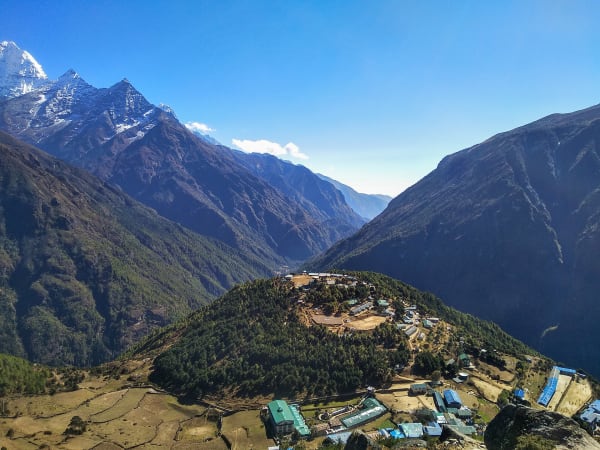
The Everest Base Camp helicopter tour is the most popular single-day trip in Nepal, and for a clear reason: it puts you at the viewpoint that trekkers reach on day nine of a fourteen-day trek, and has you back in Kathmandu before lunch.
What you get is a flight up the Dudh Koshi and the Khumbu with the whole range unfolding, a short landing at around 5,300 to 5,545 m near Kala Patthar with Everest, Nuptse, Lhotse and Pumori around you, and a breakfast stop at the Everest View Hotel at 3,880 m on the way back. What you do not get is the valley at walking pace, the villages, or ten days of earning it.
The Tour at a Glance
| Duration | 4–5 hours door to door from Kathmandu |
| Departure | Early morning, typically 6–7 a.m. |
| Highest landing | Near Kala Patthar, around 5,300–5,545 m |
| Time at the high landing | 10–15 minutes |
| Breakfast stop | Everest View Hotel, Syangboche, about 3,880 m |
| Capacity | 5 passengers, reduced at the high landing |
| Season | Best October to December and March to May; clear mornings year-round |
| Landing guarantee | Not guaranteed — weather and payload dependent |
We run it as the Everest Base Camp Helicopter Tour with Kala Patthar landing. Related options include a Kala Patthar to Kathmandu flight and a Gorak Shep to Kathmandu flight for trekkers already in the valley.
How the Morning Runs
- 5.30–6.00 a.m. Hotel pickup and transfer to the domestic terminal at Kathmandu airport. Briefing, weights taken, safety instructions.
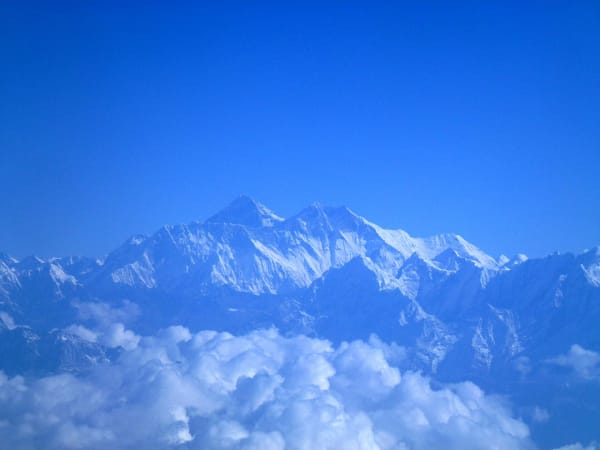
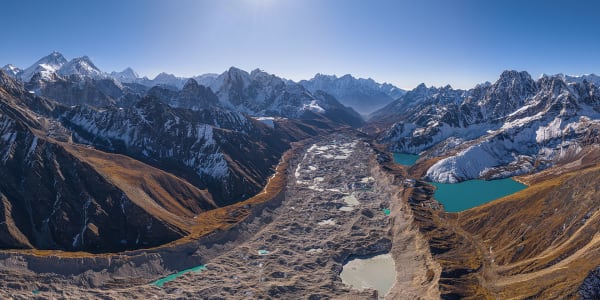
- 6.30–7.00 a.m. Departure. The flight follows the Kathmandu valley rim east, then the Dudh Koshi, with Lukla, Namche and Tengboche visible below — the entire trekking route in 40 minutes.
- About 7.30 a.m. Refuelling stop at Lukla or Syangboche. On a five-passenger flight, the helicopter may take passengers to the high landing in two groups because of payload limits at altitude.
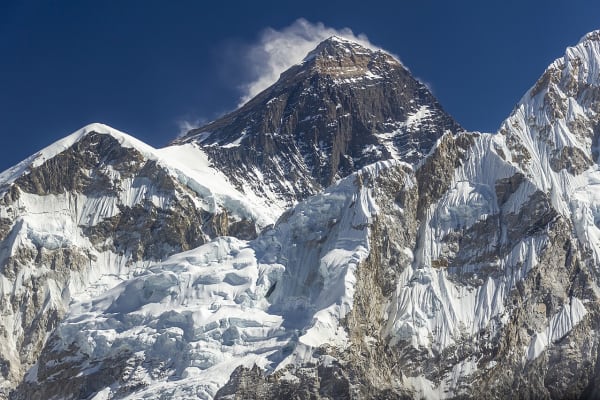
- 8.00 a.m. The high landing — a flat area near Kala Patthar or at Gorak Shep. Ten to fifteen minutes, with Everest's summit pyramid, the Khumbu Icefall, Nuptse, Lhotse, Pumori and Changtse around you. Cold, thin, loud, and extraordinary.
- 9.00 a.m. Descent to Syangboche and breakfast on the terrace of the Everest View Hotel at 3,880 m, with Everest and Ama Dablam in front of you. This is the part people remember almost as much as the landing.
- 10.00–11.00 a.m. Return flight to Kathmandu and hotel drop-off.
The refuelling and payload shuttling is the part that surprises people. Above 5,000 m a helicopter can lift considerably less than at sea level, so a full load is commonly split — two passengers up and back, then three. It adds time and it is a safety measure, not an inconvenience.
Who It Suits
- Travellers with a day, not a fortnight. This is the only way to reach the Everest viewpoint in a morning.
- Anyone who cannot trek — mobility, age, a medical reason, or simply no interest in walking for two weeks.
- Families with children who would not manage the trek.
- Photographers. The aerial perspective on the Khumbu glacier and Icefall is unavailable on foot.
- Trekkers adding it on. A number of our guests take the flight before or after a trek elsewhere in Nepal, which is a genuinely good combination.
- Groups of five, for whom the per-seat economics work best.
Who should think again: anyone with a heart condition, uncontrolled high blood pressure, significant lung disease or who is pregnant should take medical advice before booking — 1,400 m to above 5,300 m in under an hour is a genuine physiological event. And anyone with two weeks and reasonable fitness will get far more from the trek.
What Can Go Wrong
- Weather cancellation. Less frequent than for fixed-wing flights but real. Flights are rescheduled to the next clear morning, so keep a spare day.
- No landing. Wind, cloud or snow at the high site can mean a flyover instead. You still get the flight; you do not get to stand there. Operators state this in advance.
- The shuttle adds time. Payload limits at altitude mean a full helicopter often splits the high landing into two trips.
- Altitude symptoms. Light-headedness and breathlessness are normal. Anything more — a bad headache, nausea, confusion — and you tell the crew immediately and they descend.
- Cold. It is -10 to -20 °C at the landing. Bring a down jacket, hat and gloves. People step out in fleeces and regret it within a minute.
- Disappointment at the Base Camp question. The tour lands near Kala Patthar or Gorak Shep rather than at Base Camp itself, which is on moving glacier. Everest is visible from Kala Patthar and not from Base Camp, so this is the better landing regardless — see our comparison.
What to Bring
- A proper down jacket, warm hat and gloves. Non-negotiable for the high landing.
- Sunglasses — category 3 or 4. Snow glare at 5,300 m is severe.
- Sunscreen for the short exposure, which is stronger than it feels.
- A camera with a charged battery kept warm in an inside pocket. Cold flattens batteries in minutes.
- Your passport for the flight manifest, and any medication you need.
- Light clothing underneath — Kathmandu is warm, Syangboche is mild in the sun, and the landing is freezing. Layers, as always.
- Nothing heavy. Payload matters, and operators will ask you to leave bags behind.
One final note on expectations. The landing is brief, loud and cold, and the experience is genuinely disorienting — several of our guests have said the breakfast at the Everest View Hotel, sitting on a warm terrace at 3,880 m with Everest in front of them, is the part they remember best. Both are worth having.