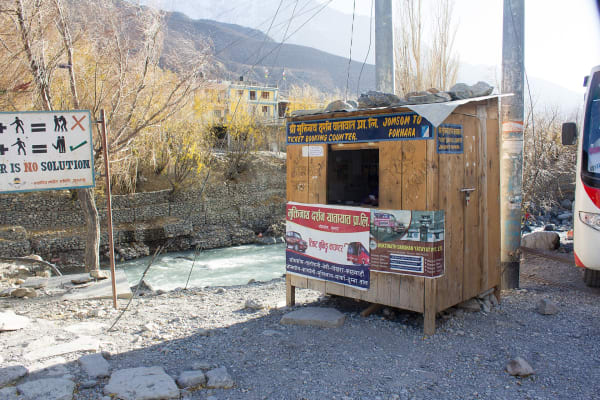
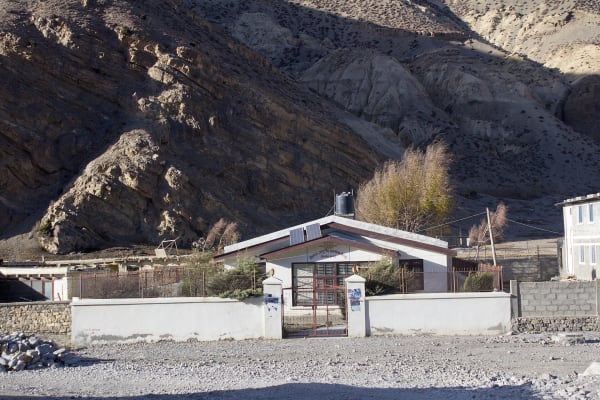
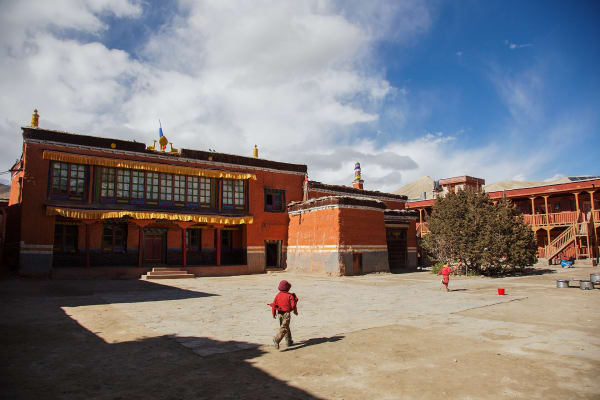
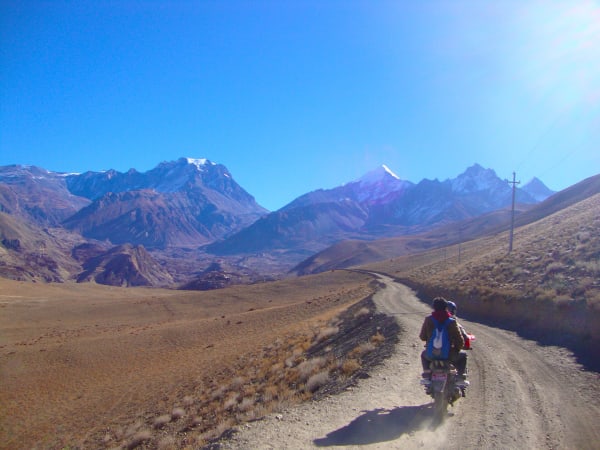
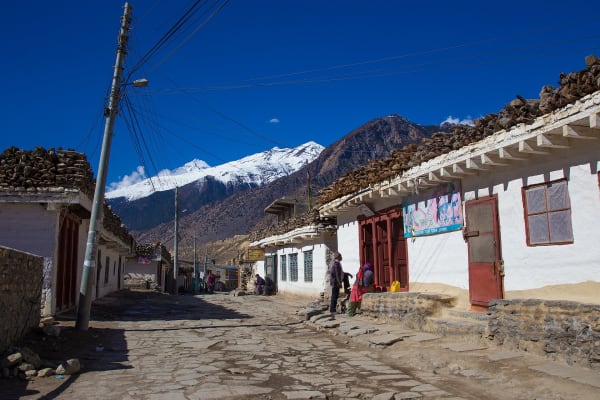
Lower Mustang is the southern, open half of the district that lies in the rain shadow behind the Annapurna and Dhaulagiri massifs — arid, Tibetan-influenced, and completely unlike anywhere else on the Nepali trekking map. A mountain flight from Pokhara lands you at Jomsom (2,700 m), and from there the trail follows the Kali Gandaki through ochre cliffs, wind-scoured river flats and whitewashed villages.
The route takes in the walled medieval village of Kagbeni, the sacred temple complex at Muktinath (3,800 m) with a full exploration day, and the beautifully preserved Thakali village of Marpha (2,640 m) — famous throughout Nepal for its apple orchards, flagstone streets and hilltop monastery.
It is a trek defined as much by culture, architecture and food as by mountain scenery, and it needs no restricted-area permit.

The Trek at a Glance
| Duration | 10 days Kathmandu to Kathmandu, 5 of them walking |
| Highest point | Muktinath, 3,800 m |
| Difficulty | Moderate — short days, modest altitude |
| Best seasons | March to May, September to November |
| Accommodation | Comfortable lodges with mains power and Wi-Fi |
| Access | Flight Pokhara to Jomsom and back |
| Permits | Annapurna Conservation Area Permit — no restricted permit |
| Price | From USD 775 per person |
We run it as a 10-day trip from Kathmandu and a 7-day version from Pokhara. To continue north to Lo Manthang, see the Upper Mustang trek, which needs a separate restricted permit.
The Route
Jomsom to Kagbeni (2,700 m to 2,800 m)
An easy three-hour first day up the riverbed. Kagbeni is the highlight of the lower valley: a walled medieval village of mud-brick alleys, a red gompa, and a checkpoint marking the boundary of the Upper Mustang restricted area. It is worth walking to the edge of town to look north up the valley at country you cannot enter without a much more expensive permit.
Kagbeni to Muktinath (2,800 m to 3,800 m)
Four to five hours of steady climbing out of the Kali Gandaki into the Jhong valley. Muktinath is one of the very few sites sacred to both Hindus and Buddhists — 108 water spouts, an eternal flame burning on natural gas beside a spring, and a constant flow of pilgrims. The exploration day lets you see it properly rather than in passing.

Muktinath to Marpha (3,800 m to 2,670 m)
Five to six hours, mostly descent, back down to the Kali Gandaki and south to Marpha. Flagstone streets, whitewashed Thakali houses, a monastery above the rooftops, and orchards that have made it the apple capital of Nepal. Try the local apple brandy; it is not optional.
Marpha to Jomsom and out
A gentle two to three hours along the valley floor to Jomsom, then the morning flight to Pokhara.
The Wind, and Why Days Start Early
The Kali Gandaki funnels air between Dhaulagiri and Annapurna, producing a powerful up-valley wind that begins mid-morning and blows all afternoon. It shapes everything about how the valley operates:
- Walking days start early and aim to finish by early afternoon.
- Flights operate in the morning only and are grounded by wind after about ten o'clock.
- Sunglasses and a buff are essential — the wind carries grit off the riverbed.
If your Jomsom flight is cancelled, the alternative is a jeep up or down the Kali Gandaki taking most of a day. Keep a spare day in your schedule. Our domestic flights guide covers how to plan around this.
Lower Mustang or Upper Mustang?
| Lower Mustang | Upper Mustang | |
|---|---|---|
| Where | South of Kagbeni | North of Kagbeni to Lo Manthang |
| Permit | Standard ACAP | Restricted permit with a substantial government fee |
| Guide and group | Guide required, no minimum group | Licensed guide and minimum two trekkers |
| Days | 10 from Kathmandu | Typically 14 to 18 |
| From | USD 775 | See the Upper Mustang guide |
Lower Mustang gives you the landscape, the Thakali culture and Muktinath at a fraction of the cost. Upper Mustang gives you the walled capital at Lo Manthang and the cave monasteries — read our Upper Mustang guide if that is the draw.
What It Costs
| Group size | Price per person |
|---|---|
| 1 trekker | USD 900 |
| 2 to 4 | USD 875 |
| 5 to 7 | USD 850 |
| 8 to 10 | USD 825 |
| 11 to 14 | USD 800 |
| 15 and over | USD 775 |
Trail extras are lower here than on most routes because the valley has mains power — charging is often free and Wi-Fi is cheap. Jomsom has a reasonably reliable ATM, but carry rupees from Pokhara regardless.
What Is Included
- Airport pickup and drop-off in Kathmandu.
- Transport Kathmandu to Pokhara and back.
- Pokhara–Jomsom return flights.
- Hotel accommodation in Kathmandu and Pokhara with breakfast.
- Teahouse and lodge accommodation throughout the trek.
- Three meals a day during the trek.
- Annapurna Conservation Area Permit and trekking registration.
- A licensed English-speaking trekking guide.
- Group trekking map, first aid kit carried by the guide, and all government taxes, permit fees and service charges.
What Is Not Included
- International flights and the Nepal entry visa fee.
- Travel insurance including emergency helicopter evacuation.
- Personal trekking equipment and clothing.
- Porter services, available at additional cost.
- Lunch and dinner in Kathmandu and Pokhara.
- Snacks, bottled water, hot showers, Wi-Fi, charging and drinks.
- Laundry, phone calls, souvenirs and personal expenses.
- Tips for guides, drivers and support staff.
- Extra accommodation or a jeep transfer if the Jomsom flight is cancelled, or anything else outside the itinerary.
Note the roughly 15 kg baggage limit on the Jomsom flight. Both hotels store anything you do not need free of charge until you return.