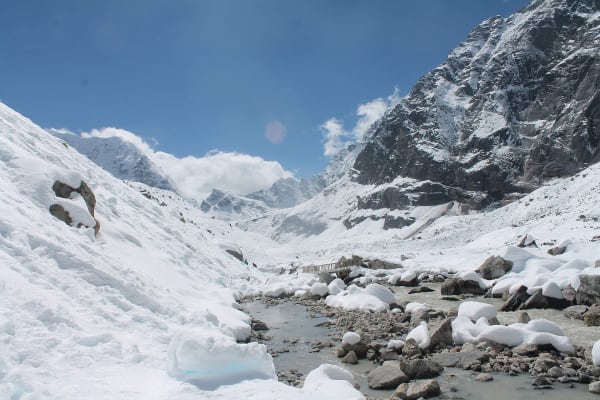
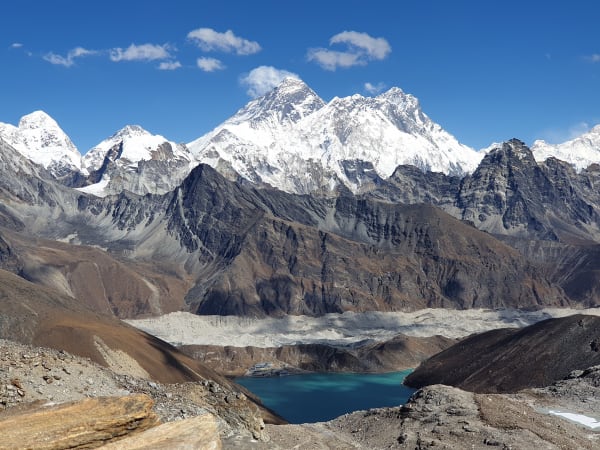
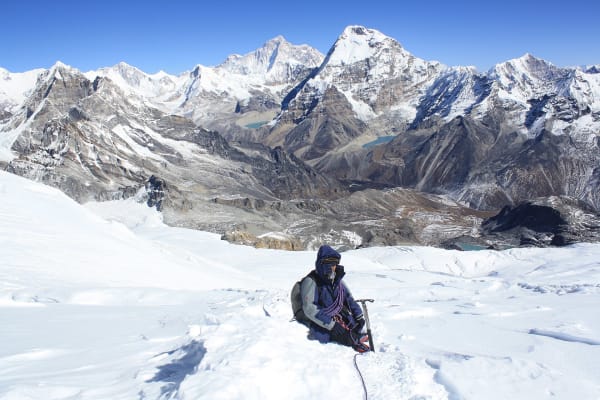
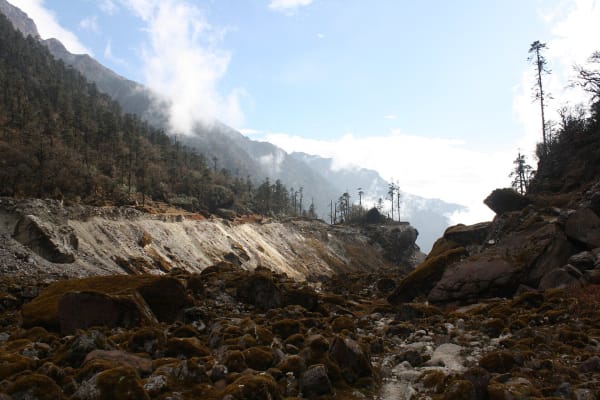
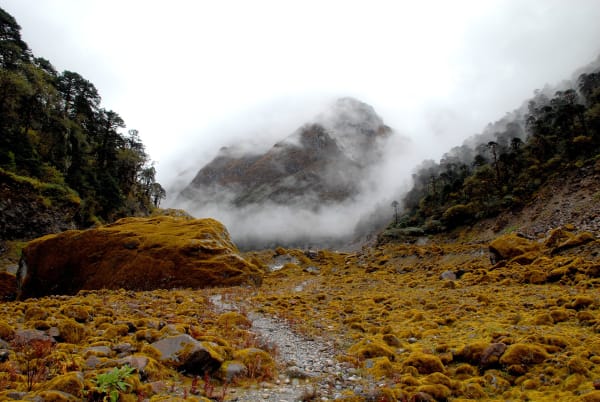
This is the most serious trip we run, and calling it a trek understates it. The route crosses from the Barun valley beneath Makalu (8,485 m) into the Khumbu over three high passes in a single push: the Sherpani Col (6,180 m), the West Col (6,135 m) and the Amphu Labtsa (5,845 m). Two are above 6,000 m, all three are glaciated, and the ground between them is a closed basin with no exit but forward.
The approach is the full Makalu Base Camp trek — the flight to Tumlingtar, the ridge climb through Tashi Gaun and over the Shipton La, and the Barun valley to base camp at 4,870 m. Beyond that it becomes a mountaineering expedition: fixed ropes, abseils off the West Col, roped glacier travel and camps above 5,500 m.
It finishes with the descent to Chukhung and the walk out through Namche to Lukla — which, after what precedes it, feels like a holiday.

The Trek at a Glance
| Duration | 24 days Kathmandu to Kathmandu, including two reserve days |
| Highest point | Sherpani Col, 6,180 m |
| Highest night | Sherpani Col Base Camp, 5,690 m |
| Difficulty | Extreme — a mountaineering expedition without a summit |
| Best seasons | April to May, October to November |
| Accommodation | Teahouses on the approach, mountain tents above Makalu Base Camp |
| Access | Fly to Tumlingtar, out from Lukla |
| Permits | Makalu Barun, Sagarmatha and Khumbu municipality permits |
| Price | From USD 4,500 per person |
We run it as a 24-day expedition. If you want the Barun valley without the cols, the Makalu Base Camp trek is the route; the Everest Three Passes trek is the serious but non-technical alternative.
The Route
Tumlingtar to Makalu Base Camp (410 m to 4,870 m)
The standard Makalu approach and a substantial trek in its own right: a flight to Tumlingtar, a jeep to Num, and then days of steep ridge walking through Seduwa and Tashi Gaun to Khongma Danda, over the Shipton La (4,216 m), and up the Barun valley through Yangle Kharka and Langmale Kharka. Acclimatisation days at Khongma Danda and at Makalu Base Camp (4,870 m).
Base Camp to Sherpani Col Base Camp (4,870 m to 5,690 m)
The trekking ends here. Two days on moraine and glacier via Swiss Base Camp (5,150 m) to the high camp at 5,690 m, with a reserve day built in. From this point the group is committed to the weather.
The Sherpani Col and West Col (6,180 m / 6,135 m)
The crux day, and both cols are crossed in one push. Fixed rope on the climb to the Sherpani Col, roped glacier travel across the top, and then the abseil off the West Col — a steep, committing descent into the Hongu basin and the camp at Baruntse Base Camp (5,450 m).
There is no escape from the Hongu basin. Going back means re-climbing the West Col. Going forward means the Amphu Labtsa. There is no village, no road and no walking exit at lower altitude, which is why the weather decision made back at Sherpani Col Base Camp is the most consequential one on the trip.

The Amphu Labtsa and out (5,845 m to 2,840 m)
A rest and reserve day at Baruntse Base Camp, then to the Amphu Labtsa Base Camp (5,500 m) and over the final pass — fixed rope and an abseil on the Khumbu side — dropping to Chukhung (4,730 m). From there it is ordinary Khumbu trekking out through Tengboche and Namche to Lukla.
What Experience You Need
We ask for a climbing CV at the booking stage, and we mean it. This is not a route where enthusiasm substitutes for experience — the abseil off the West Col is not somewhere to learn the technique.
- Previous experience above 6,000 m.
- Competence with crampons, a rope, a jumar and an abseil device without needing to be taught on the mountain.
- A 12 to 15 kg pack on the pass days — water, layers, harness, crampons and the day's food. Considerably more than on a teahouse trek.
- Tolerance for -25 °C and colder at the camps above 5,400 m, where water bottles freeze solid outside a sleeping bag and boot liners must be slept with.
- Two weeks with no mobile signal between Yangle Kharka and Chukhung. The group carries a satellite phone with daily contact windows to our Kathmandu office.
The support ratio is closer to an 8,000 m expedition than to a trek — a climbing guide, assistant climbing guides, a cook and kitchen crew, and a large porter and high-altitude team to move camps and fix ropes. That is the main driver of the price.
Turning Back Is a Real Outcome
If the passes are not crossable, the group walks back down the Barun valley to Tumlingtar, which takes about a week. This happens, and we plan and price for it. Your guide makes the call at Makalu Base Camp and again at Sherpani Col Base Camp.
The itinerary carries two reserve days — one at Baruntse Base Camp for weather on the cols, and one in Kathmandu for a cancelled Lukla flight. On this route the spare days are used more often than not, and an itinerary without them is not a serious itinerary.
Read our Lukla flight guide for the exit risk, and the fixed rope and jumar guide for the technical ground.
What It Costs
| Group size | Price per person |
|---|---|
| 1 trekker | USD 4,625 |
| 2 to 4 | USD 4,600 |
| 5 to 7 | USD 4,575 |
| 8 to 10 | USD 4,550 |
| 11 to 14 | USD 4,525 |
| 15 and over | USD 4,500 |
What Is Included
- Airport pickup and drop-off in Kathmandu.
- Kathmandu–Tumlingtar and Lukla–Kathmandu flights with airport transfers, and a private jeep Tumlingtar to Num.
- Hotel accommodation in Kathmandu with breakfast, and teahouse accommodation on the trekking sections.
- Two-person mountain tents, mess tent, toilet tent and all group camping equipment.
- A cook and kitchen crew for the full camping section.
- Crampons, harness, jumar, descender, helmet, ice axe and all fixed rope for the three col crossings.
- A climbing guide, assistant climbing guides and high-altitude staff for the pass section.
- A satellite phone for group emergency communication.
- Makalu Barun National Park, Sagarmatha National Park and Khumbu Pasang Lhamu municipality permits.
- Three meals a day, group map, first aid kit, and all government taxes and service charges.
What Is Not Included
- International flights and the Nepal entry visa fee.
- Travel insurance with emergency helicopter evacuation valid above 6,000 m — mandatory, and check the altitude ceiling on your policy carefully.
- Personal trekking and climbing equipment, including a bag rated to -30 °C, double or insulated boots and an insulated mat.
- Porter services for your personal duffel, available at additional cost.
- Lunch and dinner in Kathmandu.
- Snacks, bottled water, hot showers, Wi-Fi, charging and drinks.
- Laundry, phone calls, souvenirs and personal expenses.
- Tips for the climbing guide, crew and high-altitude staff — budget generously here.
- Extra accommodation, transport or rescheduled flights caused by weather or a turned-back crossing, or anything else outside the itinerary.