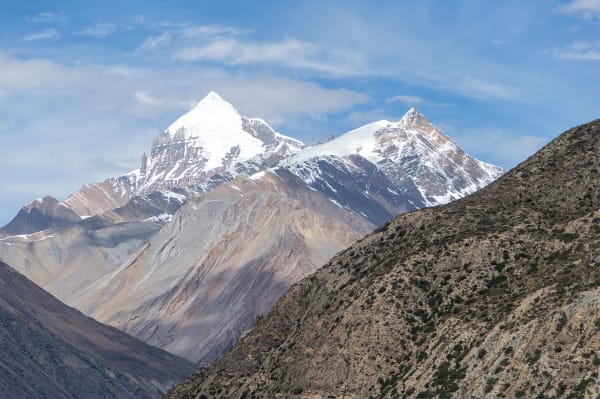
For twenty years the Annapurna Circuit was routinely called the best long trek in the world. Then road building reached the Marsyangdi and the Kali Gandaki, and a persistent question appeared on every forum: has the road ruined it?
The honest answer is no, but it has changed it, and how much depends entirely on whether your guide knows the alternative trails. This is what has actually happened and what to do about it.
Where the Roads Are
| Section | Road status | Walking quality now |
|---|---|---|
| Besisahar to Chame | Jeep road the whole way | Poor on the road; good on the old trail above it, which exists most of the way |
| Chame to Pisang | Jeep road | Fair — the NATT trail climbs away from it in places |
| Pisang to Manang | Road on the valley floor | Excellent if you take the high route through Ghyaru and Ngawal |
| Manang to Thorong Phedi | No road | Unchanged and superb |
| Thorong La | No road, and never will be | The best day on the circuit |
| Muktinath to Jomsom | Jeep road | Mediocre — busy and dusty on the valley floor |
| Jomsom to Tatopani | Jeep road | Poor. Most itineraries fly or drive this section |
| Tilicho and Nar Phu side trips | No road | Unchanged |
Read the table and the pattern is clear: the best part of the circuit has no road and cannot have one. The sections that have suffered are the low approach and the walk out, both of which are now commonly replaced by a jeep.
The NATT Trails
The New Annapurna Trekking Trails project marked a network of alternative walking routes that deliberately avoid the road, using old village paths, high traverses and river-bank trails. They are signed with red-and-white or blue-and-white paint markings.
- The high route from Pisang through Ghyaru and Ngawal — higher, harder, and with the best views on the whole circuit. Always take this over the valley road.
- The old trail above the Marsyangdi between Besisahar and Chame, which climbs away from the road through villages.
- The west-bank trail in the Kali Gandaki below Jomsom, which avoids the jeep track entirely.
- The Ghyaru to Manang traverse, which stays high rather than dropping to the road.
Whether you walk these or the road is entirely a function of your guide. This is one of the clearest practical arguments for a guide with recent experience on the route rather than a cheap itinerary.
What the Jeep Actually Lets You Do
It is worth being even-handed: the road has opened the circuit to people who could not do it before.
- Shorter itineraries. Our 7-day Short Annapurna Circuit uses a jeep to Chame or Manang and still crosses Thorong La. Without the road it would take a fortnight.
- Skipping the dull parts. There is no merit in walking a dusty jeep track for four hours. Driving it and spending the time in Manang or Kagbeni is a better trek.
- Escape routes. If someone is ill at Manang, a jeep out is now possible. That is a real safety improvement.
- Resupply and lodge quality. Lodges in Manang and Chame are better than they were because goods arrive by vehicle rather than by mule.
- Local benefit. The road serves the villages, not the trekkers. Manang families can reach a hospital, and children can reach a school.
That last point matters. The road was not built for tourism and objecting to it on aesthetic grounds is a position worth holding lightly.
Should You Go Elsewhere?
If what you want is a long Himalayan circuit with no road at all, there are better answers than the Annapurna Circuit in 2026.
| Trek | Days | Why it is the closer match |
|---|---|---|
| Manaslu Circuit | 15 | The closest thing to the old Annapurna Circuit — a restricted area, a 5,106 m pass, and a fraction of the traffic |
| Kanchenjunga Circuit | 21 | Genuinely remote eastern Nepal, two base camps, almost no one |
| Nar Phu Valley | 14 | A restricted side valley off the circuit itself, plus the 5,320 m Kang La |
| Tilicho Lake | 12 | The best road-free section of the Annapurna region, reached from Manang |
| Upper Mustang | 16 | Beyond the Kagbeni checkpoint, where the road matters far less |
| Rolwaling Valley | 17 | Remote central Nepal with no vehicle access at all |
One thing the debate tends to miss: the circuit's reputation was built when it took three weeks and there were no roads anywhere in Nepal's mountain districts. Judged against that memory it has lost something. Judged against what it is — ten days between two eight-thousanders, over a 5,416 m pass, through four distinct climate zones, with lodges the whole way and a Tilicho side trip available — it is still better than the great majority of long treks anywhere in the world.
But do not write off the Annapurna Circuit. Ten days from Besisahar to Muktinath, taking the NATT trails, including Tilicho, and crossing Thorong La, is still one of the most varied walks in the Himalaya — subtropical farmland to Tibetan high desert, with an 8,000 m peak on either side of the deepest gorge on earth. Our full circuit guide sets out the route in detail.