This is the part of Dashain that guidebooks tend to mention in one sentence and visitors tend to worry about. It deserves a plain account. Animal sacrifice is not a fringe of the festival; it is the ritual centre of its middle days, practised by a large part of the population. It is also confined to particular places and two particular days, and a visitor who would rather not see it need not.
We have tried to describe it without either relish or lecturing. The festival as a whole is covered in our Dashain travel guide.
What Happens, and Why
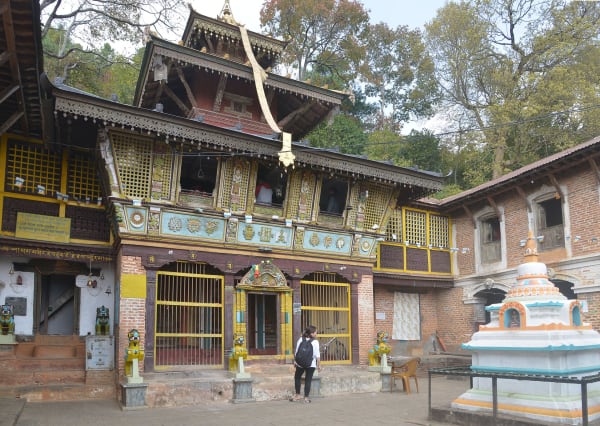
Dashain commemorates the goddess Durga's killing of the buffalo demon Mahishasura. On Maha Ashtami and Maha Navami, the eighth and ninth days, that act is re-enacted as an offering, bali, to the goddess in her fierce forms — Durga, Kali, Bhagwati. The animal is most often a male goat; buffalo, ducks, chickens and occasionally sheep are also offered.
The animal is sprinkled with water, and when it shakes itself this is taken as consent. It is killed with a single stroke of a heavy knife, and the blood is offered to the image of the goddess. The carcass goes home, or to the butchers working beside the temple, and is eaten over the following days — it is the feast described in our Dashain food guide.
On the ninth day the same blessing is extended to tools and vehicles. Cars, buses and motorbikes are garlanded and marked with red, and many have a small animal, an egg or a coconut offered in front of them for a year without accidents.
Not Everyone Sacrifices
It would be wrong to picture the whole country with a knife in its hand. A substantial number of Hindu households are vegetarian and never have. Others have stopped: the standard substitute is a pumpkin or ash gourd, split with the same stroke, and coconuts, sugar cane and radish are also used. Urban families increasingly make a symbolic offering and buy their meat from the butcher. Buddhist communities — Sherpa, Tamang in many places, the people of Mustang and Manang — generally do not sacrifice at Dashain at all.
Where It Happens
| Place | What happens | For a visitor |
|---|---|---|
| Dakshinkali, south of Kathmandu | The best-known sacrificial temple; sacrifices twice a week all year, and in great numbers at Dashain | Visitors watch from the terraces above the enclosure — Pharping and Dakshinkali tour |
| Goddess temples in Kathmandu | Bhadrakali, Shobha Bhagwati, Maitidevi, Naxal Bhagwati, Guhyeshwari and others | Queues from dawn; easy to walk past without entering |
| Hanuman Dhoka, Kathmandu | The army's sacrifices in the Kot courtyard on the night of the eighth day | Not a public spectacle |
| Bhaktapur | At Taleju, the goddess shrines and before the Navadurga | Part of Mohani — see Bhaktapur during Dashain |
| Manakamana and Gorkha | Among the busiest sites in the country on the eighth day | See Gorkha and Manakamana |
| Bindhyabasini, Pokhara | The town's main temple | See Pokhara during Dashain |
| Household yards | Anywhere, in villages and towns alike | Private, but visible from the lane |

What You Will See if You Go
At a large temple on the eighth day: a long, orderly queue of families, each with an animal and a plate of offerings; an enclosure in front of the image where the killing is done, quickly and without ceremony, one after another; blood on the stone; and beside it, butchers at work and fires where families cook and eat together afterwards. The mood is not sombre. It is a festival day, people are dressed well, and children are present.
It is also, to an unaccustomed eye, a lot of death at close range, with the sounds and smells that go with it. Most visitors who go find it less frightening and more thought-provoking than they expected. Some find it distressing. You know which you are likely to be.
How to Avoid It Entirely
Sacrifice is concentrated in two days and at particular kinds of temple, which makes it straightforward to plan around.
- Spend the eighth and ninth days at Buddhist sites. Boudhanath, Swayambhunath and the monasteries of Pharping have none — a Kathmandu day tour can be arranged around them, or see the Buddhist Pilgrimage Tour.
- Be on a trek in Buddhist country. In the Khumbu on the Everest Base Camp trek, or in Upper Mustang, the festival's middle days pass unnoticed.
- Visit Khokana. The village keeps its own festival instead of Dashain — Bungamati and Khokana tour.
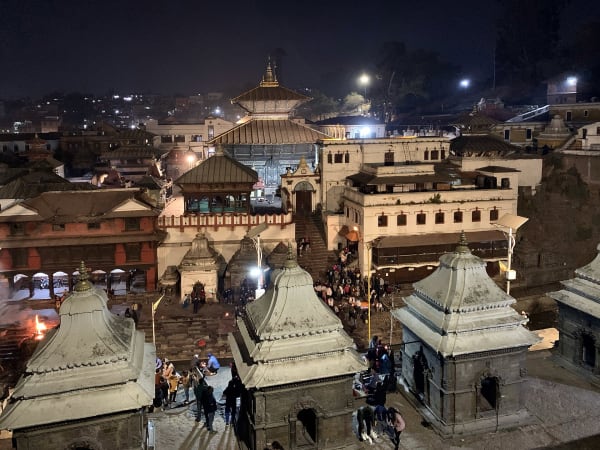
- Stay away from Durga and Kali temples in the mornings. Vishnu and Shiva temples, including Pashupatinath, do not have animal sacrifice.
- Go up to the valley rim or out to a national park. Nagarkot and Chitwan are untouched by it.
- In a homestay, say so. Hosts will tell you when the goat is to be killed and nobody will mind if you go for a walk.
Our day-by-day plans in Kathmandu during Dashain mark which days and places are affected.
The Debate Inside Nepal
Visitors sometimes assume they are the first to find this uncomfortable. They are not. Animal sacrifice is argued over in Nepal every Dashain — in newspapers, on social media and within families. Animal-welfare organisations campaign against it and against the conditions in which animals are transported to market. Religious reformers argue that the texts ask for the sacrifice of one's own faults, not of a goat. Some temples and communities have ended the practice or replaced it with pumpkins. Many younger, urban Nepalis decline to take part.
Others defend it as a tradition older than the country, point out that the meat is eaten rather than wasted, and note that the animal's end is quicker than in an industrial slaughterhouse. Both positions are held sincerely by people who share the same festival table.
The practical point for a traveller is that this is Nepal's argument to have. Curiosity and respectful questions are welcome. Lectures from guests are not, and change nothing.
If You Choose to Watch
- Stand where visitors stand. At Dakshinkali that is the terrace above the enclosure; non-Hindus do not enter the inner area.
- Be quiet and still. You are a guest at someone's act of worship.
- Keep the camera down unless you have asked. No flash, no close-ups of families without permission, and nothing posted online that mocks. See photographing Dashain.
- Leave leather outside where a temple asks for it.
- Go with a guide who can explain what you are seeing and when to step back.
- Leave when you have seen enough. Nobody will think less of you.
With Children, and for Vegetarians
Nepali children grow up with this and are present throughout. Whether yours should be is your decision; if not, the eighth and ninth days are easy to spend elsewhere, and the rest of the festival — swings, kites, tika — is ideal for them. See Dashain swings and kites.
Vegetarians and vegans are well understood in Nepal and will be catered for without fuss at any meal, including a family tika. It is perfectly acceptable to attend a tika and eat no meat — our guide to receiving Dashain tika explains how to say so.