Most visitors pass both without stopping. The Prithvi Highway runs along the Trishuli river beneath them; the cable car to Manakamana lifts off from the roadside, and the turning for Gorkha is forty minutes further west. For a traveller in the country at Dashain they are the two best detours on the whole road.
Gorkha is where the festival's state ceremony begins. Manakamana is where a large part of the country goes to ask the goddess for something. This guide covers both. Where they sit among the festival's other places is in where to see Dashain celebrations in Nepal.
Why Gorkha Matters to Dashain
Gorkha was a small hill kingdom, one of dozens, until its king Prithvi Narayan Shah — born in the palace here in 1723 — set out to conquer the rest. By 1769 he had taken the Kathmandu valley, and the country he assembled is the Nepal on today's map. The Shah dynasty ruled it from Kathmandu until 2008, but Gorkha remained the ancestral seat, and its goddess the family's protector.
That is the reason for the Phulpati. Each Dashain a bundle of sacred plants is prepared at Gorkha and carried on foot to the old royal palace in Kathmandu, arriving on the seventh day — a ritual that ties the capital back to the place the kingdom came from. The monarchy has gone; the walk continues. What happens at the Kathmandu end is described in Kathmandu during Dashain.
Gorkha Durbar: The Palace on the Ridge
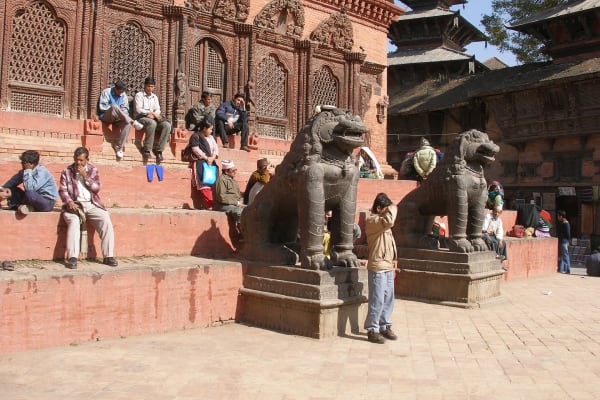
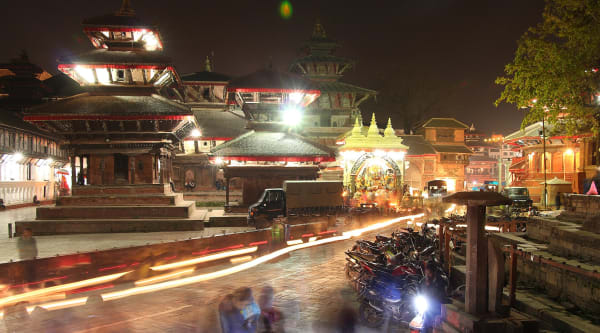
The palace stands on a narrow ridge about 250 metres above Gorkha Bazaar, reached by a stone stairway of well over a thousand steps — an hour's steady climb, or a shorter one from the road that now goes partway up. It is a fort, a palace and a temple in one building of brick and carved timber, in the Newar style of the craftsmen who were brought from the valley to build it.
- The Gorakhkali temple, at the western end, is the heart of the place and the focus of the festival here. Only its priests enter; worshippers and visitors stay outside.
- The palace wing, where Prithvi Narayan Shah was born, with latticed windows looking out over the hills.
- The cave shrine of Gorakhnath, the saint from whom the town and the Gurkha soldiers take their name, below the palace.
- The view: north to Manaslu, Himalchuli and Ganesh Himal on a clear morning; south across the ridges to the plains.
Leather is not permitted inside the compound and photography is restricted near the temple. The building was damaged in the 2015 earthquake, whose epicentre was in this district, and has been under restoration since; parts may be scaffolded.
In the bazaar below, the Tallo Durbar, the lower palace, houses the Gorkha Museum and is worth an hour.
Gorkha During Dashain
In the first week of the festival the palace is at its busiest of the year. Worshippers climb the steps from early morning, the temple receives sacrifices through the eighth and ninth days, and the town below is full of people home for the holiday. The departure of the Phulpati, a few days before the seventh, is a local occasion rather than a spectacle — priests, a small escort, drums — and the timing varies; ask in the bazaar the evening before.
| Day | At Gorkha |
|---|---|
| Ghatasthapana to day 4 | Daily worship at the palace; the Phulpati is prepared and sets out for Kathmandu |
| Phulpati | Quiet here — the ceremony is now in the capital |
| Maha Ashtami and Navami | The busiest days at Gorakhkali; animal sacrifice; long queues on the steps |
| Vijaya Dashami | A family day; the town is closed and the palace calm |
If the sacrificial days are not for you, come before Phulpati or on the tika day. The background is in animal sacrifice at Dashain.
Manakamana: The Wish-Fulfilling Goddess
Mana is the heart or mind; kamana is a wish. The goddess of this temple, a form of Bhagwati, is believed to grant what is asked of her, and people come from all over Nepal and from India to ask — for a child, an exam result, a visa, a recovery — and to return with thanks when it is granted. Its legend ties it to Gorkha: the goddess is said to have appeared as a queen of the Gorkha king Ram Shah in the seventeenth century.
The temple sits on a ridge at about 1,300 metres. Until 1998 reaching it meant a climb of several hours from the river. Now a cable car lifts off from Kurintar on the highway and covers the 2.8 km in about ten minutes, rising roughly a thousand metres over terraced hillsides. It was Nepal's first, and it carries goats as well as people, in separate carriers.

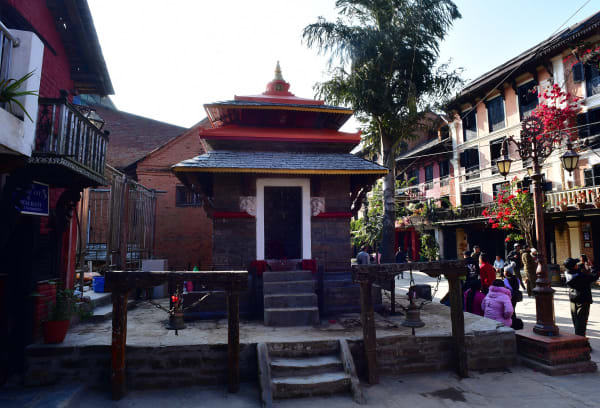
At the top a street of stalls selling offerings leads to a square with the two-tiered pagoda in the middle, rebuilt after the 2015 earthquake. Worshippers queue to pass the inner shrine; sacrifices are made behind the temple. On a clear day the Annapurna and Manaslu ranges line the northern horizon.

Manakamana During Dashain
Dashain is the temple's peak season. Families stop here on the way home to their villages, and Maha Ashtami draws the largest crowd of the year.
- Expect to queue twice: for the cable car at the bottom, and for the shrine at the top. On the eighth day each can take two hours or more.
- Go early or go on a quiet day. The first cars of the morning, or the days before Phulpati, are far easier.
- The cable car pauses for a lunch break in the middle of the day; check the hours when you buy the ticket.
- Non-Hindus may enter the square and watch, but not the inner shrine.
- Sacrifice is visible behind the temple, heavily so on the eighth and ninth days.
- Leave time for the highway. In the days before Phulpati the road below is as slow as the queue above.
Getting There
| From | To Manakamana (Kurintar) | To Gorkha Bazaar |
|---|---|---|
| Kathmandu | About 105 km; 3 hours | About 140 km; 5 hours |
| Pokhara | About 95 km; 2.5 hours | About 110 km; 3 hours |
| Between the two | — | About 45 km; 1.5 hours |
Both are easiest with a private vehicle, which can wait while you go up. Tourist buses between Kathmandu and Pokhara pass the cable car station but do not wait. Gorkha has simple hotels in the bazaar; staying a night lets you climb to the palace at dawn, when the mountains are clear and the steps are empty.
Fitting Them Into a Trip
- As a break on the Kathmandu–Pokhara drive. Manakamana adds three hours; Gorkha needs a night. Either can be built into our Kathmandu & Pokhara Tour or the Best of Nepal Tour.
- With a day on the river. The put-in for Trishuli rafting is a short drive from the cable car.
- With a village stay. Bandipur is an hour beyond the Gorkha turning, and Ghalegaun a few hours north — see the Himalayan Village Tour.
- Before a Manaslu trek. The Manaslu Circuit and the Lower Manaslu trek both lie in Gorkha district; a night in the town on the way in adds the palace without adding a day of driving.
- As part of a pilgrimage. Manakamana sits naturally with Pashupatinath and Muktinath on a Hindu Pilgrimage Tour — see the pilgrimage guide.