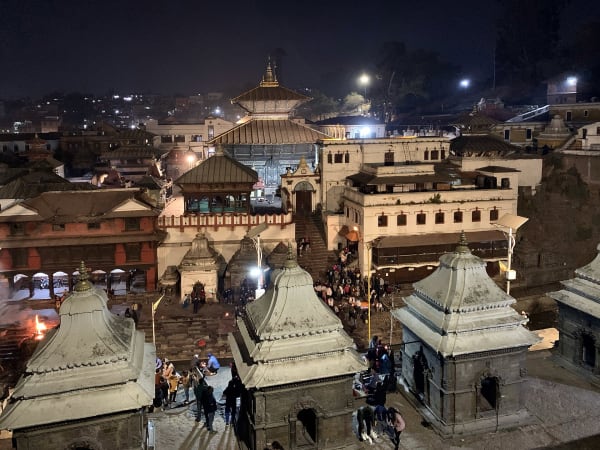
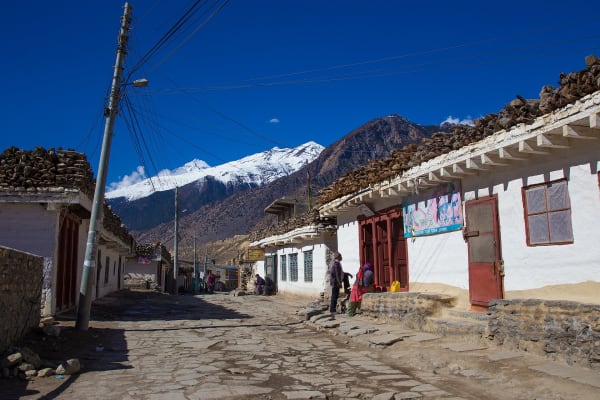
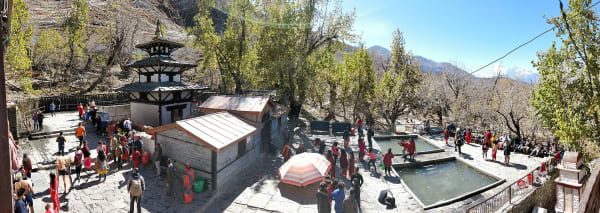
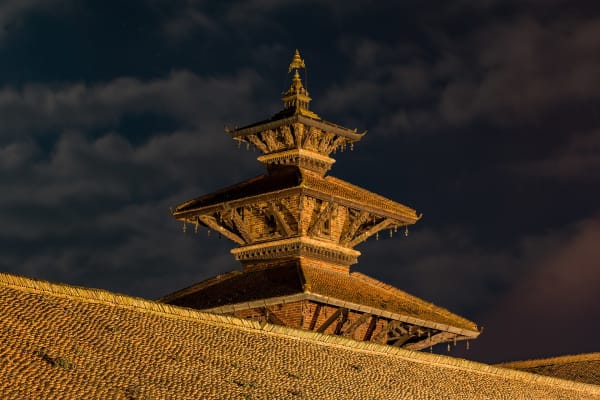
This route covers Nepal's principal Hindu shrines in a single journey: Pashupatinath, the Jyotirlinga of Shiva on the Bagmati and the holiest Hindu site in the country; Janakpur, birthplace of Sita and the setting of her marriage to Rama; Barahakshetra at the confluence of the Koshi; the ashrams of Devghat; and Muktinath at 3,760 m in Mustang, one of the eight self-manifested shrines of Vishnu.
It is built for pilgrims rather than sightseers. Time is allowed for darshan and puja at each site instead of a fixed sightseeing clock, meals are vegetarian, and the guide knows the practice at each shrine rather than only its history.
The itinerary runs from the Terai plains to the trans-Himalaya, and the Muktinath leg can be flown by helicopter for anyone who would rather not spend two days on the Kali Gandaki road.

The Tour at a Glance
| Duration | 10 days, 9 nights |
| Route | Kathmandu — Janakpur — Barahakshetra — Devghat — Pokhara — Muktinath |
| Highest point | Muktinath, 3,760 m |
| Difficulty | Easy — vehicle and flight based, with one altitude day |
| Best season | October to March |
| Meals | Vegetarian breakfast and dinner; satvik on request |
| Guide | English- and Hindi-speaking, familiar with pilgrimage practice |
| Price | From USD 1,150 per person |
We run it as a 10-day pilgrimage. For Muktinath alone, see the Muktinath pilgrimage tour or the helicopter option.
The Itinerary
Pashupatinath and the valley (days 1–2)
The evening aarati at Pashupatinath on arrival, which is the right way to begin, then darshan the following morning and the other valley shrines — Guhyeshwari, Budhanilkantha and Dakshinkali among them, depending on your practice.
Janakpur (days 3–4)
South-east to the Terai and Janakpur, birthplace of Sita, where the marble Janaki Mandir dominates a town of sacred ponds and Mithila painting. The Vivaha Panchami festival in November or December re-enacts the marriage of Rama and Sita and fills the town entirely.
Barahakshetra and Devghat (days 5–6)
East to the confluence of the Koshi and the temple at Barahakshetra, dedicated to Vishnu in his boar incarnation, then a long drive west to Devghat, where the Kali Gandaki and Trishuli meet — a quiet town of ashrams where many Nepali Hindus come to spend their last years.

Muktinath (days 7–9)
West to Pokhara, then a flight to Jomsom and a drive to Muktinath (3,760 m). The complex has 108 water spouts fed by the Gandaki, an eternal flame burning on natural gas beside a spring, and a constant flow of pilgrims from Nepal and India. It is sacred to Buddhists as well, which is unusual and visible in the site itself.
Reaching Muktinath: Three Options
| Option | What it involves |
|---|---|
| Flight to Jomsom and jeep | Included as standard. Quick, but morning-only and weather-dependent. |
| Road up the Kali Gandaki from Pokhara | Long and rough, most of two days each way. Reliable but hard going. |
| Helicopter direct from Pokhara | The option most older pilgrims choose. Can be substituted at additional cost. |
Muktinath is at 3,760 m, which is high enough to matter for older pilgrims arriving quickly from the plains. Take the day slowly, drink plenty, and tell your guide about any headache — our altitude guide covers the symptoms.
What It Costs
| Group size | Price per person |
|---|---|
| 1 traveller | USD 1,610 |
| 2 to 4 | USD 1,425 |
| 5 to 7 | USD 1,310 |
| 8 to 10 | USD 1,240 |
| 11 to 14 | USD 1,195 |
| 15 and over | USD 1,150 |
What Is Included
- Airport pickup and drop-off in Kathmandu.
- Pokhara–Jomsom return flights for the Muktinath leg, subject to weather.
- Private transportation throughout — a vehicle and driver reserved for your party alone across the full route.
- Nine nights in hotels and pilgrim guesthouses along the route, with breakfast.
- Vegetarian breakfast and dinner throughout; satvik meals on request.
- All temple entry and monument fees along the route.
- Annapurna Conservation Area Permit for the Muktinath sector.
- An English- and Hindi-speaking guide familiar with pilgrimage practice at each site.
- All government taxes and service charges.
What Is Not Included
- International flights and the Nepal entry visa fee.
- Travel insurance covering medical treatment and emergency evacuation.
- Meals not specified in the itinerary, and lunches on travelling days.
- Offerings, puja donations and priest fees, which are personal.
- The helicopter substitution for the Muktinath leg, quoted separately.
- Luxury vehicle upgrade — private transport is included as standard.
- Drinks, snacks, laundry, phone calls and souvenirs.
- Tips for the guide and driver.
- Any additional cost caused by flight delays, roadblocks, weather or other circumstances beyond our control.
Etiquette at the Shrines
- Non-Hindus cannot enter the main Pashupatinath temple. The complex and the cremation ghats are viewed from the terrace across the Bagmati, which is arguably the better vantage anyway.
- Dress modestly — shoulders and knees covered — and wear shoes that come off easily. Avoid leather belts and bags on temple days.
- Photography is generally permitted in courtyards, generally not in the inner sanctum, and never at the cremation ghats.
- Offerings — garlands, lamps, prasad — are bought at the sites. Your guide will advise what is customary for a puja.
- Festivals transform the sites: Maha Shivaratri at Pashupatinath, Vivaha Panchami at Janakpur, Janai Purnima in the hills.
The dates move with the lunar calendar, so tell us the festival rather than a date. See the festival calendar.