Ask what Dashain is and most Nepalis will describe the tenth day: the tika, the blessing, the family meal. But the festival begins nine days earlier, in a dark room with a handful of barley seeds, and it builds through a parade, a night of sacrifice and the one day a year a great temple opens its doors.
This guide goes through the fifteen days in order. For the dates in a given year see our Dashain calendar, and for the practical side of travelling through it, the complete Dashain travel guide.
The Story Behind the Festival
The demon Mahishasura, who could take the form of a buffalo, had won a boon that no man or god could kill him, and used it to drive the gods from heaven. The gods combined their powers into a goddess, Durga, gave her a weapon in each of her many hands, and sent her into battle on a lion. She fought for nine nights and killed him on the tenth day.
The nine nights are Navaratri; the tenth day is Vijaya Dashami, the tenth day of victory. A second story is told with it: that Ram prayed to Durga before defeating the demon king Ravan, and won on the same day. Both explain the festival's shape — nine days of worshipping the goddess in her fierce forms, then a day of blessing.

Day 1: Ghatasthapana
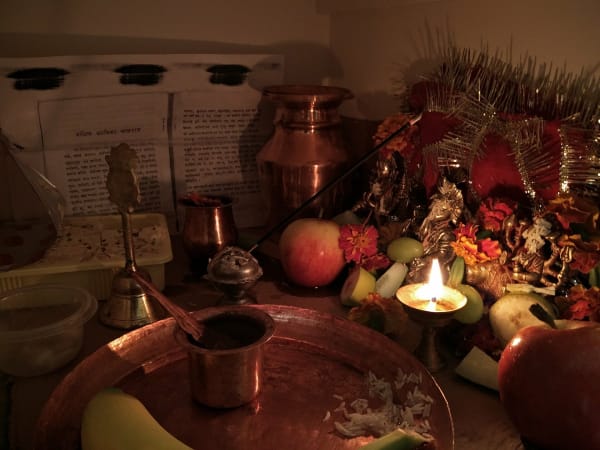
The festival opens at a moment fixed by astrologers. In each household a kalash, a vessel filled with water, is set up to represent the goddess, on a bed of sand in a room kept for the purpose — the Dashain ghar. Barley seeds, sometimes with maize and wheat, are sown in the sand around it.
The room is kept dark, the seeds are watered every day, and worship is offered morning and evening for nine days. Grown without sunlight, the shoots come up pale yellow rather than green and reach a hand's length by the tenth day. This is jamara, and it will be given with the tika.
For a visitor Ghatasthapana is nearly invisible — a public holiday on which the streets look ordinary. In a homestay you may be shown the room; do not go in unless invited.
Days 2 to 6: The Build-Up
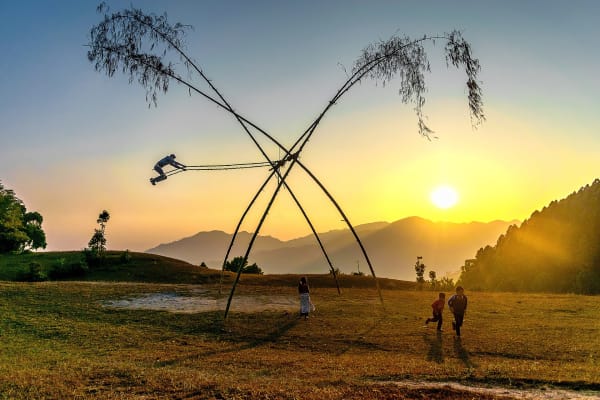
Nothing is prescribed for these days, and they are the busiest of the year. Houses are cleaned and repainted — in the hills, with fresh red and white clay carried up from the riverbank. New clothes are bought for every child. Kites go up from the rooftops, and in the villages the young men cut bamboo and lash together the tall swings that will stand until the festival season ends.
Above all, people travel. Anyone who works away from home is on a bus, and for a week the highways out of Kathmandu carry the whole city in one direction. If you are on the road in these days, read getting around Nepal during Dashain first.

Day 7: Phulpati
Phulpati means flowers and leaves: a bundle of sacred plants — banana stalks, sugar cane, jamara and others — that is carried into each home's Dashain room on the seventh day. The state has its own. For centuries the royal Phulpati has been brought on foot from the old palace at Gorkha, the ancestral seat of the kings who unified Nepal, to the Hanuman Dhoka palace in Kathmandu, a journey of about three days.
Its arrival is the festival's main public ceremony. The bundle is received in the city and carried in procession to Hanuman Dhoka, while at the Tundikhel parade ground the Nepal Army marks it with a parade, bands and ceremonial gunfire. Since the end of the monarchy the president attends in place of the king. See Gorkha and Manakamana during Dashain for the place it starts from, and Kathmandu during Dashain for where to stand.
Phulpati is also when the long public holiday begins and offices close.
Day 8: Maha Ashtami
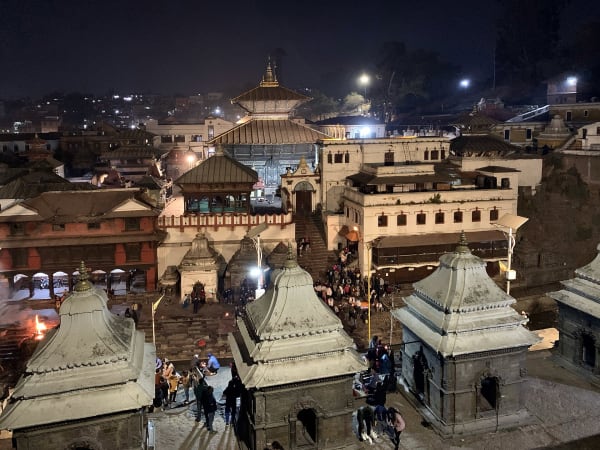
The eighth day belongs to the goddess in her most ferocious forms, Kali and Bhadrakali, and it is the main day of animal sacrifice. Goats, buffalo, ducks and chickens are offered at Durga and Kali temples across the country and in the yards of private houses, and the meat becomes the feast of the following days. The night is Kal Ratri, the black night, when sacrifices are made at the Dashain house of the old palace in Kathmandu.
Newar families sit down on this day to Kuchhi Bhoye, a feast of beaten rice and many side dishes eaten off banana leaves in order of age. It is a confronting day for some visitors and an easy one to plan around — see animal sacrifice at Dashain.
Day 9: Maha Navami
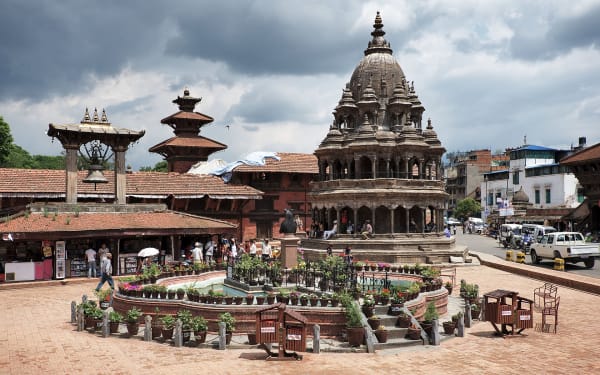
The last of the nine nights. Two things mark it. The Taleju temple in Kathmandu Durbar Square, closed all year, opens to worshippers for this one day, and the queue winds through the square from before dawn. And it is the day of Vishwakarma, the god of craft: tools, machines and vehicles are worshipped so that they will not fail in the year ahead.
You will see it everywhere. Buses, taxis and motorbikes carry garlands and a smear of red on the bonnet; workshop tools are laid out and blessed; even aircraft are given an offering at the airport. Fewer vehicles run than on any day except the next.
Day 10: Vijaya Dashami
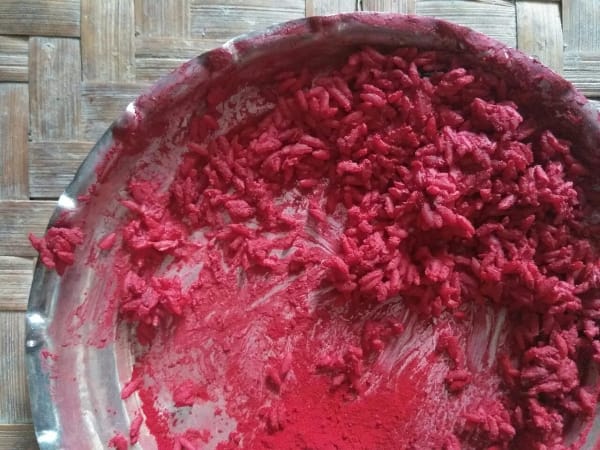
The day of victory. At the auspicious moment the head of the household mixes rice, yoghurt and red vermilion into a paste, the tika, and presses it onto the forehead of each younger member of the family in turn, with a blessing recited in Sanskrit, a few shoots of jamara, and a gift of money. Then everyone eats.
It is a day of bowed heads and full houses: grandparents holding court, children collecting banknotes, cousins who have not met for a year. Outside, the streets are as quiet as they will be until next Dashain. If you are invited in — and visitors often are — our guide to receiving Dashain tika explains what to do.

Days 11 to 15: Visiting, and Kojagrat Purnima
One day is not enough to reach every elder in a large family, so the tika continues for four more days as people travel between the houses of uncles, in-laws and grandparents. These are the days of card games, long lunches and, for anyone on the road, the first wave of return traffic.
The festival ends on the full moon, Kojagrat Purnima. The name asks a question — who is awake? — and the goddess of wealth, Lakshmi, is said to visit the houses of those who are. Many stay up through the night. The jamara and the vessel from the first day are taken to a river, and Dashain is over.
What a Visitor Can See, Day by Day
| Day | Best place to be | What you will see |
|---|---|---|
| Days 2–6 | Ason and Indra Chowk in old Kathmandu; any hill village | Festival shopping, kites, swings being built — the food tour through Ason is at its liveliest |
| Phulpati | Tundikhel and Hanuman Dhoka, Kathmandu | The army parade and the Phulpati procession |
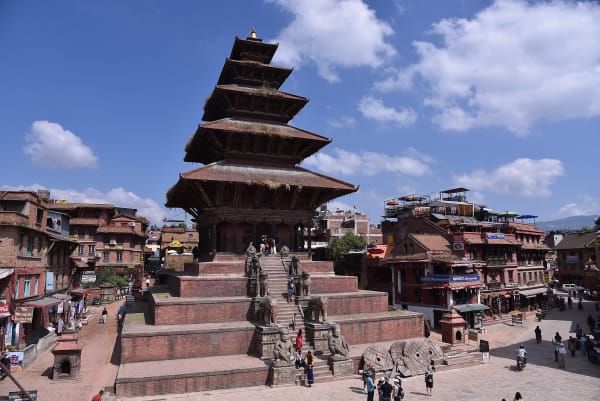
| Maha Ashtami | Bhaktapur | Mohani, the Newar Dashain — see Bhaktapur during Dashain |
| Maha Navami | Kathmandu Durbar Square | The queue at the Taleju temple; garlanded vehicles everywhere — Kathmandu day tour |
| Vijaya Dashami | With a family — a homestay or a guide's home | The tika. Village homestays at Sirubari and Ghalegaun make this possible |
| Days 11–15 | The hills above Pokhara or the valley rim | Swings in full use, families on the move, clear mountain mornings |
The Kathmandu valley's Newar community keeps the same days under different names and with its own rituals, including sword processions on the tenth day and the masked Navadurga dancers of Bhaktapur. A Kathmandu Valley Tour timed for the week takes in both traditions.