Most people plan a Nepal trek around three things: fitness, kit and permits. Almost nobody plans for the mind, and yet the mind is what decides whether day nine at 4,400 m feels like the best day of your year or the longest. A trek strips away your normal distractions — no commute, little signal, the same simple task every morning — and whatever you carried up in your head is still there when the noise stops.
Meditation before and after a trek is not a spiritual add-on. Before, it is preparation: a calmer nervous system, steadier breathing, and a way to handle the hard hours without spiralling. After, it is recovery: a deliberate landing instead of going straight from a mountain to an airport queue.
This guide covers the whole arc — the two weeks before you fly, the days in Kathmandu or Pokhara, the small practices that fit a trekking day, and the first days back down. You do not need any experience, and you do not need to be religious. You need ten minutes and somewhere to sit.
Why Meditation and Trekking Belong Together
Nepal's trails were pilgrimage routes long before they were trekking routes. The paths to Muktinath, Gosaikunda and Tengboche were walked by people who treated the journey itself as the practice — slow, repetitive, attentive. You still pass the evidence every day: mani walls carved with mantras, prayer wheels turned by water, chortens at the entrance to every village in the Buddhist valleys.
Trekking also does half the work of meditation for you. Walking for six hours at a steady pace regulates breathing. The scenery holds attention without demanding anything. Evenings are early and quiet. People who have never managed five minutes on a cushion at home often find they can sit for twenty in a lodge dining room at dusk, simply because there is nothing pulling them away.
- The pace is already meditative. Above 3,000 m you walk slowly whether you like it or not, and slow, rhythmic walking is one of the oldest forms of practice there is.
- The setting does the reminding. Prayer flags, monasteries and morning puja are part of the route on Everest Base Camp, Langtang, Tsum Valley and Upper Mustang.
- You are offline. Patchy signal and paid Wi-Fi remove the single biggest obstacle to attention.
- The difficulty is useful. Cold mornings, steep climbs and poor sleep are exactly the conditions in which a calm mind is worth having — and in which you can practise having one.
What Meditation Can and Cannot Do for a Trek
It is worth being precise, because a lot of wellness writing about the Himalaya is not. Meditation is useful on a trek. It is not medicine and it does not change how your body handles altitude.
| Claim | The honest answer |
|---|---|
| Meditation prevents altitude sickness | No. Acclimatisation depends on ascent rate, sleeping altitude and time. Nothing you do with your attention replaces a rest day. See our altitude guide. |
| Breathing exercises raise your oxygen level | Briefly, while you are doing them. Slow deep breathing can lift a pulse-oximeter reading for a few minutes; it does not speed long-term adaptation. |
| Meditation reduces pre-trek anxiety | Yes, reliably. This is the best-evidenced benefit — regular practice lowers baseline stress and makes worry easier to notice and put down. |
| It helps you sleep at altitude | Somewhat. It will not stop the periodic breathing that wakes you at 4,000 m, but it helps you fall back asleep instead of lying awake counting the hours. |
| It makes hard days easier | Yes. A trained ability to keep attention on the next ten steps, rather than the next four hours, is the most practical skill a trekker can have. |
| It helps recovery afterwards | Yes. Body-scan practice and guided relaxation shift the nervous system out of the constant low-level effort of trekking, and help with the flat mood many people feel when a trek ends. |
One rule follows from this: never use calm to override a symptom. A headache that will not go, unsteadiness, or breathlessness at rest are reasons to tell your guide, not sensations to breathe through.
Before the Trek: A Two-Week Lead-In
The mistake is to wait until Kathmandu. A single session the night before departure is pleasant, but the benefit of meditation comes from repetition, and two weeks of ten minutes a day does far more than one ninety-minute class.
| When | Practice | Time |
|---|---|---|
| 14 to 8 days before | Breath counting: sit, count each out-breath from one to ten, start again when you lose count | 10 minutes daily |
| 7 to 4 days before | Add a body scan in bed: move attention slowly from feet to head | 10 + 10 minutes |
| 3 days before to the flight | Mental rehearsal of the trek — the early start, the climb, the cold — while keeping the breath slow | 15 minutes daily |
| Arrival day in Kathmandu | No formal practice. Walk, eat, sleep. A dusk circuit of Boudhanath if you have the energy | As it comes |
| Day before departure | One longer guided session: breathing, body scan, and a clear intention for the trek | 60 to 90 minutes |
| Morning you start walking | Three minutes of slow breathing at the trailhead before the first step | 3 minutes |
The full routine, with each technique explained step by step, is in our guide to pre-trek meditation. If you are flying into Kathmandu a day or two early, our guide to where to meditate in Kathmandu covers Boudhanath, Kopan, Pharping and the quieter options on the valley rim.
During the Trek: Practices That Fit the Day
A trekking day has natural gaps, and none of these practices needs more than a few minutes or any equipment.
- First ten minutes of walking in silence. Before the conversation starts, walk without talking and let attention rest on your steps. Details in our guide to walking meditation.
- Breath and step together on climbs. Inhale for two steps, exhale for two; shorten the pattern as the air thins. It sets a pace you can hold. See breathing exercises for high altitude.
- One deliberate stop a day. At a viewpoint, put the camera away for five minutes and simply look.
- Arrival routine. Boots off, warm layer on, five minutes of slow breathing before you reach for your phone.
- Ten minutes of stretching before dinner. A short sequence for calves, hips and lower back — see yoga for trekkers.
- Body scan in the sleeping bag. The single most useful practice for the broken sleep of high altitude.
- Sit in on a puja. Where the route passes a working monastery, the afternoon or morning prayers are open to respectful visitors — see monasteries where you can meditate on a trek.

After the Trek: The First Three Days
The end of a trek is abrupt. One morning you are walking down through rhododendron forest; by evening you are in traffic with 200 unread messages. Many trekkers feel flat, restless or oddly sad for several days afterwards, and almost nobody warns them about it.
- Day one: do nothing structured. Shower, eat, sleep. A long body scan lying down is the only practice worth attempting.
- Day two: restorative movement and a guided session. Gentle yoga for the legs and back, followed by guided relaxation or a singing bowl session — see sound healing after a trek.
- Day three: integration. Sit for twenty minutes, then write down what you want to keep from the trek — the early mornings, the walking, the lack of screens — before normal life overwrites it.
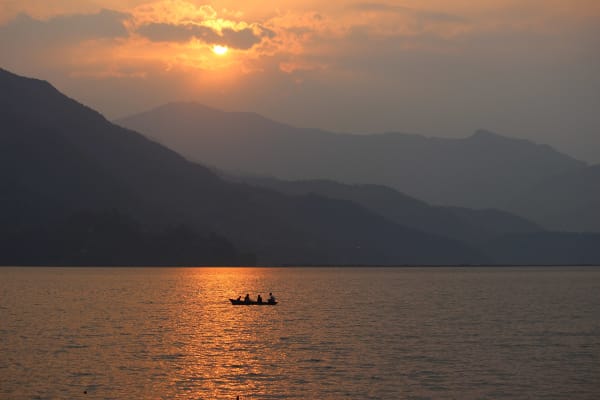
Pokhara is the natural place for this if your trek ends in the Annapurna region: warm, low, quiet, with the lake and the World Peace Pagoda on the ridge above it. Our guide to meditation and yoga in Pokhara sets out a two-day programme, and post-trek meditation and recovery covers the practices themselves. If you have a week or more, a proper retreat after the trek is the strongest option of all.
Which Style of Meditation Suits Which Trekker
| Style | What you do | Best for | When on a trek |
|---|---|---|---|
| Breath awareness | Rest attention on the breath; return when it wanders | Complete beginners; pre-trek nerves | Mornings, arrival at the lodge |
| Body scan | Move attention slowly through the body | Poor sleepers; sore legs | In the sleeping bag |
| Walking meditation | Attention on each step and the breath | People who cannot sit still | First stretch of each day |
| Loving-kindness (metta) | Silently wish well to yourself and others | Group friction; homesickness | Evenings |
| Mantra | Repeat a phrase in time with breath or steps | Long, monotonous climbs | Uphill sections |
| Yoga nidra | Guided relaxation lying down | Exhaustion; post-trek recovery | After the trek |
| Silent retreat | Many hours of sitting a day, in silence | Those wanting a serious practice | A separate week after the trek |
If you have never meditated, start with breath awareness and the body scan and ignore the rest. Those two cover almost everything a trekker needs.
We Provide This Service: Pre- and Post-Trek Meditation
Green Compass Treks arranges meditation before and after any trek in our catalogue. It is not a separate retreat package you have to fit your holiday around — it is added to the itinerary you are already booking, on the days that would otherwise be spent waiting for a flight or a permit.
- Before the trek: a guided session in Kathmandu or Pokhara with an experienced local teacher — breathing, body scan and intention-setting — plus, if you want it, a dawn visit to Boudhanath, Kopan or Pharping.
- On the trail: a guide who knows you want quiet time, a short morning breathing routine, a silent first stretch each day, and monastery visits timed for prayers rather than for photographs.
- After the trek: restorative yoga, guided meditation and a singing bowl session in Pokhara or Kathmandu, with extra days added if you want them.
- Longer stays: help planning a monastery stay or a multi-day retreat once the walking is done.
It works on a short route such as Mardi Himal or Poon Hill just as well as on a three-week circuit. Tell us when you enquire that you would like pre- and post-trek meditation, say how much experience you have, and we will build it into your dates and quote for it alongside the trek. Contact us and we reply within 24 hours.