Ask trekkers what worried them before their first Himalayan trek and the answers are rarely about legs. Will I cope with the altitude? What if I am the slowest? What about the flight to Lukla? What if I get ill four days from a road? These are not fitness problems, and no amount of stair climbing solves them.
Pre-trek meditation is mental training in the same way that hill walking is physical training. It will not make the trek easier in any objective sense — the pass is still at 5,416 m — but it changes how you meet the hard parts. This is a practical plan, not a philosophy: four techniques, fourteen days, ten to fifteen minutes a day.
What Actually Worries People Before a Trek
Naming the worry is the first step, because vague dread is much harder to work with than a specific fear. These are the ones we hear most often, with what is actually true about each.
| The worry | What is true | What helps |
|---|---|---|
| Altitude sickness | Common and usually mild; serious cases are rare on a well-paced itinerary | Knowing the symptoms and the plan. Read our altitude guide |
| Not being fit enough | Most routes are walked at a slow pace with long breaks; steadiness beats speed | Training, and rehearsing the hard days in your mind |
| Being the slowest in the group | Someone is always slowest, and above 3,500 m slow is correct | Practising walking at your own pace without comparison |
| The mountain flight | Short, weather-dependent, flown only in good visibility | Slow breathing techniques; knowing the alternatives |
| Getting ill far from help | Guides carry a medical kit; helicopter evacuation covers the main routes | Insurance, and trust in a clear plan |
| Cold, basic lodges, shared toilets | True, and less of a problem than people expect after day two | Accepting discomfort in small doses beforehand |
| Being out of contact | Wi-Fi is available on most main routes, at a price | Deciding in advance how connected you want to be |
Notice that half of the right-hand column is information and half is mental practice. Do both. Reading our guide to first-time trekking in Nepal removes a surprising amount of anxiety on its own.
The 14-Day Pre-Trek Plan
The plan builds one technique on another. Do it at the same time each day — first thing in the morning works for most people, before the day supplies reasons not to.
| Days before departure | Morning | Evening | Total |
|---|---|---|---|
| 14 to 11 | Breath counting, 10 minutes | — | 10 min |
| 10 to 8 | Breath counting, 10 minutes | Body scan in bed, 10 minutes | 20 min |
| 7 to 5 | Breath counting, then 5 minutes of mental rehearsal | Body scan, 10 minutes | 25 min |
| 4 to 2 | Mental rehearsal of one hard day, 10 minutes | Body scan, 10 minutes | 20 min |
| Day before flying | Intention setting, 10 minutes | Slow breathing only — pack calmly | 10 min |
| Travel days | Slow breathing on the plane, whenever you remember | Body scan to fall asleep in a new time zone | As needed |
If you miss a day, do not double up the next day. Just carry on. The plan fits neatly alongside the last two weeks of a physical training programme, when the hard sessions are tapering anyway.
Four Techniques, Step by Step
1. Breath counting
- Sit upright on a chair or cushion, hands resting, eyes closed or lowered.
- Breathe normally through the nose. Do not try to breathe deeply.
- Count each out-breath silently: one, two, three, up to ten. Then start again at one.
- When you notice you have drifted — you will, within seconds — return to one without comment.
- Continue for ten minutes. Use a timer so you are not checking the clock.
Losing count is not failure. Noticing that you lost count, and coming back, is the exercise. It is the same movement of mind you will use at 4,500 m when your thoughts run to how far there is still to go.
2. Body scan
- Lie on your back, arms by your sides.
- Bring attention to your toes. Notice any sensation — warmth, pressure, nothing at all.
- Move slowly upward: feet, ankles, calves, knees, thighs, hips, belly, chest, hands, arms, shoulders, neck, face.
- Where you find tension, breathe out and let it soften. Do not force it.
- If you fall asleep, good. That is the point of doing it at night.
3. Mental rehearsal
Athletes use this before competition, and it works for trekking for the same reason: the mind copes better with something it has already walked through. Sit as for breath counting, settle for two minutes, then run through one specific day of your itinerary in detail.
- The alarm at 4:30 am. The cold of the room. Putting on a headtorch.
- The first steep hour, breathing hard, feeling slow.
- A moment of doubt — and yourself slowing the pace, breathing out, and carrying on.
- Reaching the top. Then the long descent, and tea at the lodge.
The key is to rehearse the difficulty and your calm response to it, not just the summit photograph. Use the real profile of your route — the pass day on the Annapurna Circuit, the climb to High Camp on Mardi Himal, the walk to Gorak Shep on the Everest Base Camp trek.
4. Intention setting
The day before you fly, sit for ten minutes and decide what the trek is for. Not the goal — reaching base camp is a destination, not an intention — but how you want to walk it. Patiently. Without comparing. Looking up more than at the phone. One sentence is enough. Write it somewhere you will see it on the trail. On a bad day it is more useful than any motivational slogan, because you chose it when you were calm.
Arrival Day in Kathmandu
You will arrive tired, dehydrated and in the wrong time zone, into a city that is loud and dusty by any standard. This is not the day for a long sit. It is the day to let the nervous system catch up with the body.
- Walk rather than nap. Daylight and gentle movement reset the body clock faster than sleep at the wrong hour.
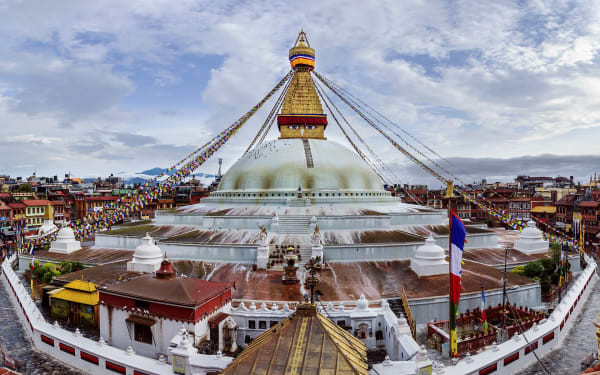
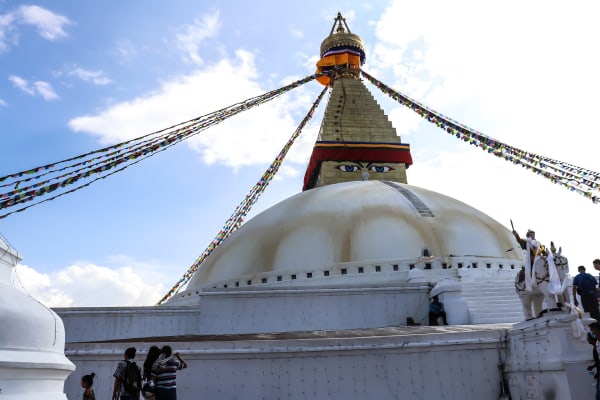
- Go to Boudhanath at dusk. The great stupa is circled clockwise by hundreds of people every evening, many of them elderly Tibetans with prayer beads. Join the flow for three or four circuits. It is walking meditation with no instruction needed.
- Eat early, drink water, skip the beer.
- Body scan in bed. It works on jet lag as well as anything does.
If your itinerary has a full free day before the trek, that is the day for a proper guided session, and for the practical errands covered in our guide to your first 48 hours in Kathmandu. The quieter places to sit — Kopan monastery, the caves at Pharping, the hilltop at Swayambhunath before the crowds — are described in where to meditate in Kathmandu.

The Morning You Start Walking
Trailheads are chaotic: porters dividing loads, permits being checked, jeeps unloading. Step to one side for five minutes.
- Stand with your pack on and feet hip-width apart. Feel the weight settle.
- Take ten slow breaths, each out-breath slightly longer than the in-breath.
- Recall the intention you set before you flew.
- Look at the trail ahead — only as far as the first bend.
- Start walking, and stay silent for the first ten minutes.
That is the whole routine. Repeat the first ten silent minutes every morning of the trek and it becomes the part of the day you look forward to.
Common Mistakes
- Starting in Kathmandu. One session the night before is better than nothing, but two weeks of short daily practice is what changes how you feel on day nine.
- Sitting for too long. Ten minutes done daily beats forty minutes done twice.
- Expecting a blank mind. Thoughts do not stop. The skill is returning, not emptying.
- Using it to suppress fear. If you are worried about altitude, the answer is also a sound itinerary, proper insurance and an honest conversation with your guide — not just more breathing.
- Rehearsing only the summit. Rehearse the cold, the slow hours and the bad night's sleep. Those are what you need to be ready for.
- Learning forceful breathing techniques from a video the week before. Keep it gentle. Anything that leaves you dizzy at sea level is a bad idea at 4,000 m.
We Provide This Service: Guided Pre-Trek Meditation
Green Compass Treks arranges a guided pre-trek meditation session for guests who want one, in Kathmandu or in Pokhara, on the preparation day before the trek begins. It is led by an experienced local teacher and built for trekkers rather than for long-term practitioners: slow breathing you can use on a climb, a body scan for the nights at altitude, and time to set an intention for the days ahead.
- Fits your existing itinerary. The session takes place on the day already set aside for briefing, kit check and permits — no extra night needed.
- Private or shared. For solo trekkers, couples, families and groups.
- Optional dawn visit. Boudhanath, Kopan or Pharping before the city wakes, with a guide who can explain what you are seeing.
- Carried onto the trail. Your trekking guide is told what you practised, so the silent first stretch and the evening routine continue for the whole trek.
We can also send you the 14-day plan above when you book, so the session in Kathmandu builds on something you have already started. Ask for pre-trek meditation when you get in touch, and we will add it to your dates.