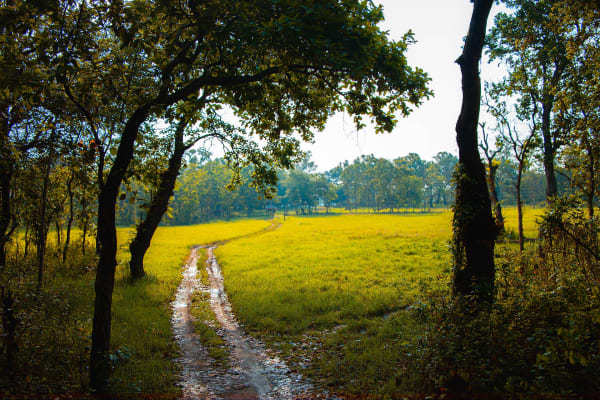
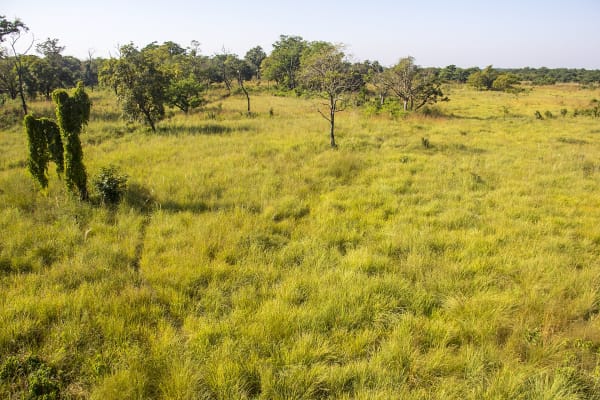
Chitwan lies in the Terai lowlands at around 150 m, four to five hours by road from Kathmandu, and it protects 952 km² of sal forest, riverine grassland and oxbow lakes. It became Nepal's first national park in 1973 and a UNESCO World Heritage site in 1984, and it holds one of the great conservation success stories in Asia: the greater one-horned rhinoceros, down to around 100 animals in the 1960s, now numbering over 600 in the park.
It is also the easiest wildlife experience in Nepal to add to a trip — a three-day stop between Kathmandu and Pokhara that genuinely delivers.
What You Will See
| Species | Likelihood | Where |
|---|---|---|
| Greater one-horned rhino | Very likely — often several in a visit | Grassland and riverbanks, especially early morning |
| Spotted deer (chital), sambar, barking deer | Certain | Throughout the forest and grassland |
| Wild boar, langur and rhesus macaque | Very likely | Forest edges |
| Gharial and marsh mugger crocodile | Likely | Rapti and Narayani rivers, and the breeding centre |
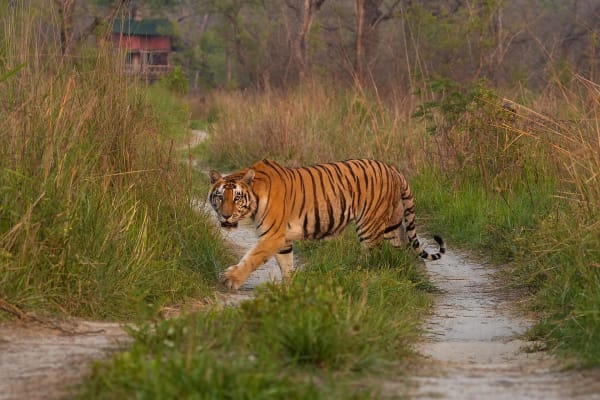
| Bengal tiger | Unlikely — perhaps 1 in 15 visits | Tracks and calls are common; sightings are not |
| Sloth bear, leopard, wild dog | Uncommon | Deeper forest |
| Gaur (Indian bison) | Occasional | Grassland, mainly in the west |
| Birds — over 500 species | Certain | Everywhere; the grasslands and oxbow lakes are outstanding |
Set expectations properly: rhino sightings are close to routine, and tigers are not. Chitwan has around 125 tigers across a large area of dense habitat, and a sighting is a genuine piece of luck rather than an itinerary item. For better tiger odds, go to Bardia — see our Bardia guide.
How You See It
- Jeep safari. The main activity — a four-wheel drive into the park on forest tracks, with a naturalist. Half or full day. Full-day safaris reach the interior and quieter grasslands and are considerably better.
- Canoe trip. A dugout canoe down the Rapti or Budhi Rapti at dawn — silent, excellent for crocodiles, waterbirds and often rhino on the bank. The best single activity in Chitwan.
- Guided jungle walk. On foot with two armed naturalists, which is how you learn to read the forest. Genuinely exciting, and the only way to understand the scale of a rhino when it is not behind a vehicle.
- Birdwatching walk. Early morning in the grasslands and around the oxbow lakes. See our dedicated Chitwan birding trip.
- Elephant breeding centre. The government facility at Khorsor, where working elephants are bred and calves raised.
- Tharu village and cultural programme. The Tharu are the indigenous people of the Terai, with a distinct language, architecture and a stick dance performed in the evening.
- Watchtower night. Some lodges offer a night in a park watchtower, which is the best chance of a tiger and a memorable experience regardless.
The Elephant Question
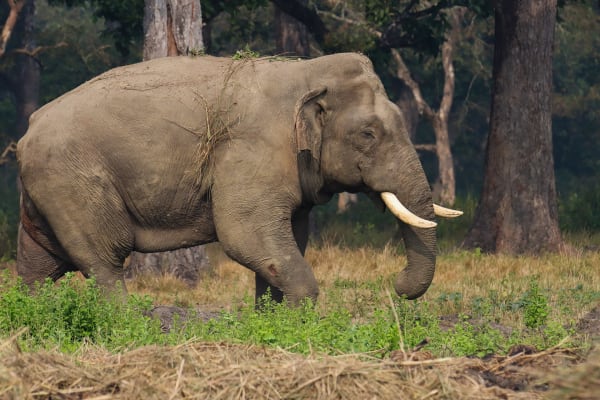
Chitwan was for decades synonymous with elephant-back safaris, and this has changed. The practice involves captive elephants, and the training and handling methods used to make an elephant rideable are widely regarded as cruel. A growing number of operators, lodges and national authorities have moved away from it.
- We do not offer elephant riding on any itinerary, and we will not arrange it on request.
- Jeep safaris and canoe trips see as much or more wildlife, and from a vehicle a rhino is less disturbed than by an approaching elephant.
- The breeding centre is a different matter — it is a working government facility and visiting it is observation rather than participation, though the chaining of elephants there is itself a subject of legitimate criticism.
- Elephant bathing experiences marketed as ethical alternatives generally still involve captive, trained elephants. We do not include them.
- If you want to see elephants, wild ones do move through Chitwan and Bardia, particularly in Bardia, and a sighting of a wild herd is a genuinely different experience.
This is a case where the responsible option is also the better one — a dawn canoe on the Rapti is a more remarkable hour than an elephant ride, and it leaves nothing behind. Our responsible travel guide covers the wider principles.
When to Go
| Season | Conditions | Wildlife viewing |
|---|---|---|
| October – December | Warm days, cool nights, grass still tall early on | Very good, improving as the grass is cut |
| January – March | Cool and dry, grass burnt and cut short | The best of the year — excellent visibility |
| April – June | Very hot, often above 40 °C | Good at waterholes; uncomfortable for visitors |
| July – September | Monsoon, high water, tall grass | Poor visibility; some activities suspended |
January to March is the clear best window. The grasslands are cut and burnt in the dry season as part of park management, which drops visibility from three metres to three hundred, and the weather is comfortable. The monsoon is the one period we would not recommend.
Practicalities
- Getting there: four to five hours by road from Kathmandu, five from Pokhara, or a 25-minute flight to Bharatpur. Sauraha is the main visitor village on the park's northern edge.
- Itineraries: three days or four days with us, or a two-day trip if you are very short of time. Three days is the minimum that allows a full-day jeep safari plus a canoe and a walk.
- Park fees are charged per entry day and included in our packages.
- Accommodation ranges from simple lodges in Sauraha to comfortable riverside resorts. Inside-park lodges were closed some years ago, so all accommodation is on the park boundary.
- What to bring: neutral-coloured clothing, long sleeves and trousers for mosquitoes, insect repellent, binoculars, a sun hat, and a zoom lens if you have one.
- Malaria: risk is low but present in the Terai. Take current medical advice.
- Safety: rhino are responsible for more injuries in Chitwan than tigers. On a walk, follow your naturalist's instructions exactly — they will tell you to climb a tree, and they will mean it.
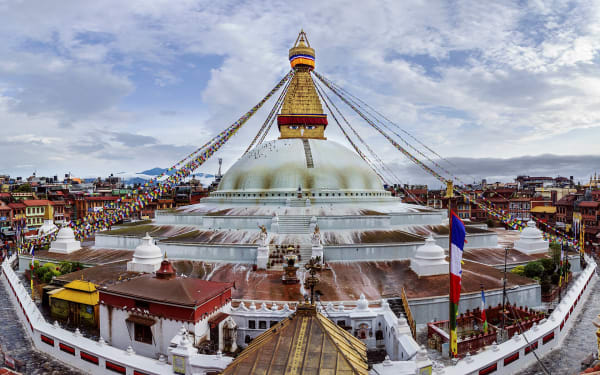
Chitwan combines naturally into a circuit with Kathmandu and Pokhara — see our cultural itineraries guide — and it is on the same highway as Lumbini.