Lumbini, in the Rupandehi district of Nepal's southern plains, is where Siddhartha Gautama — the historical Buddha — was born, traditionally in 623 BCE. It is one of the four principal Buddhist pilgrimage sites, alongside Bodh Gaya, Sarnath and Kushinagar in India, and it was inscribed as a UNESCO World Heritage site in 1997.
It is also, unlike the Kathmandu Valley sites, a quiet place. The sacred garden is a large landscaped park, the monastic zone is spread over several square kilometres, and the Terai heat means most visitors move slowly. Two days is about right.
The Sacred Garden
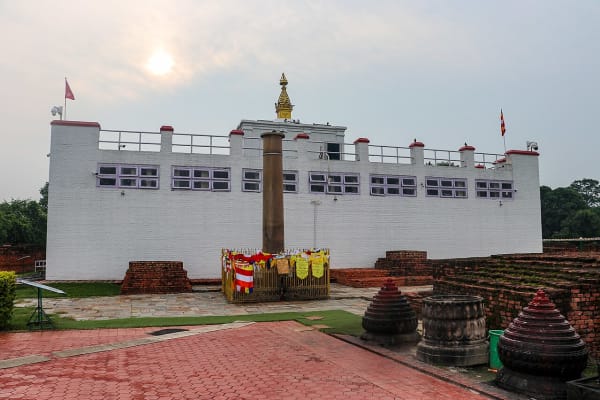
- Maya Devi Temple — built over the excavated remains of earlier shrines, and housing the marker stone identified as indicating the exact birthplace, along with a sandstone relief of the nativity. The archaeology beneath is visible on a walkway.
- The Ashoka Pillar — erected by the emperor Ashoka in 249 BCE during his pilgrimage, with an inscription recording that he came in person and exempted the village from tax because the Buddha was born there. It is the single most important piece of evidence identifying the site, and it is still standing.
- The Puskarini pool — the sacred pond beside the temple, in which Maya Devi is said to have bathed before the birth, and where the infant Buddha was bathed.
- The Bodhi tree and prayer flags beside the pool, where monks and pilgrims sit and chant. The atmosphere here in the early morning is the best thing at Lumbini.
- The ruins — brick stupas and monastery foundations from the 3rd century BCE to the 5th century CE spread across the garden.
Shoes come off at the entrance to the Maya Devi Temple area and photography inside is prohibited. The garden itself is open and peaceful, and early morning before the heat is by far the best time.
The Monastic Zone
Around the sacred garden, a master plan drawn up by the Japanese architect Kenzo Tange in the 1970s allocated land to Buddhist nations to build monasteries. The result is a sprawling park containing several dozen temples in wildly different national styles, which is either fascinating or kitsch depending on your temperament — most people find it fascinating.
- The Myanmar Golden Temple, one of the earliest and most striking.
- The Thai Monastery, a gleaming white and blue complex.
- The German Great Lotus Stupa, with remarkable interior murals.
- The Chinese, Korean, Vietnamese, Sri Lankan, Cambodian and Nepali monasteries, among many others.
- The World Peace Pagoda, built by Japanese Buddhists at the northern end.
- The eternal flame, lit in 1986 to mark the International Year of Peace.
- The Lumbini Museum and research institute, for the archaeology and the textual history.
The zone is large — several square kilometres — and best covered by bicycle, rickshaw or e-rickshaw rather than on foot in the heat. Most are open to visitors and several offer meditation sessions.
Tilaurakot and the Wider Sites
Lumbini is the birthplace; the Buddha grew up somewhere else, and that somewhere is 27 km west.
- Tilaurakot — widely identified as Kapilvastu, the capital of the Shakya kingdom where Siddhartha spent his first 29 years as a prince before renouncing it. The site holds the excavated remains of a fortified city — gateways, walls, streets, a palace complex — in open farmland with almost no visitors. For anyone interested in the historical rather than devotional Buddha, this is the more affecting place.
- Kudan — where the Buddha is said to have met his father after his enlightenment.
- Gotihawa and Niglihawa — associated with earlier Buddhas, each with an Ashokan pillar fragment.
- Ramagrama — the only undisturbed original stupa holding relics of the Buddha, to the east.
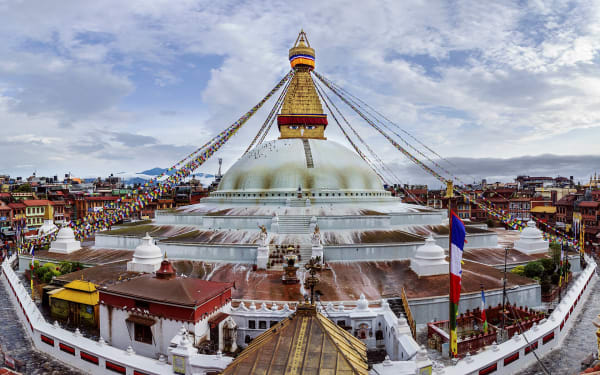
Our 3-day Lumbini tour covers the sacred garden, the monastic zone and Tilaurakot. The Buddhist pilgrimage tour links Lumbini with Boudhanath, Swayambhunath and the valley's Buddhist sites.
Practicalities
- Getting there: fly to Bhairahawa (Gautam Buddha International Airport) from Kathmandu, 35 minutes, then 30 minutes by road. Or drive from Kathmandu in eight to nine hours, or from Pokhara in six to seven.
- Climate: Terai lowland at 150 m. October to March is comfortable; April to June is very hot, often above 40 °C; the monsoon is humid and wet.
- Time needed: one full day for the sacred garden and part of the monastic zone, two days to include Tilaurakot.
- Getting around: bicycle or e-rickshaw inside the monastic zone. Do not plan to walk it in April.
- Accommodation: a range from pilgrim guesthouses to comfortable hotels near the site, plus monastery guesthouses for those on retreat.
- Buddha Jayanti in May — the Buddha's birth, enlightenment and death, and the major festival at Lumbini. Busy and worth it.
- Meditation: several monasteries run sessions and short retreats, and the Vipassana centre nearby runs longer courses.
Lumbini pairs well with Chitwan, which is on the same highway, and with the Kathmandu Valley sites. For a broader cultural circuit, see our cultural tour guide.