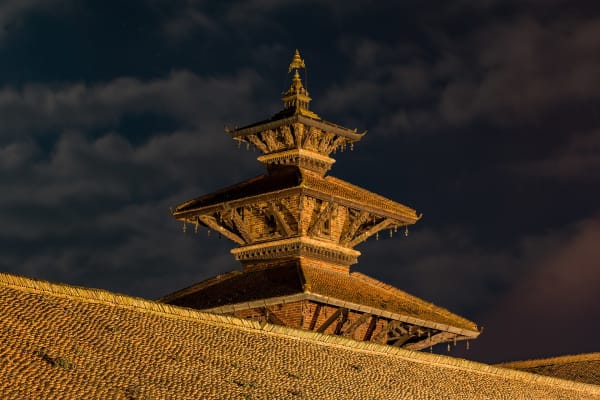
The Kathmandu Valley is one of the densest concentrations of built heritage anywhere in Asia. UNESCO inscribed it in 1979 as a single World Heritage property made up of seven monument zones: the royal squares of Kathmandu, Patan and Bhaktapur; the Buddhist stupas of Swayambhunath and Boudhanath; the Hindu temple complex of Pashupatinath; and the hilltop shrine of Changu Narayan.
All seven are within an hour of central Kathmandu, and all seven were damaged to varying degrees in the 2015 earthquake, with restoration now largely complete. Trying to see them all in one day is possible and not advisable; here is what each one actually offers.
The Seven at a Glance
| Site | What it is | Time needed | Entry |
|---|---|---|---|
| Kathmandu Durbar Square | The old royal palace complex at Basantapur, with the Kumari house | 1.5–2 hours | Ticketed |
| Patan Durbar Square | The finest Newar architecture in the valley, plus the Patan Museum | 2–3 hours | Ticketed |
| Bhaktapur Durbar Square | A whole medieval city, not just a square | Half to full day | Ticketed |
| Swayambhunath | A hilltop stupa above the city, the valley's oldest Buddhist site | 1–1.5 hours | Ticketed |
| Boudhanath | The largest stupa in Nepal, centre of Tibetan Buddhist life | 1–2 hours | Ticketed |
| Pashupatinath | Nepal's holiest Hindu temple, with riverside cremation ghats | 1.5–2 hours | Ticketed |
| Changu Narayan | The oldest temple in Nepal, with 5th-century stone inscriptions | 1 hour | Ticketed |
We cover them across several itineraries: all seven in one long day, a shorter Kathmandu day tour, and dedicated half days to Patan and Bhaktapur. Longer options include a 5-day valley tour and a 9-day cultural tour.
The Three Durbar Squares
Each was the royal court of a separate Newar kingdom until the Gorkha conquest of 1769, and they are best understood as rivals rather than variations.
Kathmandu Durbar Square
The largest and most chaotic, at Basantapur in the old city, with the Hanuman Dhoka palace, the Taleju temple, the nine-storey Basantapur tower, and the Kumari Ghar — home of the living goddess, a young girl selected from the Newar Shakya caste who appears at her window to visitors. It suffered the heaviest earthquake damage of the three and restoration is ongoing.
Patan Durbar Square
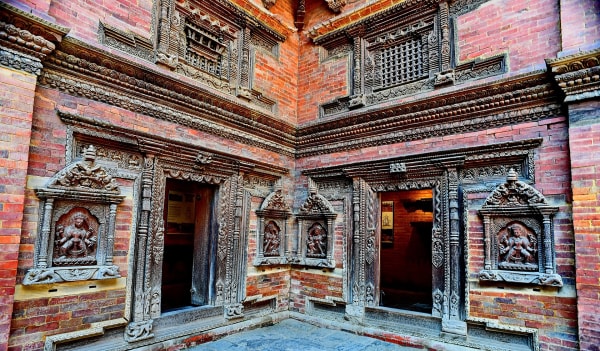
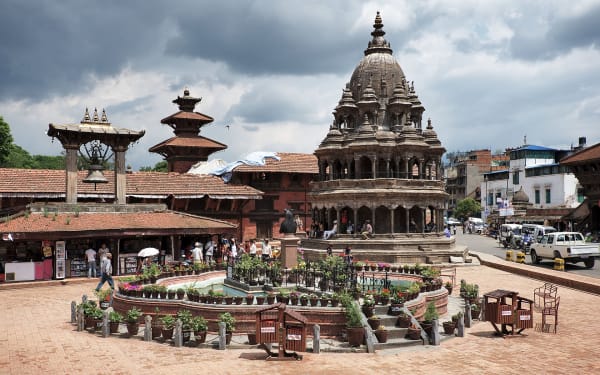
The most architecturally refined, across the Bagmati in Lalitpur, and our pick if you only visit one. The Krishna Mandir is a stone shikhara temple of extraordinary quality, the Patan Museum in the old palace is genuinely the best museum in Nepal, and the surrounding courtyards — Sundari Chowk with its royal bath, the metalworking alleys behind — repay an unhurried afternoon.
Bhaktapur Durbar Square
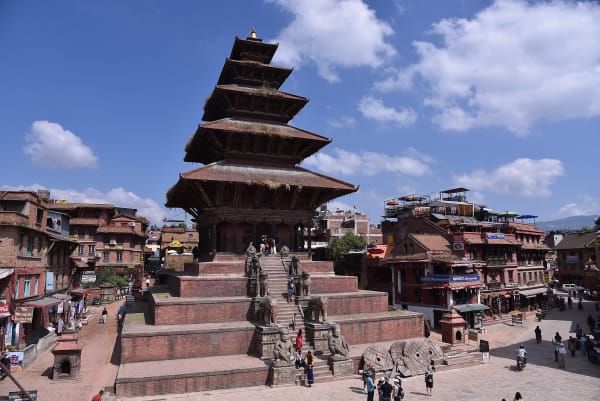
Not a square but a city. Bhaktapur is a walled medieval town where the whole street plan, not just the monuments, is intact — brick lanes, carved windows, pottery squares, and the five-storey Nyatapola temple, the tallest in Nepal. It needs half a day minimum and rewards a full one, or an overnight. See our Bhaktapur guide.
The Buddhist Stupas
Swayambhunath
A stupa on a hill west of the city, reached by 365 steps, with the valley laid out below. It is the oldest Buddhist site in the valley — the core may date to the 5th century — and the swayambhu of the name means self-arisen, from the legend that the hill emerged from a lake that once filled the valley. The resident macaques are the reason for the nickname Monkey Temple, and they are genuinely thieving.
Boudhanath
The largest stupa in Nepal and the centre of Tibetan Buddhist life in the country, surrounded by a ring of monasteries founded by refugee communities after 1959. The practice is to walk the kora clockwise around it at dusk with everyone else, which is one of the most atmospheric hours available anywhere in Kathmandu. It was substantially damaged in 2015 and rebuilt by 2016, largely with community donations.
Pashupatinath and Changu Narayan
Pashupatinath
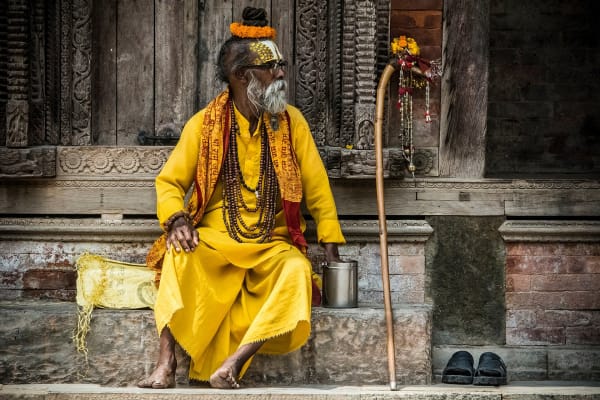
Nepal's most important Hindu temple, dedicated to Shiva as Pashupati, lord of animals, on the Bagmati river. The main temple is closed to non-Hindus, but the complex around it is open and it is the cremation ghats on the river that most visitors find unforgettable — open-air funeral pyres, families performing rites, and sadhus on the opposite bank.
Two rules here, and they are not negotiable: do not photograph cremations or grieving families, and stay on the far bank where visitors are directed. The sadhus who pose for photographs expect payment; agree it first.
Changu Narayan
The oldest temple in Nepal, on a ridge above Bhaktapur, with a stone inscription dated to 464 CE — the earliest dated inscription in the country. It is dedicated to Vishnu, and the stone sculpture around the courtyard, particularly the Vishnu Vishwarup and the Garuda, is the finest early Licchavi work surviving. It is also the quietest of the seven, and the walk down from Nagarkot arrives here.
How to See Them
| Time available | Plan |
|---|---|
| One day | All seven in one long day — efficient, and admittedly a lot |
| One day, unhurried | Kathmandu Durbar Square, Swayambhunath, Boudhanath and Pashupatinath |
| Half day | Patan — the best single site, 20 minutes from Thamel |
| Half to full day | Bhaktapur, with Changu Narayan added |
| Two days | Kathmandu and Swayambhunath on day one, Bhaktapur and Changu Narayan on day two |
| Five days | The valley tour, adding Nagarkot and the surrounding villages |
| Nine days | The cultural tour, adding Pokhara, Bandipur and Gorkha |
Practical advice that makes a real difference: go early, because the squares are empty and beautifully lit before about 9 a.m.; take a guide, because the iconography is dense and nothing is labelled usefully; keep your tickets, which are valid for re-entry on the same day and sometimes longer; and dress modestly at Pashupatinath and inside temple courtyards.
If you are fitting this around a trek, the valley sites are the obvious use of a buffer day — see our arrival guide.