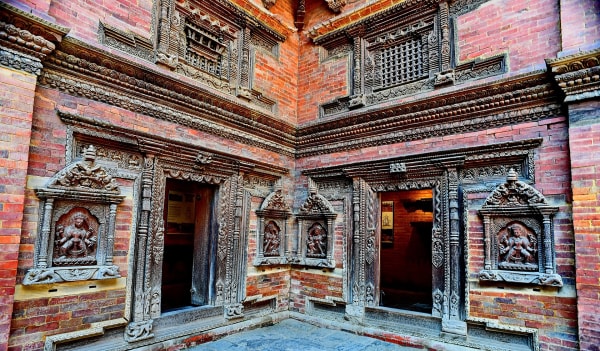
Bhaktapur was the capital of an independent Newar kingdom until 1769, and it is the best-preserved city in the Kathmandu Valley by a wide margin. What makes it different from Kathmandu and Patan is not the quality of individual monuments — Patan's are arguably finer — but that the entire urban fabric is intact: brick lanes, carved window frames, water tanks, courtyard houses, and squares that are still working public spaces rather than ticketed compounds.
It is 30 to 45 minutes from central Kathmandu, and most visitors give it a morning. It deserves a full day, and an overnight is better still.
The Four Squares
Durbar Square
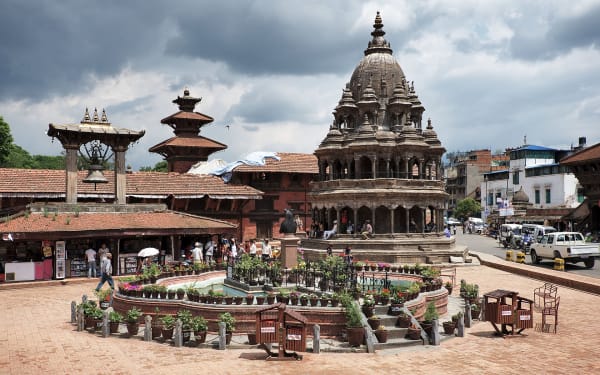
The royal court, with the Golden Gate — a gilded copper doorway into the palace, and the finest piece of metalwork in Nepal — the 55-Window Palace, the stone Siddhi Lakshmi temple, and the statue of King Bhupatindra Malla on his column. The square lost several temples in the 1934 earthquake and more in 2015, so it is emptier than old photographs show, which has the odd effect of making what survives more legible.
Taumadhi Square
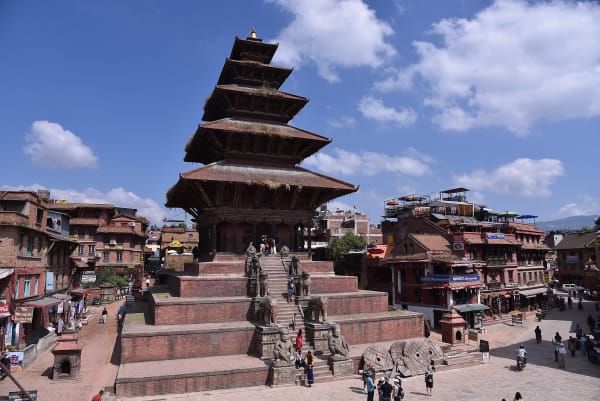
Dominated by Nyatapola, a five-storey pagoda of 1702 on a five-tiered plinth, the tallest temple in Nepal and the one that survived both the 1934 and 2015 earthquakes essentially undamaged — a fact Nepali engineers still study. Opposite it stands the Bhairavnath temple, and the square is the best place in the valley to sit with a cup of tea and watch a city work.
Dattatreya Square
At the eastern end of the old city, quieter, with the Dattatreya temple said to be built from a single tree, and beside it the Peacock Window — a 15th-century carved wooden lattice that is the most reproduced image of Newar woodwork in existence. The Woodcarving Museum is here.
Pottery Square
A working potters' quarter rather than a display. Clay is thrown, pots are laid out to dry in the sun across the whole square, and fired in straw kilns. You can watch, you can try, and you can buy directly from the potter. It is the most photographed part of Bhaktapur for good reason.
Beyond the Squares
- The lanes. The real pleasure of Bhaktapur is walking the brick alleys between the squares with no particular destination — courtyards, shrines, water tanks, and carved windows every few metres.
- Juju dhau. King curd — a thick sweet buffalo-milk yoghurt set in clay pots, and a Bhaktapur speciality with no equivalent elsewhere. Eat it from the pot.
- Newari food. Bara, chatamari, choila, yomari and samay baji. Bhaktapur has the best Newari eating in the valley.
- The water tanks. Siddha Pokhari at the western entrance and the stepped hitis throughout the city, several of which still supply water.
- Changu Narayan. The oldest temple in Nepal is a 40-minute drive or a pleasant two-hour walk from Bhaktapur, and the two pair naturally.
- Staying overnight. Several restored Newar houses operate as small hotels. Bhaktapur after the day visitors leave, with the squares lit and empty, is a different city.
The 2015 Earthquake and Restoration
Bhaktapur was among the worst-affected places in the valley. Several temples in Durbar Square collapsed, many houses were destroyed, and the death toll in the district was significant. Restoration has been substantial and is ongoing, and it has been unusual in two ways worth knowing about.
- Traditional technique. Much of the rebuilding has used traditional brick, timber and mud-mortar construction rather than concrete, partly on conservation grounds and partly because the traditional system performed better in 2015 than cement retrofits did.
- Local funding. Bhaktapur Municipality retains its own entry-fee revenue and has financed much of the work directly, which is unusual in Nepal and visible in how fast it has proceeded.
- Nyatapola survived. The tallest temple in the country, on a stepped plinth, came through both 1934 and 2015 essentially intact, which is studied as a case in traditional seismic design.
- Some gaps remain. A few temple platforms in Durbar Square are still empty, and you will see scaffolding. It is a living restoration rather than a finished one.
Your entry fee goes directly into this. It is one of the clearer cases in Nepal where a tourist ticket is visibly doing something.
Practical Notes
- Getting there: 30 to 45 minutes by taxi from Thamel, depending on traffic. Our Bhaktapur day tour includes the transfer, the entry fee and a guide.
- Entry: around NPR 1,800 for foreign nationals, which covers the whole old city rather than individual monuments. Keep your ticket — it can usually be extended for a multi-day visit at the ticket office.
- Timing: arrive before 9 a.m. or stay past 5 p.m. The middle of the day brings the tour groups.
- Footwear: brick and stone lanes, often uneven. Not the place for sandals.
- Festivals: Bisket Jatra at Nepali New Year in mid-April is Bhaktapur's great festival — chariot processions, a tug of war between city wards, and an enormous pole raised in Taumadhi. If you can time a visit for it, do. See our festival calendar.
- Guides: available at the entrance gates, and worth it. Nothing in the city is labelled.
One combination worth knowing: Bhaktapur in the afternoon, overnight at Nagarkot for the Himalayan dawn, then the ridge walk down to Changu Narayan the next morning. That is the best two-day cultural itinerary available from Kathmandu, and it is a good use of the days either side of a trek.