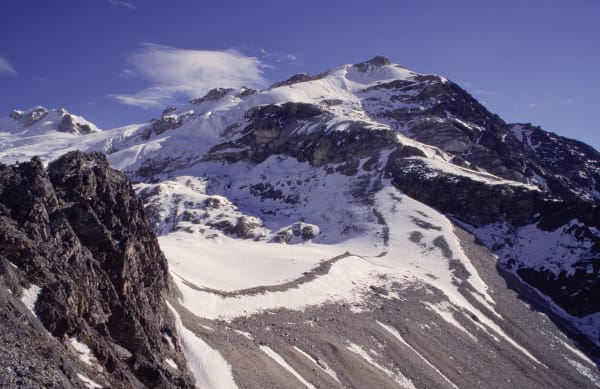
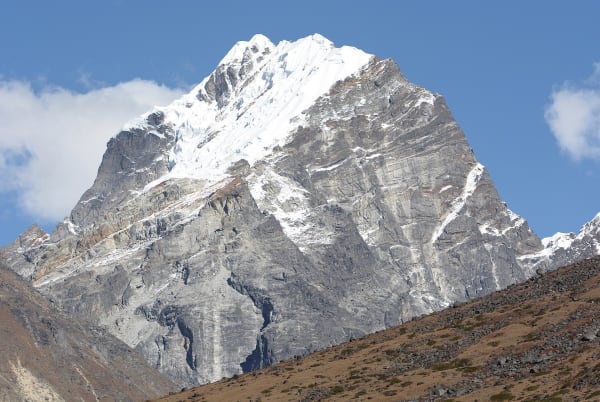
Yala Peak at 5,520 m sits above Kyanjin Gompa in the Langtang valley, and it is the most forgiving genuine climbing objective in Nepal. There is a glacier, there are crampons, there is a rope, and there is a summit with a Tibetan border panorama — and the summit day is five to seven hours rather than fifteen.
It is reached by road from Kathmandu, with no mountain flight to be cancelled, and the acclimatisation comes from the Langtang valley trek that precedes it. For anyone who wants to find out whether Himalayan climbing suits them before committing to a 6,000 m peak, this is the answer.
The Climb at a Glance
| Summit | 5,520 m |
| Duration | 15 days from Kathmandu |
| High camp | About 4,800 m |
| Summit day | 5–7 hours round trip |
| Technical grade | Alpine F — a glacier and a snow slope with basic rope work |
| Approach | Road to Syabrubesi, then the Langtang valley trek — no flight |
| Permits | NMA Group B, Langtang National Park |
| Best seasons | March to May, October to November |
We run it as a 15-day Yala Peak itinerary built on the Langtang valley trek.
The Route
The Langtang valley approach
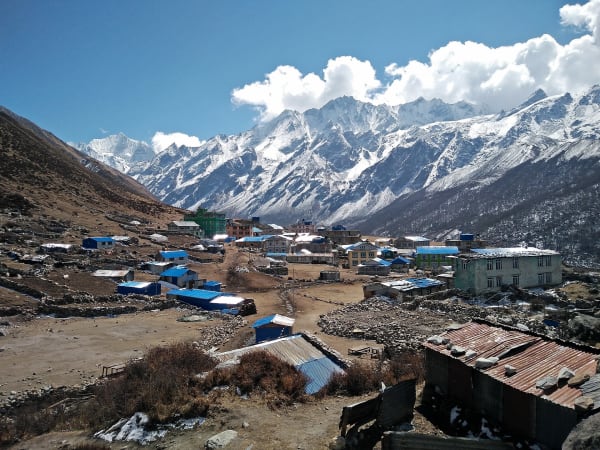
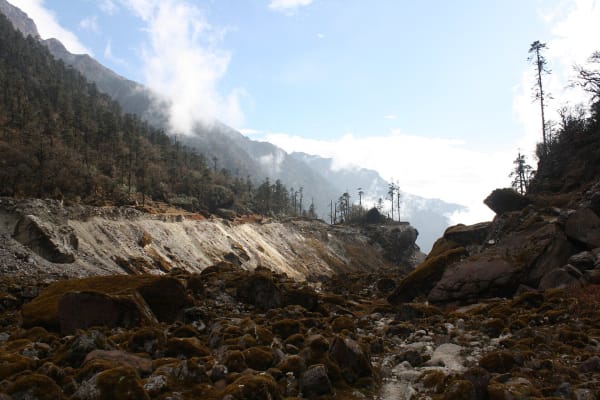
A road day from Kathmandu to Syabrubesi, then the standard Langtang trek up the gorge through Lama Hotel and Langtang village to Kyanjin Gompa (3,870 m). Our Langtang guide covers this stretch — it is a fine trek in its own right and it does the acclimatisation work.
Acclimatisation above Kyanjin
Two days at Kyanjin with climbs to Kyanjin Ri (4,773 m) and Tserko Ri (4,984 m). These are not optional extras — they are the acclimatisation that makes a 5,520 m summit comfortable, and they are excellent walks.
Base camp and high camp
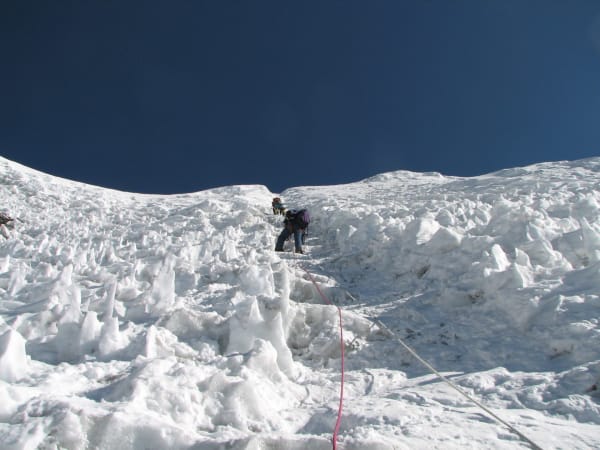
Up the valley to a base camp at around 4,600 m and a high camp near 4,800 m below the glacier, with a training day: crampons, ice axe, harness, rope team, and basic fixed-rope technique.
Summit day
A pre-dawn start, roped, onto the glacier and up a broad snow slope to the summit at 5,520 m. Five to seven hours round trip. From the top: Shishapangma (8,027 m) across the border in Tibet — the only eight-thousander entirely within Tibet — plus Langtang Lirung, Langtang Ri, Dorje Lakpa and the Jugal Himal.
Out
Back down the Langtang valley to Syabrubesi and Kathmandu by road.
Why It Works as a First Climb
- A short summit day. Five to seven hours, not fifteen. You learn what a climbing day feels like without needing to survive one.
- Basic technical demand. A glacier and a snow slope with rope work, and no sustained steep ice or exposed corniced ridge.
- Modest altitude. 5,520 m is high, and it is 650 m to 950 m lower than the Khumbu trekking peaks.
- No mountain flight. Road access to Syabrubesi removes the biggest logistical risk in Nepali climbing trips.
- A good trek attached. The Langtang valley to Kyanjin Gompa is worth doing on its own, so the trip is not just an approach.
- Quiet. A fraction of the Khumbu's climbing traffic.
- Cheaper. No flights, lower lodge costs, shorter itinerary.
What it is not: a substitute for Island Peak or Mera if a 6,000 m summit is the goal. It is a step below both, deliberately. Climbers routinely do Yala one season and a 6,000 m peak the next, which is a sound progression.
What You Still Need
Easiest does not mean easy. The requirements are real:
- Hill fitness to walk five to six hours a day for a week before the climb.
- Willingness to sleep at 4,800 m in a tent, at around -15 °C.
- Crampons, ice axe, harness and boots — bring or hire in Kathmandu. Group technical kit is supplied.
- Insurance covering mountaineering to 6,000 m, which is the same requirement as any peak.
- A licensed climbing guide, which is a permit condition and included in the trip.
- Engagement with the training day. Even basic rope work needs practice with gloves on at altitude.
Our peak climbing gear list sets out exactly what to bring, and the fixed rope guide covers the technique.
Other Gentle First Climbs
| Peak | Altitude | Days | Note |
|---|---|---|---|
| Yala Peak | 5,520 m | 15 | The gentlest — road-accessible, short summit day, Langtang |
| Naya Kanga | 5,844 m | 16 | Also Langtang, a step up in altitude and steepness |
| Pokalde | 5,806 m | 16 | Khumbu, rocky and short, often added to an EBC trek |
| Paldor Peak | 5,896 m | 14 | Ganesh Himal, very quiet, a genuine expedition feel |
| Mera Peak | 6,476 m | 18 | The next step for altitude, still technically easy |
| Island Peak | 6,189 m | 18 | The next step for technique |
If Yala goes well and you want the next thing, the usual progression is Yala, then Mera or Island Peak, then Lobuche East, then Ama Dablam. Each step adds one thing rather than several.