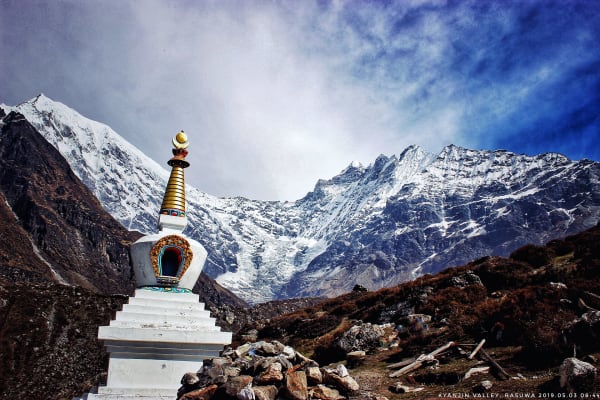
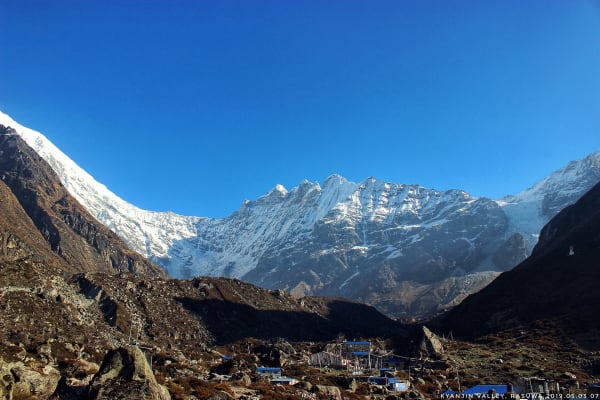
Langtang is the Himalayan valley nearest to Kathmandu, and it is the most underrated trek in Nepal. Seven hours by road gets you to the trailhead; four days of walking gets you to Kyanjin Gompa at 3,870 m beneath Langtang Lirung (7,227 m), with a glacier at the head of the valley and a 4,773 m viewpoint above the village.
No flight, no restricted permit, no 5,000 m pass, and a fraction of the traffic on the Everest or Annapurna trails. The valley also has a more recent history that matters: it was devastated by the 2015 earthquake and has been rebuilt by families who came back.
The Trek at a Glance
| Duration | 10 days from Kathmandu, 7 days of walking |
| Highest night | Kyanjin Gompa, 3,870 m |
| Highest point | Tserko Ri, 4,984 m, or Kyanjin Ri at 4,773 m |
| Difficulty | Moderate — a sustained forest climb, then a gentle upper valley |
| Access | Road from Kathmandu to Syabrubesi, 7–8 hours |
| Permits | Langtang National Park entry and trekking registration |
| Best seasons | March to May, October to November; viable in winter |
| Accommodation | Teahouse lodges, rebuilt since 2015 and good |
We run it as a 10-day Langtang Valley Trek, with a 15-day version adding Gosaikunda and a 14-day route over the Ganja La for experienced trekkers.
The Route
Kathmandu to Syabrubesi (1,400 m to 1,460 m)
A seven to eight hour drive north-west through Trishuli Bazaar and Dhunche, climbing over a ridge into the Rasuwa district with the Ganesh Himal on one side. It is a long, winding day on an indifferent road, and it is the price of reaching a Himalayan valley without a flight.
Syabrubesi to Lama Hotel (1,460 m to 2,380 m)
Into the gorge. The trail follows the Langtang Khola through dense subtropical forest — oak, maple, bamboo, rhododendron — with langur monkeys overhead and the river loud below. Superb forest walking, and in late March the rhododendron here is among the best in Nepal.
Lama Hotel to Langtang village (2,380 m to 3,430 m)
The forest thins and the valley opens. You pass Ghoda Tabela and the park checkpoint, then reach the site of Langtang village, destroyed by an avalanche triggered by the 2015 earthquake. The new village is built alongside, and the memorial to the 300 or more people who died there is on the trail. It is a quiet stretch to walk through.
Langtang to Kyanjin Gompa (3,430 m to 3,870 m)
A short, gentle morning through yak pasture, mani walls, and a working cheese factory to Kyanjin Gompa — a scatter of lodges and a small monastery at the head of the valley, with the Langtang glacier above and Langtang Lirung's 7,227 m wall directly overhead. You stay two nights.
Kyanjin Ri and Tserko Ri
The reason for the second night. Kyanjin Ri (4,773 m) is a three to four hour climb directly above the village for a panorama of Langtang Lirung, Langtang Ri, Dorje Lakpa and the Tibetan border peaks. Tserko Ri (4,984 m) is longer — six to seven hours return — and higher, with the whole Langtang glacier system laid out below. Either is the high point of the trek.
Back down
Two days retracing the valley to Syabrubesi, with an optional detour via Sherpagaon or the Tamang villages above the gorge for a different route out, then the drive to Kathmandu.
Why Langtang Is Underrated
- No flight. One road day each way, and nothing to be cancelled by cloud. For a ten-day trip that is a significant practical advantage.
- No restricted permit. Park entry and registration only, which keeps the cost low.
- Quiet. Visitor numbers never fully recovered after 2015, so the valley carries a fraction of the Annapurna or Khumbu traffic.
- High without a pass. Kyanjin Gompa at 3,870 m with day walks to nearly 5,000 m gives real altitude without a committed crossing.
- Tamang culture. The valley is Tamang and Tibetan-Buddhist, with gompas, mani walls, and a language distinct from Nepali.
- It works in winter. South-facing, sheltered, and road-accessible, which makes it one of the better December and January treks.
- Your money matters more here. The lodges are rebuilt family businesses in a valley that lost almost everything.
Our Langtang recovery guide covers that last point properly.
Difficulty and Altitude
Moderate, and more manageable than most treks that reach this altitude.
- Five to six hours a day with 600 to 1,000 m of gain on the two forest days.
- The Lama Hotel to Langtang day is the hardest, at around 1,050 m of ascent.
- The upper valley is gentle — Langtang to Kyanjin is two to three hours on near-level ground.
- Kyanjin Ri and Tserko Ri are steep but optional, and done from a lodge you return to.
- Altitude: the highest sleep is 3,870 m with a 4,984 m day walk, which is an ideal climb-high sleep-low structure. The two nights at Kyanjin are the acclimatisation.
- Cold: Kyanjin nights run to -5 to -12 °C in the main seasons. A -10 °C bag with a liner is right.
Extensions and Variants
| Option | Days | What it adds |
|---|---|---|
| Langtang Valley | 10 | The standard route with two nights at Kyanjin Gompa |
| Langtang with Gosaikunda | 15 | The sacred lakes at 4,380 m over the Laurebina La, then out via Helambu |
| Langtang with Ganja La | 14 | A committed 5,130 m pass crossing south into Helambu — for experienced trekkers |
| Tamang Heritage Trail | 13 | The villages west of the valley, combined with the Langtang trek itself |
| Gosaikunda alone | 12 | The lakes without the Langtang valley |
| Langtang helicopter tour | 1 | A morning from Kathmandu if you have no days at all |
The best two-week option in the region is the Langtang valley plus Gosaikunda, which walks up one valley, crosses the Laurebina La at 4,610 m to the sacred lakes, and descends through Helambu to a road an hour from Kathmandu. No flights, no restricted permits, and two very different landscapes.