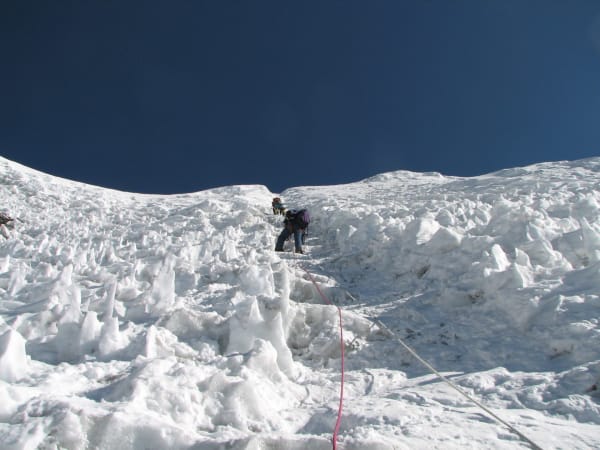
A trekking peak trip needs everything on a normal high-altitude trekking list, plus a technical layer on top and a significant step up in cold-weather clothing. The summit morning on Island Peak or Mera starts at around -20 to -25 °C with wind, standing still on a glacier in the dark, which is a different proposition from walking uphill at Gorak Shep.
This list covers the standard NMA Group B peaks — Island, Mera, Lobuche East, Yala, Pokalde. Start from our general Nepal packing list and add what follows.
Technical Equipment
| Item | Who supplies | Notes |
|---|---|---|
| Ropes, ice screws, snow stakes, anchors | We supply | Group equipment, carried and placed by the climbing guides |
| Climbing harness | Bring or hire | Must fit over full clothing. Try it on with your down trousers. |
| Crampons | Bring or hire | 12-point steel, with the correct binding for your boots. Fit them to the boots before you travel. |
| Ice axe | Bring or hire | General mountaineering axe, sized to your height |
| Jumar or ascender | Bring or hire | The single most used item on summit day. Practise with it. |
| Belay device or figure-of-eight | Bring or hire | For abseiling the headwall |
| Carabiners | Bring or hire | 2 locking, 2 non-locking minimum |
| 120 cm sling and a cow's tail | Bring or hire | For clipping past anchors |
| Helmet | Bring or hire | Mandatory on Island Peak and Lobuche East |
| Headlamp | Bring | Plus spare batteries kept warm. You climb in the dark for 3 hours. |
Almost all of this hires in Kathmandu for a few dollars a day per item, and the quality is generally adequate. The exceptions worth buying or bringing are the harness and the jumar: fit matters on the first and familiarity matters enormously on the second.
Boots: The Decision That Matters
Trekking boots will not take crampons reliably and will not keep your feet warm at -25 °C. You need mountaineering boots, and there are two realistic options.
| Type | Suits | Note |
|---|---|---|
| Single mountaineering boot (B2/B3) | Yala, Pokalde, Island Peak in spring | Lighter and more comfortable on the approach; marginal for cold at 6,400 m |
| Double mountaineering boot | Mera, Lobuche East, any winter or late-autumn ascent, and Island Peak for cold feet | Warmer and stiffer, less pleasant to walk in. The safe choice above 6,000 m. |
Both hire in Kathmandu, and hiring is reasonable if you will not climb again — but try them on with your climbing socks and fit your crampons to them at the shop, not at base camp. Wear them for a full day on the approach before the summit push. Ill-fitting boots cause more failed summit attempts on these peaks than technique does.
Also bring: gaiters, two pairs of thick climbing socks, and a pair of overboots if you are climbing Mera in cold conditions.
Clothing for a -25 °C Summit Morning
Everything on the standard high-altitude list, plus:
- Down trousers or insulated salopettes. The item most often missing, and the one that makes the crampon point bearable.
- An expedition-weight down jacket with a hood that fits over a helmet. A trekking down sweater is not enough.
- A three-layer glove system — liners, insulated gloves for climbing, and expedition mittens for the cold sections. You need to operate a jumar and a carabiner in the middle layer.
- A balaclava and a buff, plus goggles as well as sunglasses. Category 4 lenses for glacier glare, goggles for wind.
- Two thermal base layer sets, one kept dry for summit day only.
- A hard shell jacket and trousers with full-length side zips, so you can put the trousers on over boots and crampons.
- Hand and toe warmers. Cheap, light, and genuinely useful at the crampon point.
On sleeping kit: a -25 to -30 °C bag for high camp on Mera, -20 °C for Island Peak and Lobuche East, plus a liner and a good insulated mat. High camps are on snow or rock ledges, not lodge floors.
Everything Else
- Daypack 35–45 litres with ice axe attachment and compression straps for the rope if you carry one.
- 2 × 1 litre insulated bottles. A bladder hose freezes solid at -20 °C, so no hydration bladders on summit day.
- A thermos, which is the single most appreciated item at the crampon point.
- High-calorie snacks you can eat with gloves on — gels, bars, chocolate. Appetite at 6,000 m is poor and cold bars are hard work.
- Factor 50 sunscreen and zinc stick, plus SPF lip balm. Glacier reflection burns under the chin and inside the nose.
- Personal first aid including blister kit, painkillers, and any prescription medication. Guides carry group medical kit and oxygen.
- Power bank and spare camera batteries, kept in your sleeping bag.
- A pee bottle. Leaving a tent at 5,800 m at 1 a.m. is worth avoiding.
Buy, Hire, or Bring: A Summary
| Category | Recommendation |
|---|---|
| Mountaineering boots | Hire in Kathmandu if climbing once; buy if you intend to continue. Fit crampons at the shop. |
| Harness | Bring — fit over full clothing matters |
| Jumar and belay device | Bring — familiarity matters more than quality |
| Crampons and ice axe | Hire is fine, but fit crampons to your boots before leaving Kathmandu |
| Helmet | Hire is fine |
| Down jacket and down trousers | Hire in Kathmandu is excellent value for expedition-weight kit |
| Sleeping bag | Hire to -30 °C in Kathmandu, or bring your own with a liner |
| Base layers, shell, gloves | Bring from home — fit and quality matter and they are cheap enough |
| Goggles and category 4 sunglasses | Bring, with a spare pair of glasses |
| Group technical equipment | We supply — ropes, screws, anchors, oxygen, medical kit |
Allow a full day in Kathmandu before departure for hiring and fitting, and your climbing guide will run a kit check at the pre-trip briefing. That is the moment a problem can still be fixed. Our fixed rope guide covers how to use the technical items once you have them.