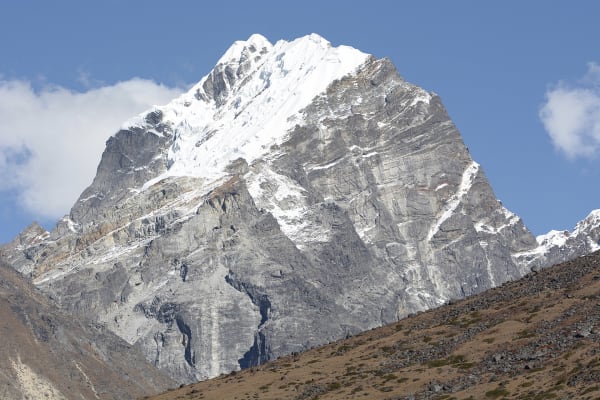
Nepal has 8,848 m at one end of the scale and a category at the other that is genuinely open to ordinary trekkers: the trekking peaks, a list of 33 summits between about 5,500 m and 6,500 m administered by the Nepal Mountaineering Association. On the most popular of them, a fit trekker with no climbing background can stand on a 6,000 m summit after a fortnight in the country and two or three days of instruction.
That is a real thing rather than a marketing claim, and it also misleads. A trekking peak is not a walk. Summit day involves a harness, a rope, crampons, an ice axe and a jumar, starting at 2 a.m. at around -20 °C, and the failure rate on the popular peaks is significant. This guide sets out what is actually involved.
The Peaks That Suit a First Climb
| Peak | Altitude | Days | Technical demand |
|---|---|---|---|
| Yala Peak | 5,520 m | 15 | The easiest — a snow slope with basic rope work. The best first climb in Nepal. |
| Island Peak (Imja Tse) | 6,189 m | 18 | The classic first 6,000 m peak — a glacier, a headwall with fixed rope, and an exposed summit ridge |
| Mera Peak | 6,476 m | 18 | The highest trekking peak, and technically the easiest at that altitude — a long glacier plod with a short steep summit step |
| Lobuche East | 6,119 m | 18 | Steeper and more technical than Island Peak, with rock and mixed ground |
| Pokalde | 5,806 m | 16 | Short, rocky, and often combined with a Khumbu trek |
| Naya Kanga | 5,844 m | 16 | A Langtang snow peak, quiet and straightforward |
| Pachermo | 6,187 m | 20 | Rolwaling, remote, with a fine summit ridge |
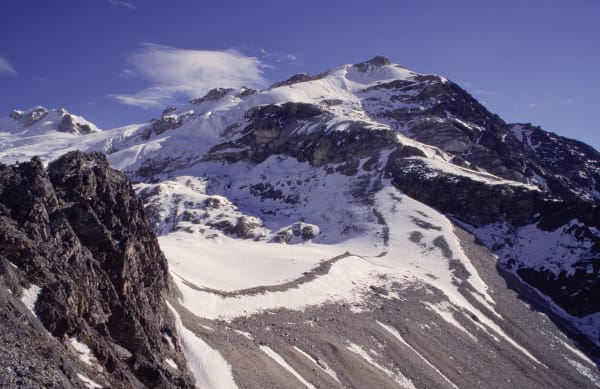
If this is your first Himalayan climb, the honest ranking is: Yala Peak if you want to learn the skills on a genuine summit without a hard day; Mera Peak if you want the highest number with the least technical difficulty; Island Peak if you want the classic Khumbu climb with a proper technical summit day.
What Summit Day Actually Involves
Take Island Peak as the model, since it is the most commonly climbed. From high camp at around 5,200 m:
- 1.00–2.00 a.m. Wake, tea, force down something to eat. -15 to -20 °C.
- 2.00 a.m. Leave in the dark, in a rope team, on rock and scree for the first two to three hours. Steep, loose, relentless.
- 5.00 a.m. Crampon point at the glacier's edge. Harness on, crampons on, rope up.
- 5.00–7.00 a.m. Glacier travel, roped, crossing crevasses on snow bridges and occasionally a ladder.
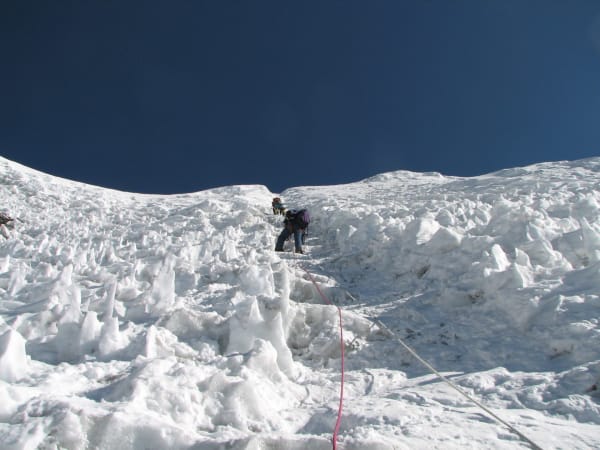
- 7.00–9.00 a.m. The headwall — 100 to 150 m of steep snow and ice at 45 to 50 degrees, ascended on fixed rope with a jumar.
- 9.00–10.00 a.m. A narrow, exposed summit ridge with drops on both sides, then the summit at 6,189 m.
- 10.00 a.m.–3.00 p.m. Down — abseiling or arm-wrapping the headwall, back across the glacier, and the long descent to high camp or Chhukung.
Twelve to fifteen hours, most of it above 5,500 m. That is what the word climbing is doing in the phrase. Our Island Peak guide covers the day in detail.
The Skills You Need
Every trip we run includes pre-climb training days at base camp or on a glacier, where our climbing guides teach and drill the following. You do not need them before you arrive; you do need to take the training seriously.
- Walking in crampons — flat-footing, front-pointing, and not catching a point on your gaiter.
- Using an ice axe — as a walking aid, in self-belay, and for a self-arrest.
- Jumar or ascender technique — the single most important skill. Going up a fixed rope efficiently is the difference between a two-hour headwall and a four-hour one.
- Abseiling and arm-wrapping for the descent.
- Roped glacier travel — spacing, keeping the rope taut, what to do if someone goes into a crevasse.
- Harness, figure-of-eight, carabiners, and clipping past an anchor with gloves on, in the dark.
See our fixed rope and jumar guide for the detail, and practise jumar technique at home if you have access to a wall — it pays for itself on the headwall.
Permits and Fees
Trekking peaks are administered by the Nepal Mountaineering Association and priced by group and season.
| Group | Spring | Autumn | Winter / summer |
|---|---|---|---|
| NMA Group B (most trekking peaks — Island, Mera, Lobuche East, Yala, Pokalde) | USD 250 | USD 125 | USD 70 |
| NMA Group A (Ama Dablam, Pumori and other 6,500 m+ peaks) | USD 400 | USD 200 | USD 100 |
Also required: a licensed climbing guide — a separate qualification from a trekking guide licence — and insurance that explicitly covers mountaineering to the altitude of your peak. Many policies cover trekking to 6,000 m and exclude the use of ropes and crampons, which is exactly what you will be doing. Our NMA permits guide covers the whole system.
Are You Ready?
Three honest tests.
- Have you slept above 4,500 m? If not, you do not know how your body handles it, and a summit push at 6,000 m is a poor place to find out. A Khumbu or Annapurna trek first is the sensible sequence.
- Can you do a 12-hour day? Not a 12-hour day at sea level — a hard day on your feet that starts at 2 a.m. and finishes in the afternoon, on consecutive days of walking before it.
- Are you comfortable with exposure? The Island Peak summit ridge and the Lobuche East upper section have real drops. It is not a question of technique; it is a question of whether you can function there.
If the answer to any of those is no, the best route in is a trekking peak trip built on a full acclimatisation trek — which is how our itineraries are structured. Island Peak, for instance, follows the Everest Base Camp acclimatisation profile before turning up the Imja valley.
And if a 6,000 m summit is not the point but the glacier experience is, Yala Peak at 5,520 m gives you rope, crampons and a summit with a far shorter and kinder day.