Mera Peak at 6,476 m is the highest summit on the Nepal Mountaineering Association's trekking peak list, and — unusually for a mountain of that height — it is technically straightforward. The standard route is a long glacier ascent at a moderate angle with one short steep step below the summit, which makes it the most accessible 6,400 m peak in the Himalaya.
The approach is also the best part. Instead of the Everest Base Camp corridor, Mera is reached over a 4,600 m pass from Lukla into the Hinku valley — a forested, almost uninhabited valley with a fraction of the Khumbu's traffic. And the summit view is arguably the finest from any trekking peak: Everest, Lhotse, Makalu, Cho Oyu and Kanchenjunga, five of the world's six highest mountains, in a single panorama.
The Climb at a Glance
| Summit | 6,476 m — Mera Central, the standard objective |
| Duration | 18 days from Kathmandu |
| High camp | Mera La high camp, about 5,800 m |
| Summit day | 8–12 hours round trip |
| Technical grade | Alpine F/PD — glacier travel, a short steep summit step on fixed rope |
| Approach | Lukla over the Zatrwa La (about 4,600 m) into the Hinku valley |
| Permits | NMA Group B (USD 250 spring, 125 autumn, 70 winter/summer), Makalu Barun National Park |
| Best seasons | April to mid May, October to November |
We run it as an 18-day standard itinerary, a 15-day short version, and in several combinations: Mera with Island Peak, Mera with the Amphu Lapcha crossing, and three peaks in 30 days.
The Route
Lukla over the Zatrwa La into the Hinku
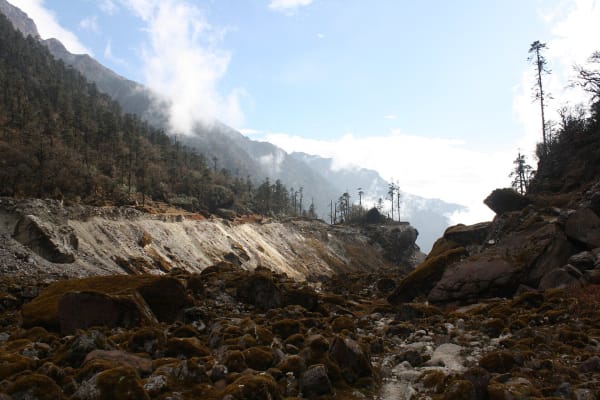
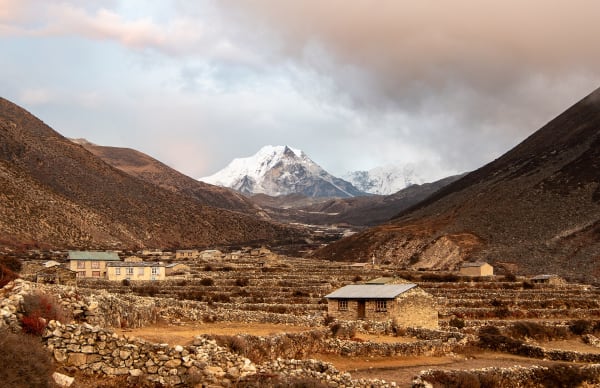
From Lukla the route turns south-east and climbs immediately to the Zatrwa La at around 4,600 m — a serious first pass that comes early, which is why our itinerary breaks the climb with a night at Chhutanga. Beyond it the trail drops into the Hinku valley: forest, a river, yak pasture at Kothe and Thangnak, and almost no permanent settlement.
Thangnak and Khare
Up the valley to Thangnak (4,360 m) and Khare (5,045 m), with an acclimatisation day at each. Khare is the staging post for the climb — a cluster of lodges beneath the Mera glacier, where the training day happens and where you can see the whole route above you.
Training at Khare
A full day on the glacier edge: crampons, ice axe, roped travel, jumar and abseil. Mera needs less technical skill than Island Peak, but the glacier is long and crevassed and rope team discipline matters more.
Mera La and high camp
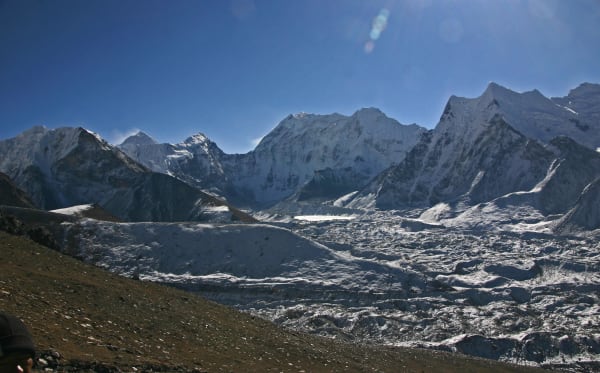
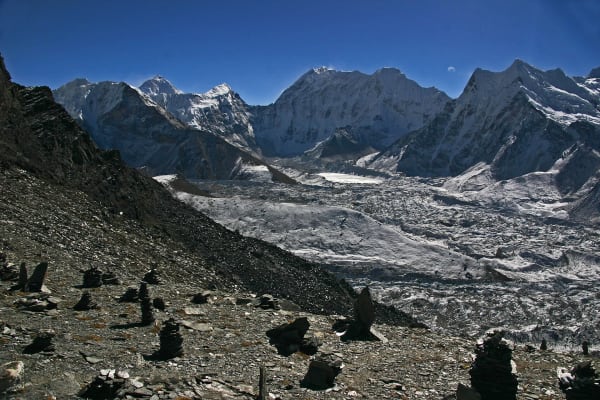
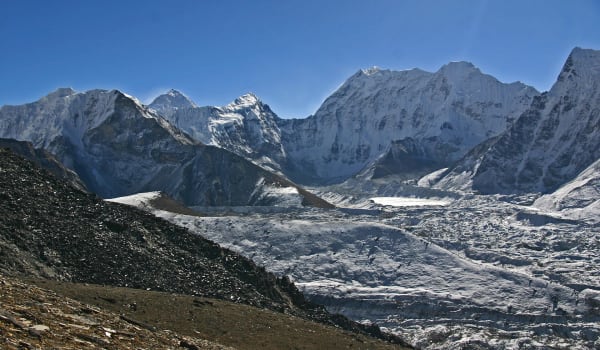
Onto the glacier and up to the Mera La at around 5,400 m, then to high camp at about 5,800 m on a rock shelf beside the glacier. This is the highest camp on any trekking peak itinerary in Nepal and it is cold, exposed and spectacular — Makalu fills the view south.
Summit day
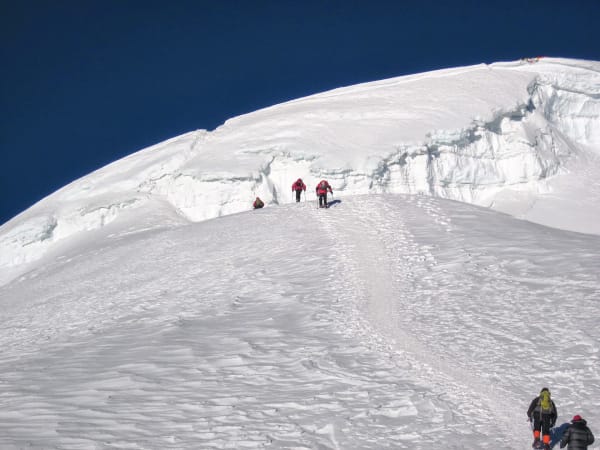
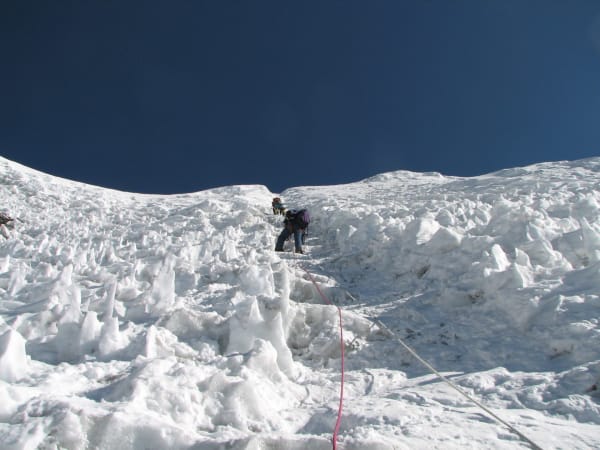
A 2 to 3 a.m. start on the glacier, roped, for four to six hours of steady ascent on a broad snow slope at moderate angle. The final 40 to 50 m to Mera Central (6,476 m) is a short steep step, usually with a fixed rope. From the top: Everest, Lhotse, Makalu, Cho Oyu, Kanchenjunga, Baruntse, Chamlang and Ama Dablam. Then back down the glacier to high camp and on to Khare — eight to twelve hours in total.
Why Mera Suits a First Climb
- Technically the easiest 6,400 m peak available. A glacier plod rather than a climb, with one short steep section.
- A long, graded approach. Nine days of walking before the summit push, with rest days at Thangnak and Khare, which is excellent acclimatisation.
- The highest number on the trekking peak list. If the altitude itself is the objective, this is it.
- A quieter approach than the Khumbu. The Hinku valley sees a small fraction of the Everest trail's traffic.
- The best summit view of any trekking peak. Five eight-thousanders in one panorama.
What it asks in return: altitude tolerance. 6,476 m is 287 m higher than Island Peak, and high camp at 5,800 m is 600 m higher than Island Peak's. The cold at high camp is the single most commonly underestimated part of the trip, and a -30 °C sleeping bag is not excessive there.
The Zatrwa La Problem
The one genuine weakness of the standard Mera itinerary is the Zatrwa La. It comes on day three or four, at around 4,600 m, barely 48 hours after flying into Lukla at 2,860 m. That is a fast gain by any standard.
What we do about it:
- Break the climb with a night at Chhutanga (around 3,450 m) rather than crossing in one push from Lukla.
- Keep the pace deliberately slow and monitor oxygen saturation on the pass day.
- Build the rest days at Thangnak and Khare into the schedule, which is where acclimatisation is recovered.
- Offer an alternative approach on request — flying or walking in via Paiya and Pangkongma, which is lower, longer and gentler.
If you have any history of altitude trouble, tell us and we will use the longer approach. It costs two days and removes the one pinch point in an otherwise well-graded itinerary.
Combinations
| Itinerary | Days | What it adds |
|---|---|---|
| Mera Peak | 18 | The standard route, with rest days at Thangnak and Khare |
| Short Mera Peak | 15 | A compressed itinerary for climbers with prior altitude experience |
| Mera and Island Peak | 25 | Mera first as acclimatisation, then Island Peak — the most effective double |
| Mera with Amphu Lapcha | 21 | A technical 5,845 m pass crossing from the Hinku into the Imja valley |
| Mera, Island and Lobuche | 30 | Three 6,000 m summits in one expedition |
| Mera with Baruntse | 35 | Mera as acclimatisation for a 7,129 m expedition peak |
The Mera-then-Island combination is the one we recommend most often for climbers who want two summits: Mera's gradual glacier route acclimatises you to 6,476 m, which makes Island Peak's technical day considerably more comfortable. Our comparison guide covers choosing between them if you only have time for one.