Nepal's climbing permits fall into two systems. The 33 trekking peaks between roughly 5,500 m and 6,500 m are administered by the Nepal Mountaineering Association (NMA), with fees that vary by group and season. Everything above that — the expedition peaks and the eight-thousanders — is permitted directly by the Department of Tourism, at a different order of cost.
Here is how each works, what it costs, and the conditions that come with it. Fees are revised periodically by both bodies, so treat these as planning figures and confirm before you budget.
Trekking Peaks: NMA Groups A and B
| Group | Peaks | Spring | Autumn | Winter / summer |
|---|---|---|---|---|
| Group B | Most trekking peaks — Island, Mera, Lobuche East, Yala, Pokalde, Naya Kanga, Pachermo, Paldor, Singu Chuli, Tharpu Chuli | USD 250 | USD 125 | USD 70 |
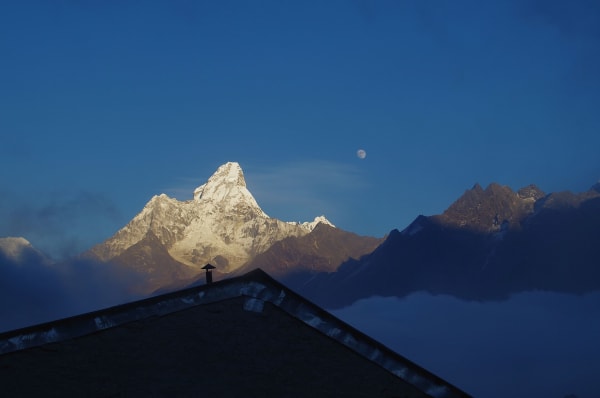
| Group A | The higher NMA peaks — Ama Dablam, Pumori, Kusum Kanguru, Kyajo Ri, Nirekha, Phari Lapcha, Chulu | USD 400 | USD 200 | USD 100 |
Alongside the permit fee:
- A refundable garbage deposit — typically USD 250 to 500 per group, returned when the team's waste is brought out and verified.
- National park or conservation area entry — Sagarmatha, Langtang, Makalu Barun, ACAP, as applicable.
- The Khumbu rural municipality fee for Everest-region peaks.
- A licensed climbing guide, which is a permit condition rather than an option.
On our trips all of this is arranged and included, and what we need from you is a passport scan, photographs and your insurance details. See our trekking peak guide for which peaks sit in which group.
Expedition Peaks and Eight-Thousanders
Above the NMA list, peaks are permitted by the Department of Tourism with royalties set by altitude band and season, and the difference in scale is substantial.
| Peak band | Spring royalty (indicative, per person) | Notes |
|---|---|---|
| Everest, south side | USD 15,000 | Raised from USD 11,000 with effect from September 2025 |
| Other 8,000 m peaks — Lhotse, Makalu, Manaslu, Kanchenjunga, Annapurna, Dhaulagiri, Cho Oyu | USD 1,800 | Autumn and winter rates are lower |
| 7,501–7,999 m | USD 600 | Seasonal variation applies |
| 7,001–7,500 m | USD 500 | Seasonal variation applies |
| 6,501–7,000 m | USD 400 | Seasonal variation applies |
Expedition permits also carry:
- A liaison officer assigned to the expedition, whose costs the team covers.
- A larger garbage deposit, typically USD 3,000 to 4,000 on an eight-thousander.
- Insurance and equipment requirements for all Nepali staff, which reputable operators exceed rather than meet.
- Medical and experience documentation — since 2025, Everest applicants have been required to show evidence of a previous ascent above 7,000 m, a change intended to reduce inexperienced crowding on the route.
Our Everest expedition guide and eight-thousanders guide cover what those expeditions actually involve.
The Climbing Guide Requirement
A climbing guide licence is separate from a trekking guide licence. It requires assessed technical training — rope work, crevasse rescue, high-altitude first aid — and it is a condition of every NMA and expedition permit.
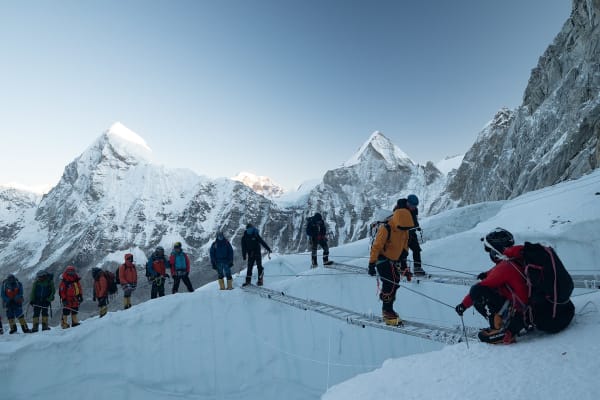
- Trekking peaks: one licensed climbing guide, with the ratio tightening as the group grows. We run a maximum of three climbers per guide on technical summit days, and one-to-one or two-to-one on the steeper peaks.
- Expedition peaks: a guide-to-client ratio appropriate to the objective, usually one-to-one on an eight-thousander.
- What it means practically: the person fixing the rope, setting the turnaround time and making the call to descend is a qualified professional rather than a trekking guide improvising.
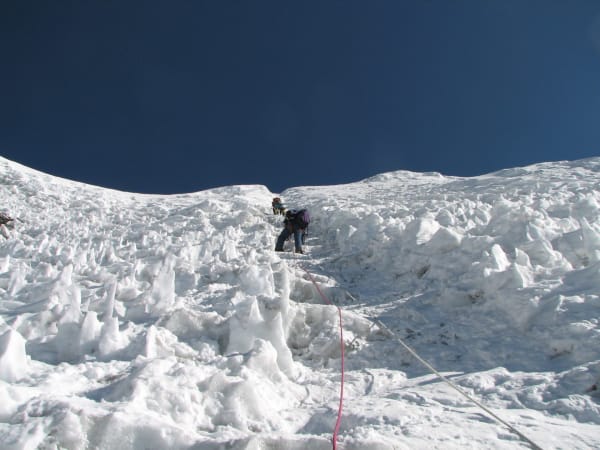
This is a place where operators differ invisibly. A cheap peak trip that sends one climbing guide with eight clients on an Island Peak headwall is technically permitted and practically unsafe, because the guide cannot watch eight people on a fixed rope at 6,000 m.
Insurance: The Clause That Catches People
This is the single most common gap we see in climbing bookings. A policy that covers trekking to 6,000 m frequently excludes mountaineering — the use of ropes, crampons and an ice axe — which is exactly what a trekking peak is.
Your policy must state, in the wording rather than the marketing:
- A maximum altitude at or above your peak, with margin. For a 6,189 m peak, buy 7,000 m.
- Mountaineering or climbing as a covered activity, named explicitly, including the use of fixed ropes and crampons.
- Helicopter evacuation and repatriation, explicitly.
- Medical expenses of USD 100,000 or more.
- Search and rescue, which is separate from medical evacuation and matters on a remote peak.
If the wording is ambiguous, email the insurer naming your peak and its altitude and keep the written answer. Our insurance guide covers the detail, and we will not take a climbing booking without the policy number, the altitude figure and the insurer's 24-hour emergency line.
Season and the Cost of Going Off-Peak
NMA fees drop sharply outside spring, which is a genuine saving and a signal about conditions.
| Season | Group B fee | What you are accepting |
|---|---|---|
| Spring (Mar–May) | USD 250 | The most settled conditions and the busiest routes |
| Autumn (Sep–Nov) | USD 125 | Clear air, colder, firmer snow, fewer climbers |
| Winter (Dec–Feb) | USD 70 | Very cold, high winds, short days, serious commitment |
| Summer (Jun–Aug) | USD 70 | Monsoon — poor visibility, unstable snow, rarely worth it |
The honest reading: autumn at half the spring fee is excellent value and often the better season for a technical peak, because the snow is firmer and the air clearer. Winter and summer fees are low because the climbing is genuinely harder, not because the mountain is on sale.