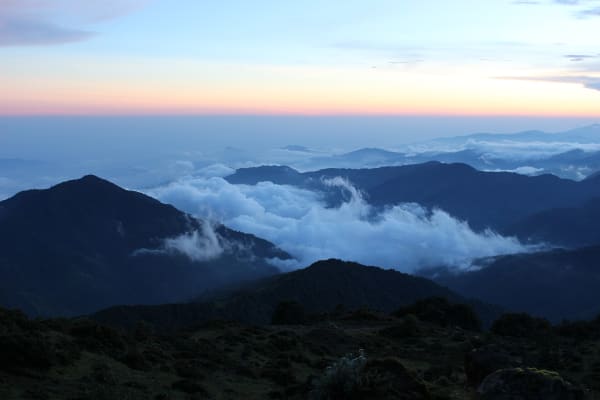
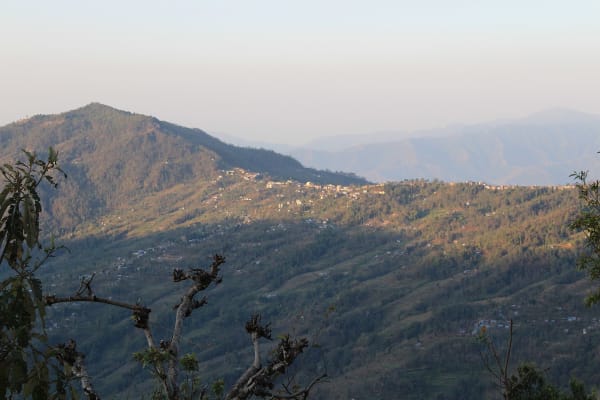
Ilam, in Nepal's far south-east corner, is tea country — steep green terraces of Camellia sinensis on ridges that run down from the Singalila range, with Darjeeling visible across the border. Above the tea, the ridges rise into temperate cloud forest of oak, magnolia and bamboo, which is prime habitat for the red panda.
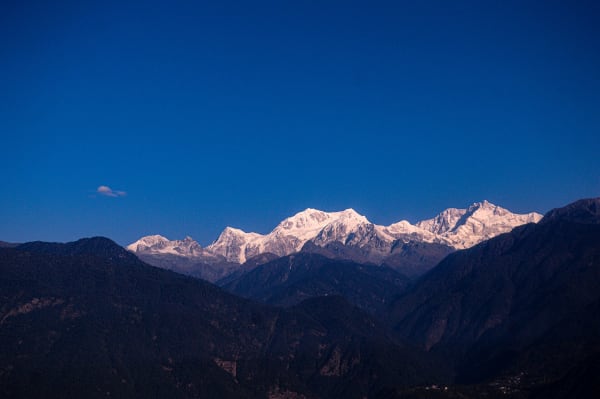
The Red Panda Trail is a community conservation trek built around that habitat: homestays, forest walks with local monitors, and ridge viewpoints looking north to Kanchenjunga. It is low, warm, culturally interesting, and completely unlike anything else in this catalogue.
The Trek at a Glance
| Duration | 12 days from Kathmandu |
| Highest point | About 3,636 m on the Singalila ridge |
| Difficulty | Moderate — forest and ridge walking, no altitude risk |
| Access | Flight to Bhadrapur, then road to Ilam |
| Permits | Trekking registration; local conservation fees |
| Best seasons | October to December, March to May |
| Accommodation | Community homestays and small lodges |
We run it as a 12-day Red Panda Trail trek.
The Red Panda
The red panda (Ailurus fulgens) is not a bear and not closely related to the giant panda — it is the only surviving member of its own family, a cat-sized arboreal mammal that eats bamboo, lives between about 2,200 m and 4,800 m in Himalayan temperate forest, and is listed as endangered with perhaps a few hundred individuals in Nepal.
- They are nocturnal and crepuscular, solitary, and superbly camouflaged against moss and lichen. Sightings are genuinely uncommon even for the monitors who work the forest daily.
- Be realistic. Expect to see habitat, signs, and possibly a glimpse. Do not book this trek on the assumption of a sighting — book it for the forest, the tea country and the culture, and treat a sighting as a bonus.
- Local forest guardians employed by the community conservation programme accompany the forest sections, and their knowledge of the habitat is the most interesting part of those days.
- The trail exists to fund that programme. Homestay and guide income supports anti-poaching patrols, habitat monitoring and community forest management.
- What you will reliably see: extraordinary birdlife — the eastern hills hold some of Nepal's richest bird diversity — plus barking deer, Himalayan squirrel, and if you are lucky a Himalayan black bear's feeding sign.
The Route
- Bhadrapur to Ilam — a flight to the eastern Terai, then a road climb into the hills through Kanyam and Fikkal, where the tea gardens begin. The Kanyam estates are the image of Ilam that appears on Nepali tea packets.
- Ilam to the community forests — up through villages into oak and magnolia forest, staying in homestays in Limbu and Rai villages and walking with local forest monitors.
- The Singalila ridge — the border ridge with India, rising to around 3,636 m, with Kanchenjunga, Kumbhakarna (Jannu) and the whole eastern Himalaya on the northern skyline, and the plains of Bengal to the south.
- Sandakpur area — the classic viewpoint on the ridge, shared with the Indian side of the border.
- Down through Panchthar — Phidim and the tea and cardamom country, and out by road to Bhadrapur.
The whole trek sits between about 1,200 m and 3,636 m, so it is warm, green, and free of altitude concerns. Spring brings extraordinary rhododendron — eastern Nepal has the greatest diversity of species in the country, including several found nowhere else on the trekking map.
Tea, Cardamom, and the Economy of Ilam
Ilam has grown tea since the 1860s, when the first bushes were planted from Darjeeling stock, and the district now produces most of Nepal's orthodox tea. Several estates receive visitors, and the process — plucking, withering, rolling, oxidation, firing — is genuinely interesting to walk through.
- Orthodox tea from Ilam competes directly with Darjeeling and is often better value; the high-grown first flush in spring is the prize.
- Large cardamom is the other cash crop, grown in the shade of alder on steep slopes, and the drying sheds are a distinctive smell of the eastern hills.
- Tea estate visits can be built into the itinerary, including at Kanyam and Fikkal.
- Buy from the estates rather than in Kathmandu — it is cheaper, fresher, and the money stays in the district.
Who It Suits
- Wildlife and bird enthusiasts. The eastern hills are the richest part of Nepal for birds, and the forest walking with local monitors is the core of the trek.
- Trekkers who want warmth and green. Nothing above 3,636 m, subtropical to temperate, and comfortable from October to May.
- Anyone interested in conservation as a working thing rather than an abstraction — this trail exists to fund habitat protection.
- Travellers combining Nepal and Darjeeling or Sikkim. The border is right there.
- Photographers. Tea terraces, cloud forest, and Kanchenjunga from the ridge.
Who should look elsewhere: anyone whose priority is high mountains or glaciers, and anyone who would be disappointed without a red panda sighting. For high eastern treks, see Kanchenjunga or Makalu; for a comparable cultural trek, the Mundum trail in the neighbouring hills.