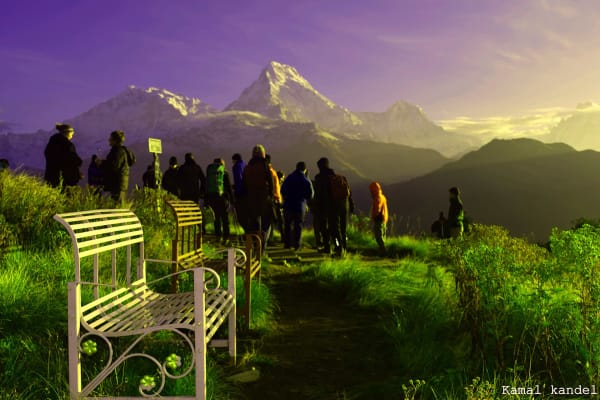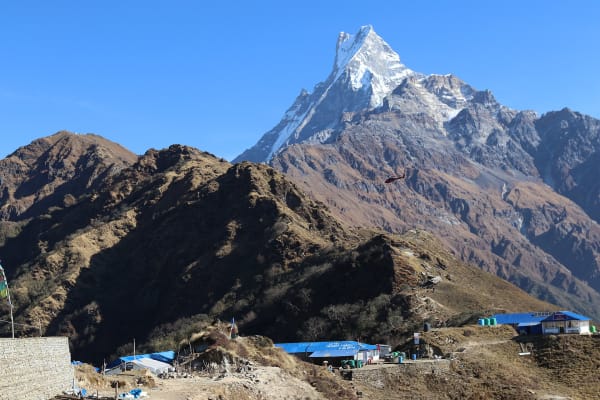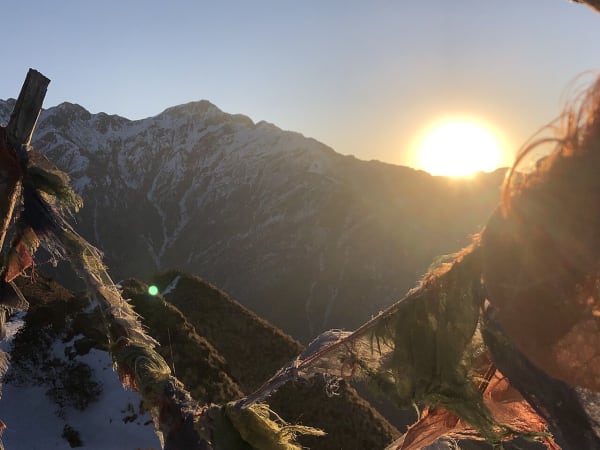

Not everyone has two weeks, and not everyone wants to sleep at 5,000 metres. The foothills north of Pokhara exist for those people. From a hill at 3,210 metres you can watch the sun come up on Dhaulagiri and the whole Annapurna range; from a ridge a valley to the east you can walk for a morning directly towards the fish-tail peak of Machhapuchhre until it fills the sky.
Poon Hill and Mardi Himal are the two most popular short treks in Nepal. Both depend entirely on visibility, and November is the month that guarantees it more nearly than any other. This is what each is like in the last weeks of autumn, and how to pick.
The Two Treks Side by Side
| Poon Hill | Mardi Himal | |
|---|---|---|
| Days from Pokhara | 3 – 4 | 4 – 5 |
| Highest point | Poon Hill, 3,210 m | Upper Viewpoint 4,200 m, or Base Camp 4,500 m |
| Highest night | Ghorepani, 2,874 m | High Camp, 3,580 m |
| The view | A wide panorama at a distance: Dhaulagiri to Annapurna South | A close view: Machhapuchhre and Annapurna South directly above |
| The trail | Stone staircases through villages and rhododendron forest | Forest, then a narrow grassy ridge |
| Villages | Large Magar and Gurung villages all the way | Lodges only; no villages above the forest |
| Difficulty | Easy to moderate; lots of steps | Moderate; steeper, colder, one long summit morning |
The short version: Poon Hill is the gentler walk with more culture; Mardi Himal is the more dramatic mountain experience and asks more of you. Our longer comparison, which adds Annapurna Base Camp, is in Mardi Himal vs Poon Hill vs Annapurna Base Camp.
November Weather on Both
| Place | Altitude | Day | Night |
|---|---|---|---|
| Pokhara | 820 m | 22 – 26°C | 10 – 14°C |
| Ghandruk | 1,940 m | 15 – 19°C | 5 – 8°C |
| Ghorepani | 2,874 m | 9 – 13°C | −1 to 3°C |
| Poon Hill at dawn | 3,210 m | −3 to 2°C | — |
| Mardi Low Camp | 2,970 m | 8 – 12°C | −2 to 2°C |
| Mardi High Camp | 3,580 m | 4 – 9°C | −7 to −2°C |
| Mardi Upper Viewpoint at dawn | 4,200 m | −8 to −2°C | — |
By day both treks are comfortable walking — cool in the forest, warm in the sun. The cold is confined to the two moments that matter most, the pre-dawn climbs. On Poon Hill that is a 45-minute walk up from Ghorepani and an hour standing still on top. On Mardi it is two to three hours along an exposed ridge from High Camp in the dark. Dress for standing around at −5°C, not for walking.
Afternoon cloud, which hides the peaks from Mardi's ridge for much of spring, is far less common in November. You have a good chance of clear views on the walk up as well as at dawn.
Poon Hill in November
The classic loop runs from the road head near Nayapul up the long staircase to Ulleri and Ghorepani, over the ridge to Tadapani, and down through Ghandruk. In November the trail is dry, the forest is quiet, and the big Gurung village of Ghandruk is bringing in its harvest.
- The sunrise crowd is real. In the first half of the month several hundred people can be on the summit at dawn. The view does not disappear when the sun is up: stay an hour after the rush has gone down for breakfast, or go up again for sunset, when you may be alone.
- Ghorepani is cold at night for its altitude, because it sits in a saddle that funnels wind. A sleeping bag is worth carrying even on this short trek.
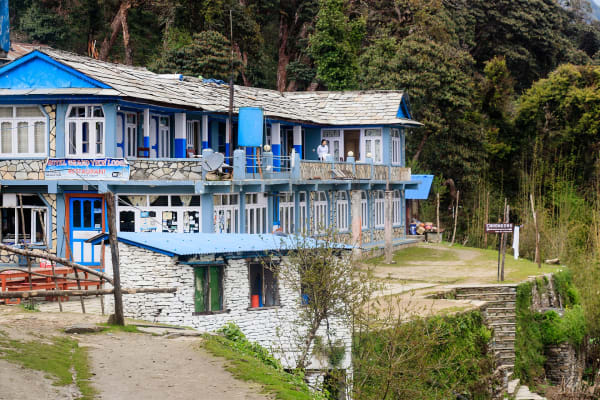
- Lodges are the best on any short trek — hot showers, real menus, attached bathrooms in many — and all are open.
- The steps are the difficulty. More than three thousand of them on the Ulleri climb alone. Poles help; so does starting from higher up the road, which jeeps now reach.
We run it as a seven-day Poon Hill trek from Kathmandu and a three-day version from Pokhara. The route is described stage by stage in our Poon Hill guide.
Mardi Himal in November
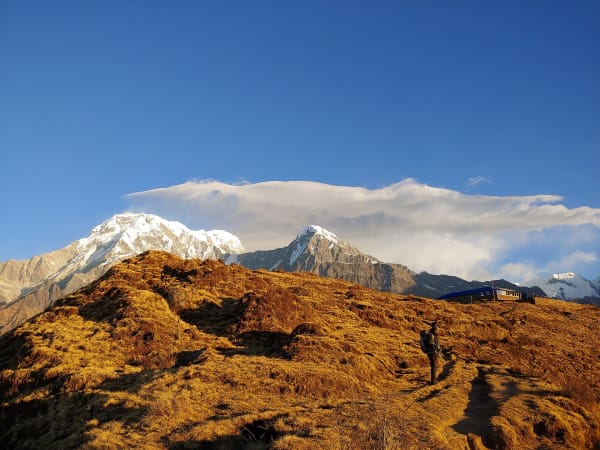
Mardi Himal climbs through dense forest for a day and a half, breaks out above the tree line at Badal Danda — the name means cloud hill — and follows a ridge to High Camp. From there the summit morning takes you along a narrowing crest to the Upper Viewpoint at about 4,200 metres, with Machhapuchhre's south face close enough to pick out the ice flutings.
- The ridge is exposed. There is no shelter between High Camp and the viewpoint. Wind is the main hazard in November; if it is strong, wait for it to drop after sunrise.
- Base Camp is optional. The trail continues from the viewpoint to Mardi Himal Base Camp at 4,500 metres, another one to two hours. It adds altitude and effort without adding much to the view. Late in the month this section can hold ice.
- High Camp fills. It has a limited number of lodges and is busy in the first half of the month, especially on the days after Tihar, when Nepali groups arrive. A guide books ahead.
- Altitude is felt. Going from Pokhara to 3,580 metres in three days is quick. Headaches at High Camp are common. Do not shorten the standard schedule.
We run a nine-day Mardi Himal trek from Kathmandu and a five-day version from Pokhara. Everything about the route is in the complete Mardi Himal guide.

Which One Should You Choose?
- Choose Poon Hill if this is your first trek, if you are travelling with children or older relatives, if you want villages and comfortable lodges, or if you have only three days.
- Choose Mardi Himal if you want to feel close to a big mountain, are comfortable with a hard early morning, and have at least four days.
- Choose both if you have a week. The ridge trail from Ghorepani through Tadapani to Landruk links the two, and the combination gives you the wide view and the close one.
- Choose neither if what you want is quiet. Mohare Danda and Khopra Danda sit on ridges nearby with similar panoramas and a handful of trekkers; see short treks from Pokhara.
Combining a Short Trek With Tihar
Short treks are the easiest to fit round a festival, and Tihar in 2026 falls neatly for it. Pokhara celebrates with real enthusiasm: Lakeside is strung with lights, rangoli patterns cover the pavements, and groups sing deusi and bhailo outside every restaurant.
| Dates (2026) | Plan |
|---|---|
| 3 – 7 November | Trek Poon Hill or Mardi Himal; walk out on the 7th |
| 8 November | Kukur Tihar in the morning, Laxmi Puja lamps on Lakeside in the evening |
| 9 – 10 November | Pokhara: the lake, the World Peace Pagoda, a village walk |
| 11 November | Bhai Tika — a quiet family day; fly or drive back to Kathmandu the day after |
Or reverse it: see the lights in Kathmandu on the 8th, travel to Pokhara on the 9th, and trek from the 10th, when the trails have their post-festival lull for a day or two. Either way, book transport between Kathmandu and Pokhara early — the days before Bhai Tika are the busiest of the month. The festival itself is covered in our Tihar guide, and the town in the Pokhara guide.