
Tihar is set by the moon, not the calendar on your phone. It occupies the last days of the dark fortnight of the month of Kartik and the first two days of the bright fortnight, with the new moon in the middle. That puts it anywhere between mid-October and mid-November, and in 2026 it falls late: 7 to 11 November.
This page is the practical version — which day is which, what time to be where, and which days the bank is shut. The meaning of the festival and how to plan around it are in our Tihar travel guide.
Tihar 2026 at a Glance
| Date | Nepali date (2083 BS) | Day |
|---|---|---|
| Saturday 7 November | Kartik 21 | Kaag Tihar — the crow |
| Sunday 8 November | Kartik 22 | Kukur Tihar — the dog; Laxmi Puja in the evening |
| Monday 9 November | Kartik 23 | Gai Tihar — the cow |
| Tuesday 10 November | Kartik 24 | Govardhan Puja and Goru Tihar; Mha Puja; Nepal Sambat New Year 1147 |
| Wednesday 11 November | Kartik 25 | Bhai Tika (Kija Puja) |
Why 2026 Is Slightly Unusual
In the textbook version of Tihar the crow has the first day, the dog the second, and the third day belongs to the cow in the morning and to Laxmi in the evening. That is how it falls in most years.
Festival days, though, are fixed by lunar days — tithi — which do not line up neatly with sunrise and sunset. Laxmi Puja must be performed on the evening when the new moon is in force. In 2026 the new-moon tithi begins during Sunday 8 November and is over by the middle of Monday, so the lamps have to be lit on Sunday evening. The dog's day, fixed by the tithi before, is also Sunday. The two share a date, and the published calendars carry the cow's worship to Monday the 9th.
What this means in practice:
- Sunday 8 November is the fullest day of the festival. Dogs in the morning, lamps and bhailo at night.
- Monday 9 November is quieter than the third day normally is. Expect cows being garlanded, houses still lit, and singing in the evening.
- Households differ. Some families will worship the cow on Sunday morning as they always have. Nobody will think you odd for asking which day they are keeping.
The same kind of quirk moved the Dashain tika by a day this year; see the Dashain dates guide.
Day by Day: What Happens and When
Saturday 7 November — Kaag Tihar
The quietest day. Early in the morning a portion of food — rice, sweets, a little of whatever is being cooked — is set out on a leaf plate on the roof or in the yard for the crows. The crow is Yama's messenger and its call is taken as news of a death; feeding it first is a way of keeping bad news from the house for the year. There is nothing organised to watch. What you will notice is the last-minute shopping: the markets are at their busiest this afternoon and evening.
Sunday 8 November — Kukur Tihar and Laxmi Puja
Morning: dogs are washed, garlanded with marigolds, marked with a red tika and fed. It happens in homes from about seven and in the streets through the morning; by midday most dogs in town are wearing their garlands. See Kukur Tihar.
Afternoon: houses are swept and washed, doorways hung with marigolds, and a rangoli is made at the entrance. Shops do the same; many perform their own puja for their account books.
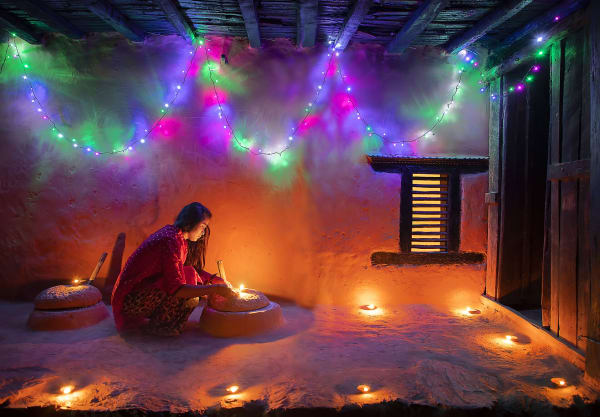
From dusk, about 5.15 pm: lamps are lit. The family performs Laxmi Puja in the early evening, and from then until late groups of girls and women go from house to house singing bhailo. The best hours to be walking are from six to nine. See Laxmi Puja.
Monday 9 November — Gai Tihar
Cows are garlanded, given a tika and fed grain and grass, usually in the morning. In the towns you see it at temples and wherever a cow is kept; in the villages, in every yard. Lights stay on in the evening and deusi-bhailo continues.
Tuesday 10 November — Govardhan Puja, Mha Puja and New Year
Morning: oxen are honoured as the cow was, and a small mound of cow dung representing Mount Govardhan is worshipped in farming households. From late morning: the Newar community marks the first day of Nepal Sambat 1147 with rallies and cultural processions in Kathmandu, Patan and Bhaktapur. Evening: Newar families perform Mha Puja, the worship of the self, at home, and groups of boys and men sing deusi late into the night. See Mha Puja and Nepal Sambat.
Wednesday 11 November — Bhai Tika
The tika is given at an auspicious time fixed for the whole country, usually late morning; the ceremony in each house takes an hour or more and is followed by a long meal. Streets are almost empty until mid-afternoon. In Kathmandu the temple in the middle of Rani Pokhari opens for this one day of the year, for people who have no brother or sister to exchange tika with. See the Bhai Tika guide.
Public Holidays and Closures
| Date | Government offices and banks | Shops | Transport |
|---|---|---|---|
| Fri 6 November | Open — the last full working day | Open, very busy | Normal; book ahead |
| Sat 7 November | Closed (the weekly holiday) | Open, at their busiest | Busy |
| Sun 8 November | Closed | Open until afternoon, then closing for puja | Normal by day, thin at night |
| Mon 9 November | Closed | Many open | Busy — people travelling for Bhai Tika |
| Tue 10 November | Closed | Many open; Newar businesses closed | Very busy |
| Wed 11 November | Closed | Mostly closed until afternoon | Very quiet; few buses and taxis |
| Thu 12 November | Open | Open | Busy with people returning |
The offices that matter to trekkers — immigration for restricted-area permits and visa extensions, and the tourism board for other permits — follow the same pattern. Anything that needs a stamp should be done by Friday 6 November. See trekking permits explained.
What Comes Straight After
| Date (2026) | Event |
|---|---|
| 13 – 16 November | Chhath, the festival of the sun, in Janakpur and the Terai and at ponds in Kathmandu. Main day: Sunday 15 November. |
| 20 November | Haribodhini Ekadashi, with fairs at Budhanilkantha and Changu Narayan. |
| Late November | The end of peak trekking season; quieter trails and colder nights. |
Chhath is worth staying for. It begins two days after Bhai Tika and looks like nothing else in the Nepali year; see our Chhath guide.
Tihar Dates for 2027
In 2027 the festivals fall almost two weeks earlier. The new moon of Kartik is on Friday 29 October 2027, which puts Laxmi Puja on or about that date, with Kaag Tihar two days before and Bhai Tika two days after — roughly 27 to 31 October. These are provisional until the official calendar for 2084 BS is published.
If you are planning well ahead, the rule of thumb holds every year: Tihar is centred on the new moon about three weeks after the Dashain tika, and Bhai Tika falls two days after Laxmi Puja.