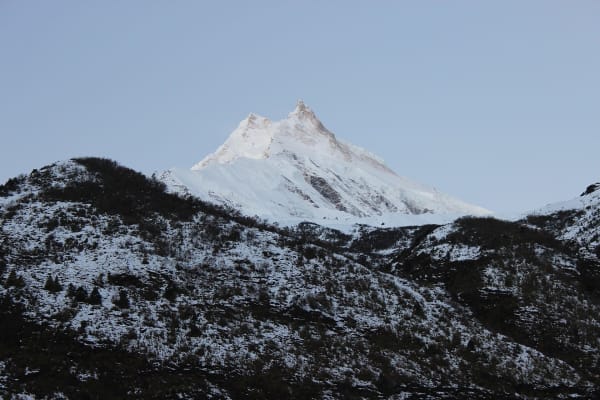
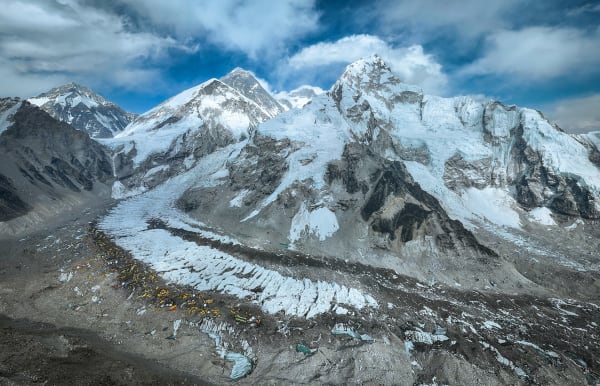
Manaslu (8,163 m) is the eighth-highest mountain in the world and the one most climbers attempt first among the eight-thousanders. The normal route on the north-east face is comparatively straightforward by 8,000 m standards, the autumn season avoids competing with Everest, and base camp is reached by walking rather than flying.
Straightforward is relative. It is still an eight-thousander, with a serious avalanche history, a long summit day above 7,400 m, and a season that has become significantly busier in the last decade as its reputation as an Everest stepping stone has grown.
The Expedition at a Glance
| Summit | 8,163 m — the true summit, not the fore-summit |
| Duration | About 47 days from Kathmandu |
| Route | North-east face, the normal route |
| Camps | Base camp 4,800 m, C1 5,700 m, C2 6,400 m, C3 6,800 m, C4 7,400 m |
| Season | Autumn — summit windows typically late September to mid October |
| Permit | About USD 1,800 per person in autumn |
| Approach | Road and trek up the Budhi Gandaki to Samagaun — no flight |
| Oxygen | Standard from Camp 3 or 4 on commercial ascents |
We run it as a 47-day Manaslu expedition. The Manaslu Circuit trek follows the same approach valley as far as Samagaun, which is where base camp begins.
The Route
The approach
By road to Soti Khola or Machha Khola, then six or seven days of trekking up the Budhi Gandaki gorge to Samagaun (3,530 m). This is one of the best walk-ins to any eight-thousander — a deepening gorge, increasingly Tibetan villages, and no aircraft involved. It also provides excellent gradual acclimatisation.
Base camp (4,800 m)
Above Samagaun on a moraine shelf beneath the north-east face, with Birendra Lake and the Manaslu glacier below. Expeditions occupy it for four to five weeks.
Camps 1 to 3
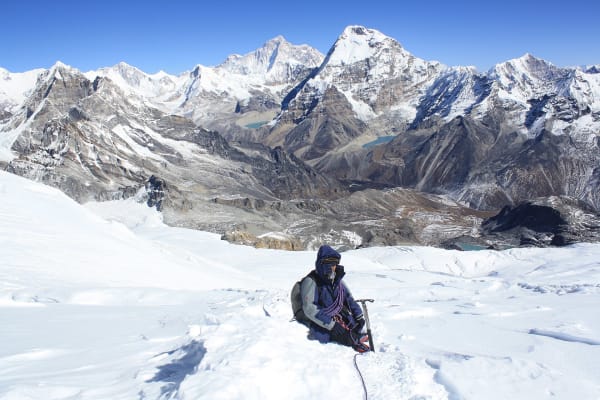
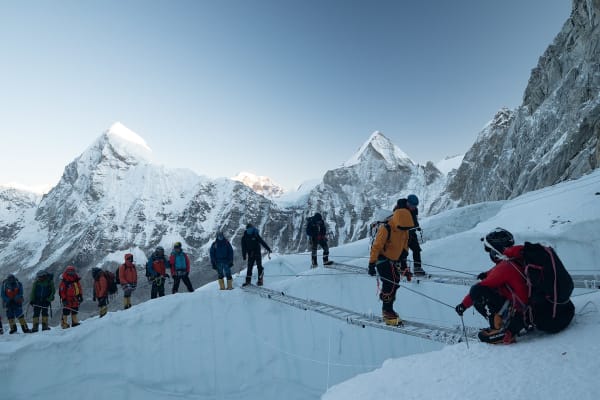
Camp 1 (5,700 m) is reached across the lower glacier with crevasse fields and some fixed rope. Camp 2 (6,400 m) lies above a steeper icefall section with seracs — the part of the route with the most objective danger. Camp 3 (6,800 m) sits on the broad upper snowfield, where oxygen typically comes into use.
Camp 4 (7,400 m) and the summit
A long snow plod to the high camp, then a summit push of eight to twelve hours across the summit plateau to the final ridge. A specific point matters here: Manaslu has a fore-summit that many climbers historically stopped at, believing it to be the top. The true summit is a further exposed section along a corniced ridge, and reputable operators now insist on it. Ask your operator directly about this.
The Avalanche Question
Manaslu has a serious avalanche history. The 2012 disaster at Camp 3 killed eleven climbers, and there have been further fatal incidents since, principally on the section between Camps 1 and 2 where seracs overhang the route.
- Autumn snow is the issue. The route is climbed shortly after the monsoon, when the snowpack is deep and consolidating, which is exactly when slab avalanche risk is highest.
- The serac band above Camp 1 is objective danger — it cannot be mitigated by skill, only by minimising exposure time and choosing when to move.
- What good operators do: move through the exposed sections in the cold of early morning, avoid Camp 3 as a sleeping camp where possible, coordinate with other teams on fixing and conditions, and cancel rotations rather than run them in poor snow.
- What you can control: your own speed through the exposed sections, and your willingness to accept a guide's decision to wait.
This is not a reason not to climb Manaslu. It is a reason to choose an operator on its safety practice rather than its price, and to understand that objective danger on an eight-thousander is a real and irreducible part of the undertaking.
Why It Is the Standard First Eight-Thousander
- Technically the most accommodating of Nepal's eight-thousanders. Snow and glacier travel with fixed rope, and no sustained technical rock or ice.
- An autumn season, which does not compete with the spring Everest calendar and suits climbers who want a second season objective.
- No flight. The walk in up the Budhi Gandaki is reliable and acclimatises you well.
- A comparatively low permit — around USD 1,800 against Everest's USD 15,000.
- It satisfies the Everest prerequisite and, more importantly, it tells you honestly how you function above 7,500 m with oxygen.
- A genuine 8,000 m summit in its own right, with a superb view across the Manaslu Himal and toward Annapurna.
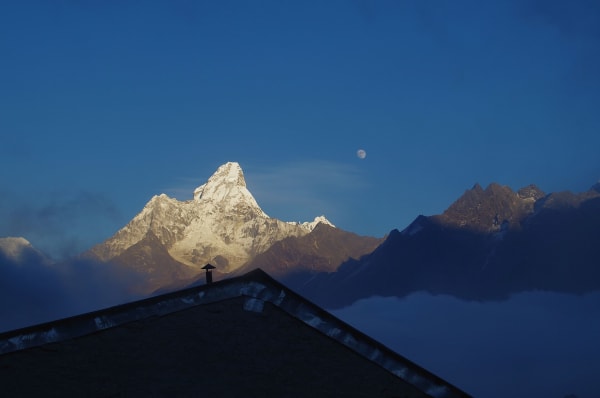
The progression most climbers follow: a high trek, then Island Peak and Lobuche East, then Ama Dablam for technical competence, then Baruntse or Pumori at 7,000 m, then Manaslu, then Everest. Our eight-thousanders guide covers the alternatives at each step.
What It Demands
- Prior 6,000 m and ideally 7,000 m experience. Manaslu is not a first Himalayan climb.
- Automatic rope work. Jumaring and abseiling on fixed line, in mittens, at 7,500 m, when exhausted. See our fixed rope guide.
- Endurance rather than power. Five weeks on the mountain with repeated rotations, and a twelve-hour summit day at the end of it.
- Full 8,000 m kit — an expedition down suit, 8,000 m boots, a -40 °C bag, and an oxygen system you have trained with.
- Insurance covering mountaineering above 8,000 m with helicopter evacuation and repatriation.
- Patience and the ability to turn back. More expeditions end in a decision than in an incident, and the ones that end in an incident often followed a decision that should have gone the other way.
One final note on the mountain itself: Manaslu means mountain of the spirit, from the Sanskrit manasa. It was first climbed in 1956 by a Japanese expedition, and it has been treated as a Japanese mountain in mountaineering history much as Annapurna is French and Everest British — a piece of context worth knowing when you reach Samagaun and see how the village relates to it.