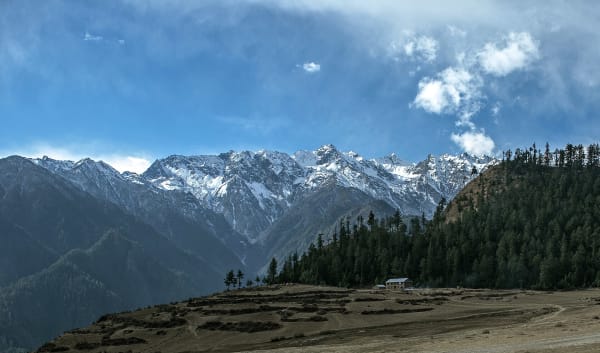
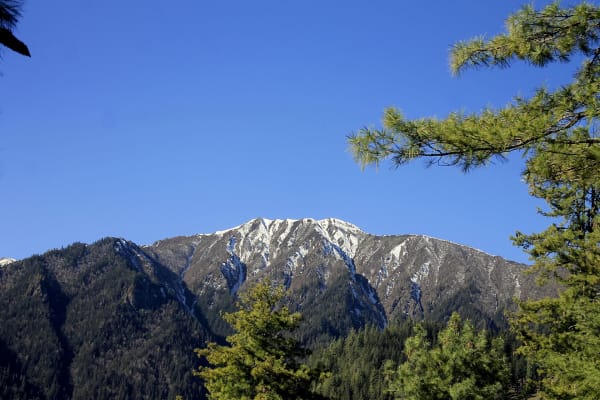
Humla is the only district capital in Nepal with no road link to the rest of the country. You reach Simikot (2,910 m) by two flights — Kathmandu to Nepalgunj, then a small aircraft into a mountain airstrip — and from there everything moves on foot or on the backs of animals, as it always has.
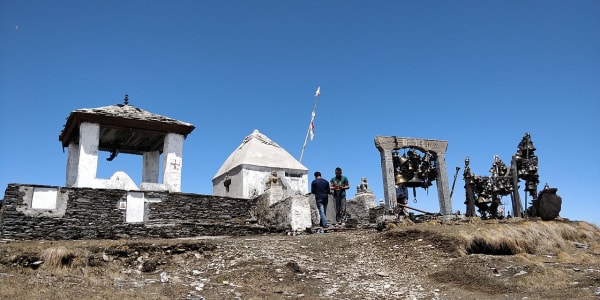
The trek follows the Karnali toward the Tibetan border and then turns east into the Limi Valley, where the three villages of Halji, Til and Jang preserve a form of Tibetan Buddhism and a way of life that has changed remarkably little in centuries. Halji's Rinchenling Gompa dates from the eleventh century and is one of the oldest continuously active monasteries in the Nepali Himalaya.
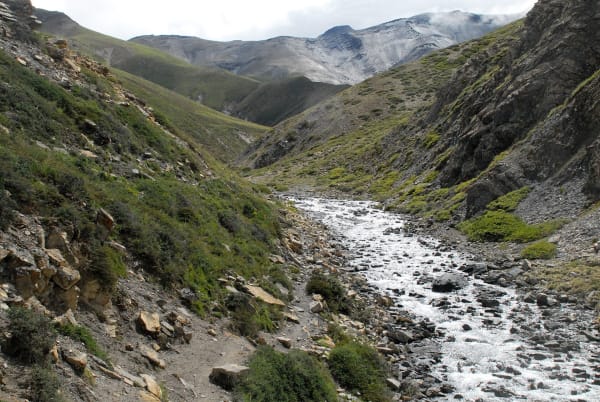
Over the pass at Talung (4,380 m) and through the wild country around Manepeme, this is as remote as trekking in Nepal gets. It is also snow leopard country — the best habitat in the country, even if you will almost certainly not see one.

The Trek at a Glance
| Duration | 20 days Kathmandu to Kathmandu |
| Highest point | Talung pass, 4,380 m |
| Difficulty | Challenging — long days, sustained altitude, no evacuation by road |
| Best seasons | May to October, including the monsoon months |
| Accommodation | Village homestays and lodges, tents for roughly half the nights |
| Access | Flights Kathmandu–Nepalgunj–Simikot; no road access at all |
| Permits | Humla Restricted Area Permit — minimum two trekkers |
| Price | From USD 1,975 per person |
We run it as a 20-day trek from Kathmandu. It is the most committing of the far-western routes; the Rara Lake trek and the Upper Dolpo trek are the nearest comparisons.
The Route
Simikot to the Chumsa Khola (2,910 m to 3,400 m)
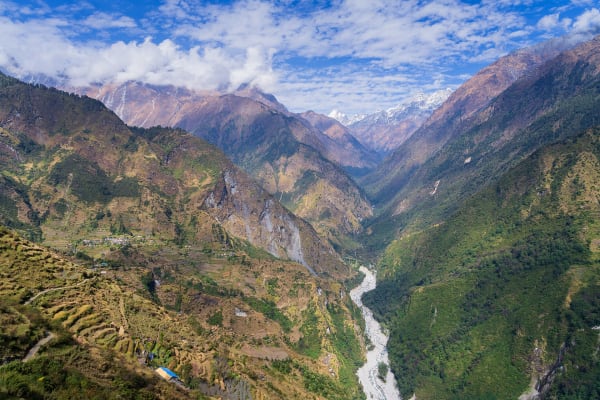
From the airstrip the trail drops to Dharapuri and follows the Karnali upstream through Kermi, where there are hot springs worth the detour. This lower section is Hindu hill country giving way to Tibetan Buddhist as you climb — the architecture, the faces and the prayer flags all change within two days' walking.
Over the Talung pass into Limi (4,000 m to 4,380 m)
Up the Chumsa Khola to a dharmashala at 4,000 m, then over the Talung pass (4,380 m) — the high point of the trek and the gateway into the valley. Beyond it the first of the three villages, Jang (4,070 m), with an acclimatisation and exploration day built in.
Jang, Halji and Til (4,070 m to 3,700 m)
The heart of the trek. Three flat-roofed Tibetan villages a day's walk apart, growing barley at the limit of where barley grows. Halji's Rinchenling Gompa holds murals, statues and manuscripts of considerable age and scholarly importance, and it is treated with real reverence by the community — visitors are guests rather than customers, and your guide arranges introductions.

Manepeme, Hilsa and the return (3,970 m to 2,910 m)
East out of Limi through Manepeme — wild, empty, and among the best wildlife ground on the route — to Hilsa on the Tibetan border, historically the trading route toward Kailash and Lake Manasarovar. Then the long walk back down the Karnali through Palbang and Muchu to Simikot, and the flights out.
Difficulty and Who It Suits
Graded challenging, and the grade comes from duration and isolation rather than from any single hard day. There is no glacier travel and no technical ground, but you are two weeks' walk from a road.
- Six to eight hours on most days, on rough trails with significant daily ascent and descent.
- Eight to ten hours on the crossings toward Talung and the long stages around Manepeme and Hilsa.
- Sustained altitude — much of the route sits between 3,700 m and 4,400 m for well over a week.
- No road access anywhere, including at the trailhead. Evacuation means a helicopter, and weather frequently prevents one.
- Camping for roughly half the nights, at Chumsa Khola, Dharmashala, Talung and Manepeme where there is no permanent shelter.
You should have completed a multi-week trek at altitude before this one. Our restricted-area permits guide covers the rules that apply here.
When to Go — and Why the Monsoon Works
Humla sits in the rain shadow north of the main Himalayan chain, which inverts the usual Nepali calendar. The trekking season runs May to October, and the summer months are among the best.
| Season | Conditions |
|---|---|
| May to June | Warm, dry and stable in Limi. Passes clear of snow. The strongest window. |
| July to August | Monsoon elsewhere in Nepal, but Limi stays dry. The risk is flight cancellation on the southern side of the range, not weather on the trek. |
| September to October | Clear and cold, with the best light. Snow can close Talung by late October. |
| November to April | Not run. The passes are snowbound and the villages are largely emptied for the winter. |
Whenever you go, the flights are the weak link. See where to trek in the monsoon for how the rain-shadow routes compare.
What It Costs
Four domestic flight legs, a restricted-area permit, and a full camp crew for half the nights account for most of the price.
| Group size | Price per person |
|---|---|
| 1 trekker | USD 2,100 |
| 2 to 4 | USD 2,075 |
| 5 to 7 | USD 2,050 |
| 8 to 10 | USD 2,025 |
| 11 to 14 | USD 2,000 |
| 15 and over | USD 1,975 |
Note that restricted-area rules require a minimum of two trekkers on a permit, so a genuine solo booking is issued as a two-person permit at the corresponding cost, or paired with another trekker on a fixed departure.
What Is Included
- Airport pickup and drop-off in Kathmandu.
- Domestic flights Kathmandu–Nepalgunj–Simikot and back, with airport transfers.
- Hotel accommodation in Kathmandu and Nepalgunj with breakfast.
- Village lodge and homestay accommodation on the trek, plus tented accommodation with a full camp and kitchen crew for the sections with no permanent shelter.
- Three meals a day during the trek.
- Humla Restricted Area Permit and trekking registration.
- A licensed English-speaking trekking guide.
- Group trekking map, first aid kit carried by the guide, and all government taxes, permit fees and service charges.
What Is Not Included
- International flights and the Nepal entry visa fee.
- Travel insurance including emergency helicopter evacuation — not negotiable on a route with no road access.
- Personal trekking equipment and clothing, including a bag rated to -15 °C or lower.
- Porter services, available at additional cost.
- Lunch and dinner in Kathmandu and Nepalgunj.
- Snacks, bottled water, hot showers, Wi-Fi, charging and drinks.
- Laundry, phone calls, souvenirs and personal expenses.
- Tips for guides, drivers and support staff.
- Extra accommodation or transport caused by domestic flight delays or anything else outside the itinerary.
The Simikot flight is cancelled often. Delays of one to three days are routine, which is why the itinerary carries buffer and why you should keep several spare days before an international departure.