Upper Dolpo is the furthest you can get from a road in Nepal while still walking between villages. It lies north of the main Himalayan crest in the far west, a high cold desert of 4,000 to 5,000 m valleys where Tibetan Buddhist and Bon communities farm barley, herd yaks, and trade salt over the passes much as they have for centuries.
Its centre is Shey Gompa, an 11th-century monastery beneath the Crystal Mountain — Shelri — which pilgrims circumambulate in a ritual kora. This is the country Peter Matthiessen walked into in The Snow Leopard, and it has changed less since than almost anywhere else in the Himalaya.
The Trek at a Glance
| Duration | 26 days from Kathmandu |
| Highest point | About 5,360 m, with several passes above 5,000 m |
| Key places | Phoksundo Lake, Shey Gompa, Saldang, Crystal Mountain |
| Difficulty | Difficult — sustained high altitude, camping throughout, very remote |
| Permit | USD 500 for 10 days, then USD 50 per day, plus Shey Phoksundo National Park |
| Minimum group | Two trekkers with a registered agency and licensed guide |
| Access | Flight Kathmandu–Nepalgunj–Juphal |
| Best seasons | May to early October |
| Accommodation | Camping with a full crew, occasional village homestay |
We run it as a 26-day Upper Dolpo trek, with a 22-day Jomsom to Dolpo traverse as the variant linking it to Mustang.
The Route
Juphal to Phoksundo Lake
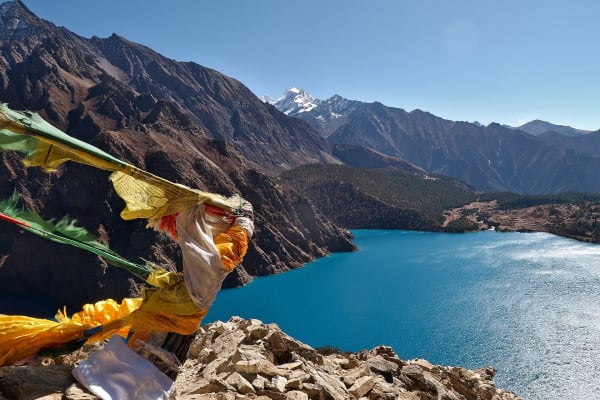
The same approach as Lower Dolpo — flights to Nepalgunj and Juphal, then the Suli Gad gorge and the cliff path to Ringmo on Phoksundo Lake. Four days, and the last of the relatively easy walking.
Over the Kang La to Shey Gompa
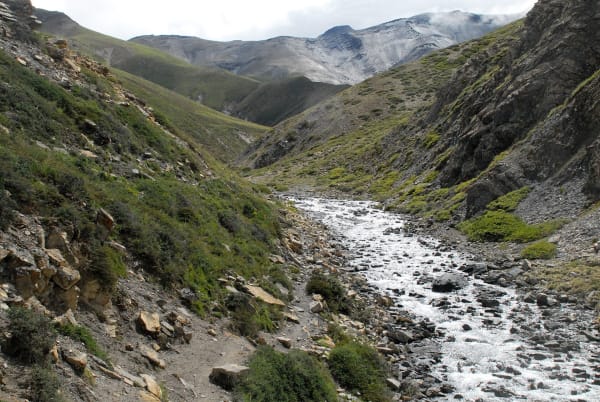
North along the lake's western shore, up the Phoksundo Khola, and over the Kang La at about 5,360 m into the Shey valley. This is the crossing into Upper Dolpo proper, and the landscape beyond it is genuinely Tibetan — no trees, ochre and grey rock, and villages visible as green patches of barley in an otherwise bare valley.
Shey Gompa and the Crystal Mountain
Shey Gompa sits at around 4,500 m beneath Shelri, the Crystal Mountain, a peak of folded rock shot through with quartz that is sacred to both Buddhists and Bon. Pilgrims walk the kora around it, a full day's circuit. The monastery dates from the 11th century, and the valley around it holds the remains of a much older settlement pattern.
Saldang, Namdo, and the northern villages
Over the Saldang La to Saldang — the largest village in Upper Dolpo, a long strip of houses and barley terraces at around 3,900 m — and on through Namdo and Yangze Gompa. This is the agricultural heart of the region, close to the Tibetan border, with yak caravans on the trails.
South to Dho Tarap and out
Over further passes south to Dho Tarap at about 4,080 m, then down the Tarap Khola gorge to Tarakot, Dunai and Juphal for the flight out. Variants continue east to Jomsom in Mustang instead, which is the Jomsom to Dolpo traverse.
What It Actually Takes
This is one of the hardest treks we run, and the difficulty is cumulative rather than dramatic.
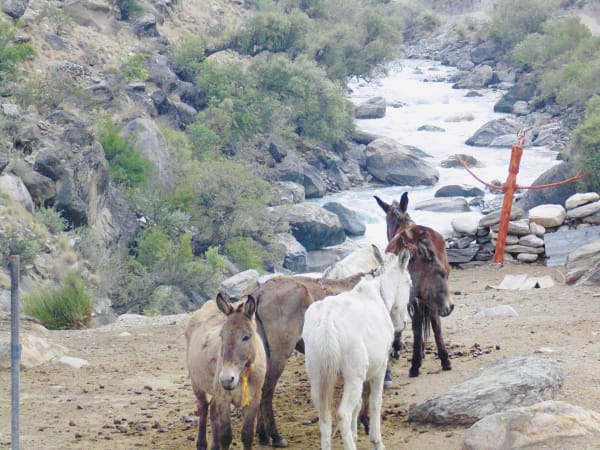
- Twenty-six days, mostly camping. A full crew — guide, cook, kitchen staff, and pack animals or porters — carrying tents, food and fuel for the whole route. There is very little to buy on the way.
- Sustained altitude. Most nights above 4,000 m for two weeks, with several passes above 5,000 m. Acclimatisation is built into the early stages and still needs care.
- Cold. Nights below -10 °C routinely, even in summer. A -20 °C bag and a good mat are essential.
- No exit. From the Shey valley onward you are days from a road and further from a hospital. A helicopter evacuation is possible from some valleys and not from others, and weather dictates it.
- Flight dependency. Nepalgunj and Juphal at each end, both weather-affected, with three spare days a sensible minimum.
- Hygiene and diet. Four weeks of camp food and no showers. Manageable, and worth knowing.
What it does not require is technical mountaineering. No rope, no crampons, no glacier travel on the standard route. It requires fitness, altitude experience, patience, and a genuine tolerance for discomfort.
Who It Is For
- Trekkers who have done several high Nepali treks and want the remotest thing available.
- Anyone drawn to Tibetan and Bon culture in its least altered form. Nothing in Nepal compares.
- People with four weeks and flexible dates. The flights alone demand slack.
- Photographers and writers. It is the landscape that produced The Snow Leopard, and it is still like that.
Who should not: first-time trekkers in Nepal, anyone on a schedule, anyone who needs a lodge, and anyone for whom the USD 500 permit plus the cost of a four-week supported expedition is a stretch. For those, Lower Dolpo at 17 days and USD 20 a week in permits delivers a great deal of the same thing — see our Lower Dolpo guide.
One final note on timing: the window is May to early October, because Dolpo is in the rain shadow and the high passes are snowbound outside it. July and August are dry, green and almost entirely empty, which for this particular trek is a real argument for the monsoon.